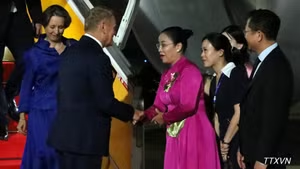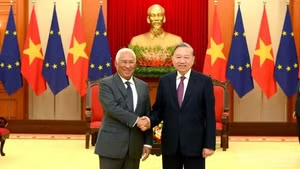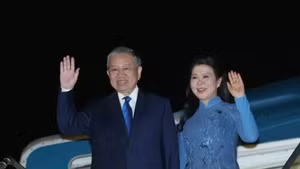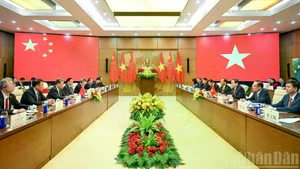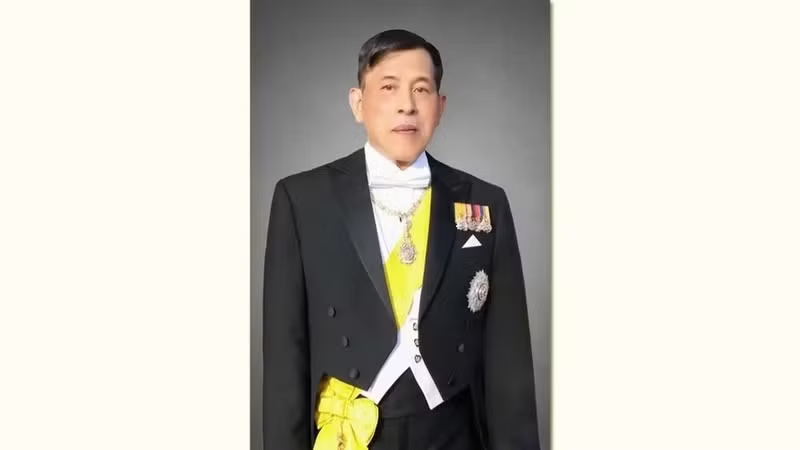
The visit marks an important milestone in Viet Nam–Thailand relations, carrying historical significance and serving as a special political symbol, as it is the first visit to Viet Nam by a Thai King since the two countries established diplomatic relations.
The state visit to Viet Nam by the King and Queen of Thailand takes place as the two countries celebrate their 50th anniversary of the establishment of diplomatic relations, a landmark in the history of bilateral relations. The visit reaffirms the determination of both countries to continue strengthening political trust and bringing closer ties between the Thai Royal Family and Vietnamese leaders, contributing to promoting bilateral cooperation in both bilateral and multilateral frameworks. Welcoming the King and Queen of Thailand to Viet Nam also demonstrates Viet Nam's high regard for the role of the King and the Thai Royal Family in strengthening friendship and developing relations between the two countries.
Viet Nam and Thailand officially established diplomatic relations in 1976, but the two countries have long shared strong ties rooted in their geographical and cultural proximity. Looking back through history, Thailand bears strong imprints of President Ho Chi Minh's journey as he travelled abroad in search of a path to national salvation. This has helped strengthen the close and warm bonds and foster deeper mutual understanding between the peoples of the two countries.
The 50-year journey of Viet Nam–Thailand relations has witnessed steady and rapid progress in cooperation and partnership. Since the relationship was upgraded to a comprehensive strategic partnership in May 2025, Viet Nam–Thailand relations have continued to achieve significant achievements. Political trust has been steadily strengthened. Since the beginning of 2026, high-ranking leaders of both countries have exchanged numerous visits. These include the official visit to Thailand by General Secretary and President To Lam in May 2026; the official visit to Viet Nam by Thai Prime Minister Anutin Charnvirakul, during which he attended the 3rd ASEAN Future Forum in June 2026; and the official visit to Viet Nam by Sophon Zaram, President of the National Assembly and Speaker of the House of Representatives of Thailand, in August 2026.
The high frequency and level of exchanges between the two countries demonstrate their strong commitment to further developing and deepening the Viet Nam–Thailand Comprehensive Strategic Partnership in the coming years. During General Secretary and President To Lam's official visit to Thailand in May 2026, the two sides signed an action programme on implementing the comprehensive strategic partnership in the 2026-2031 period.
Building on traditional friendship and a high level of political trust, Viet Nam and Thailand have achieved many positive results in cooperation in recent years. Thailand is Viet Nam's largest trading partner in ASEAN and ranks eighth among countries and territories investing in Viet Nam. Two-way trade reached 22.1 billion USD in 2025 and more than 15.03 billion USD in the first seven months of 2026, up 22% year on year. Thailand currently has 813 valid investment projects in Viet Nam with total registered capital of more than 15.4 billion USD, ranking second among ASEAN countries investing in Viet Nam.
Cooperation in culture, tourism, education, and training continues to be strengthened. In 2025, nearly 458,000 Thai visitors travelled to Viet Nam. The Thai Government is currently supporting Vietnamese universities in teaching Thai, while providing numerous long- and short-term scholarships for Vietnamese students and lecturers to study Thai language in Thailand. Twenty provinces and cities in Viet Nam have signed cooperation and twinning agreements with Thai localities. Notably, projects undertaken by the Thai Royal Family in Viet Nam in the fields of education, community development, and social welfare demonstrate the spirit of "people-centred" cooperation between the two countries.
The Vietnamese community in Thailand, including around 100,000 people and living mainly in the north-eastern provinces, has always maintained a deep and enduring love for the homeland while making sustained efforts to serve as “people's ambassadors”, building bridges of friendship between the two peoples. The dedication of the Vietnamese community to preserving and developing President Ho Chi Minh memorial sites and community cultural facilities in Thailand is a vivid testament to their strong attachment to their roots, national pride, and the enduring vitality of Vietnamese cultural traditions.
On the international stage, Viet Nam and Thailand are both active and responsible members of ASEAN. The two countries share many interests and similar views on building a united, resilient ASEAN “common home” that maintains its central role in the regional structure. They also closely coordinate their positions at regional and international forums, particularly at the United Nations and the Asia-Pacific Economic Cooperation (APEC) forum.
With close ties rooted in history and a shared strategic vision for the future, Viet Nam and Thailand are working to make their comprehensive strategic partnership increasingly substantive, effective, and far-reaching. The state visit to Viet Nam by King of Thailand Maha Vajiralongkorn Phra Vajiraklaochaoyuhua and Queen Suthida is not only an opportunity for the two sides to look back on the proud achievements of cooperation over the past half-century but also to agree on directions and measures for the flourishing development of this relationship in the future, contributing to peace, stability, cooperation, and development in the region and the world.