Specifically, 2025 is seen as a crucial transitional year, during which fundamental factors are gradually being strengthened, while the 2026-2027 period is expected to mark a growth phase that is more selective and sustainable.
According to Savills Viet Nam, macroeconomic indicators in 2025 show that the Vietnamese economy has been maintaining positive growth momentum, providing an important foundation for the property market, particularly in Ho Chi Minh City.
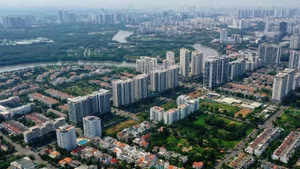
In the housing market, primary supply in the third quarter of 2025 reached around 5,200 units, marking a year-on-year increase but remaining modest relative to real demand.
In the office segment, Ho Chi Minh City’s market has continued to remain stable, with total leasable supply nearing 3 million square metres.
Savills noted that expectations of a growth inflection point for the property market in 2026-2027 are well founded, as multiple underlying factors are converging.
First, from 2026, the market will operate under the full impact of new laws, including the 2024 Land Law, the 2023 Housing Law, and the Law on Real Estate Business, along with a new land price framework effective from January 1.
Although the new land price framework may increase financial obligations for businesses and households, over the long term it is expected to create a more transparent and equitable investment environment.
Previous bottlenecks in determining land prices for projects are also expected to be eased, helping to improve market supply.
At the same time, economic growth momentum continues to be reinforced by sustained FDI inflows and rising total retail sales of goods and services.
These factors directly support demand for housing, office space, and commercial property in major urban centres.
In addition, one of the key drivers of the property market is the massive public investment programme.
Accelerated investment in key infrastructure projects over the next five years is set to become a primary growth engine, improving inter-regional connectivity, encouraging urban decentralisation, and fostering new growth poles along major infrastructure corridors.