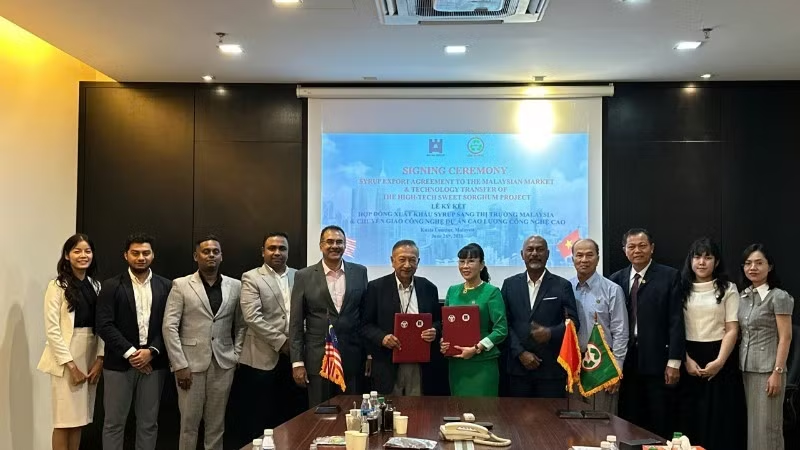
The signing ceremony was held in the presence of members of the Malaysian Royal Family and under the patronage of Malaysia's Ministry of Agriculture. The agreement marks an important milestone in cooperation between Vietnamese businesses and strategic Malaysian partners in the fields of high-tech agriculture and biotechnology.
Under the agreement, the two sides will jointly research, develop and gradually establish a comprehensive sorghum value chain in Malaysia. Key areas of cooperation include the planning of raw material cultivation zones, the transfer of core technologies, manufacturing, advanced quality control and product commercialisation.
The core orientation of the project is the application of advanced processing technologies and a circular economy model to maximise the biological value of sorghum. Planned product lines include sorghum syrup, resistant starch, purified water, dietary supplements, feedstock for black soldier fly farming and other bio-based materials.
Notably, the entire product ecosystem will be standardised in accordance with stringent Halal requirements, serving the Malaysian domestic market while creating a springboard for exports to Muslim-majority countries across the Middle East and Southeast Asia.
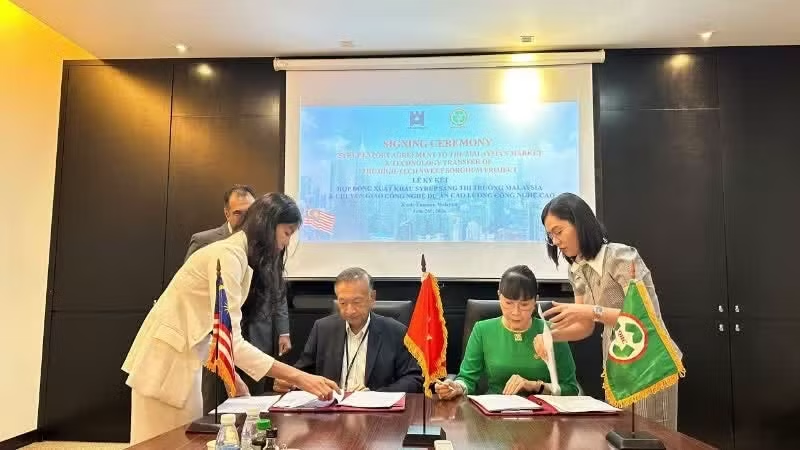
Speaking at the signing ceremony, Le Thi My Hang, Chairwoman of the Board of Directors of QHC Global, said that in addition to developing raw material sources, QHC Global's programme aims to build a complete sorghum-based product ecosystem founded on the principles of the circular economy and sustainable development.
All product lines are being developed to meet international quality standards, particularly Halal certification requirements, to serve the Malaysian market and expand into Muslim-majority countries as well as other promising markets in the Middle East and Southeast Asia, she added.
Representatives of the Malaysian Royal Family and the Ministry of Agriculture praised QHC Global's long-term strategic vision and the achievements of its years of research, which have been recognised by professional organisations in the United States, Viet Nam and internationally. The Malaysian side also expressed its desire to establish a long-term and sustainable partnership with the Vietnamese company.
Addressing the event, Dato' Seri Utama Tunku Naquiyuddin ibni Almarhum Tuanku Ja'afar, a senior member of the Malaysian Royal Family, said the Malaysian Royal Family expects this programme to help advance high-tech agriculture, create higher value-added products and strengthen domestic processing capabilities. In doing so, it will expand export opportunities and gradually position Malaysia as a regional and international hub for the production, processing and distribution of sorghum-based products.
He further noted that the Malaysian side hoped to work with QHC Global on a strategic technology transfer programme to facilitate the construction of a large-scale processing plant in Malaysia during the next phase of the project.
Looking ahead, QHC Global and Antah Group will continue working closely with the relevant Malaysian authorities to implement the project's roadmap, develop production infrastructure and establish comprehensive quality control systems.
The agreement not only opens up new opportunities for businesses in both countries but also contributes to regional innovation, the development of a green economy and the advancement of sustainable agricultural value chains.