According to Tran Ngoc Quan, Trade Counsellor at the Viet Nam Trade Office in Belgium and the EU, exports of many of Viet Nam’s key agricultural products to the EU continue to maintain positive growth momentum. In the first four months of this year alone, coffee exports reached 1.2 billion EUR, up 22% year-on-year; cashew nuts reached 289 million EUR, up 12%; wood and wood products totalled 149 million EUR, up 65%; and seafood exports reached 309.3 million EUR, up 1%.
In individual markets, many Vietnamese products have firmly consolidated their positions. In Germany, during the first three months of 2026, imports of cashew nuts from non-EU countries reached 20,126 tonnes, worth more than 150 million USD, reflecting year-on-year increases of 30.3% in volume and 33.4% in value.
Viet Nam retained its status as the largest supplier, accounting for 14,296 tonnes worth 106.8 million USD. Viet Nam’s share of Germany’s cashew market rose from 55.7% in the first quarter of 2025 to 59.9% in the same period of 2026, reflecting its stable supply and growing reputation in Europe’s largest cashew-consuming market.
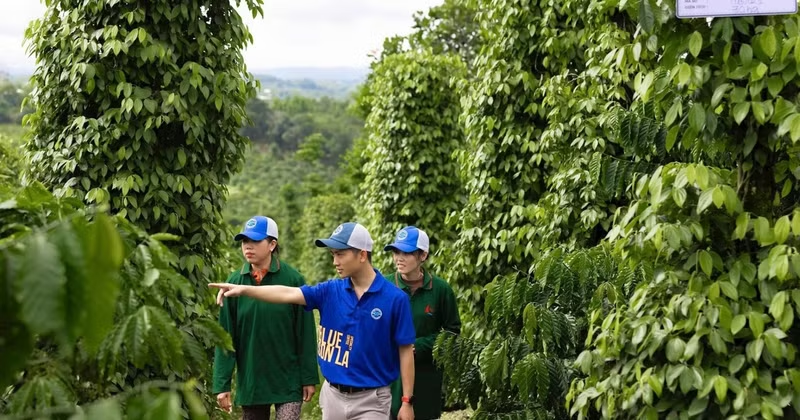
For pepper, despite a broader decline in EU import demand, Viet Nam retained its position as the leading supplier. During the first five months of 2026, the EU imported nearly 19,000 tonnes of pepper from Viet Nam, valued at 137.57 million USD, up 0.7% in volume and 0.6% in value year-on-year.
The volume of pepper imported by the EU from Viet Nam was several times higher than that from Brazil, Indonesia, and India, further underscoring Viet Nam’s central role in the EU pepper supply chain.
However, as rival nations aggressively redirect their exports, Vietnamese agricultural products are facing increasingly intense competition. In the cashew sector, West African countries such as Côte d’Ivoire and Nigeria are accelerating their investments in deep processing rather than merely exporting raw cashew nuts. Expanding processing capacity at source not only increases added value but also shortens shipping times to Europe, providing these countries with a significant competitive advantage.
In Germany alone, Côte d’Ivoire’s share of the cashew market surged from 16.9% to 21.5% within just one year. As for pepper, although Viet Nam remains the market leader, its share of total EU imports has declined amid the bloc’s efforts to diversify its import sources.
In addition to supply-side competition, Vietnamese businesses also must navigate the dual pressures of high logistics costs and the EU’s increasingly stringent market standards.
Vo Thi Ngoc Diep, Trade Counsellor at the Viet Nam Trade Office in the Netherlands, noted that a major challenge for Vietnamese goods seeking deeper penetration into the EU market lies in the bloc’s increasingly stringent requirements for sustainable development and supply chain transparency.
In recent years, the EU has continued to refine and implement a range of new policies, including expanding the Carbon Border Adjustment Mechanism (CBAM), advancing implementation of the EU Deforestation Regulation (EUDR), tightening maximum residue limits for pesticides in agricultural products, and strengthening requirements for traceability, the circular economy, and environmental, social, and governance (ESG) criteria.
This marks a decisive shift from product quality control towards oversight of the entire supply chain, requiring Vietnamese businesses to adapt swiftly. “Nevertheless, there remains considerable room for growth in many markets across the region. In the Netherlands, for example, Viet Nam’s export turnover is forecast to grow by around 18–22% for the whole of 2026, with strong growth potential for agricultural and related products such as wood products, tropical fruit and vegetables, and processed foods. In addition, the gradual resumption of maritime traffic through the Strait of Hormuz is helping ease logistics pressures, while the direct Ha Noi–Amsterdam air route, launched on June 16, 2026, is also expected to boost trade and investment and create more opportunities for high-value Vietnamese agricultural products to enter the Dutch market as well as the wider EU,” Diep asserted.
Regarding the utilisation of the EU–Viet Nam Free Trade Agreement (EVFTA) to boost exports, Tran Ngoc Quan, Trade Counsellor at the Viet Nam Trade Office in Belgium and the EU, noted that demand for Vietnamese goods in the EU continues to rise, with the EVFTA proving highly effective in opening up the market.
However, as tariffs are progressively liberalised, the two sides must critically review and resolve emerging issues in bilateral trade. For example, several new rice varieties that are increasingly popular have yet to be included under the EVFTA, while products of animal origin still face barriers to entering the EU market. Promptly addressing these issues would provide an important “lever” to further expand market access for Vietnamese agricultural products to the EU market in the coming period.







![[Infographic] VN-Index rises 0.34% on October 6](https://en-cdn.nhandan.vn/images/j0QNt7m_5iy1OXpnUKiwG61aYhTv_B140GWhfriF26IM-hJLr-YyB-igcHJ7cLRKshCXmgI3hJXGVRYJMfGPzA/chung610-8460.jpg.avif)