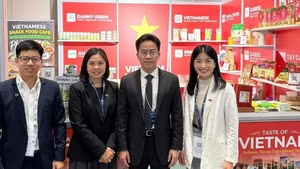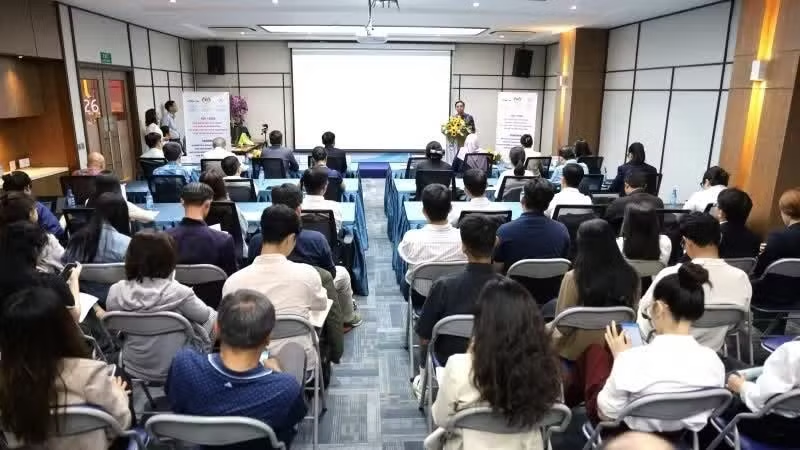
The event was co-organised with the Malaysian Consulate General and the Malaysia External Trade Development Corporation (MATRADE) in Ho Chi Minh City.
The event aimed to provide Vietnamese enterprises with the latest information on consumer trends and updates to Halal certification standards in 2026.
It also covered preferential policies for imported products meeting environmental, social, and governance (ESG) criteria in Malaysia and other Muslim markets.
According to Viet Nam Customs, two-way trade between Viet Nam and Malaysia exceeded 15 billion USD in 2025, up 5% from the previous year, with Viet Nam’s exports accounting for 4.8 billion USD.
However, amid the global shift toward green production, Vietnamese enterprises face the challenge of meeting increasingly stringent market requirements.
Le Anh Hoang, Deputy Director of the ITPC, said Viet Nam and Malaysia are targeting 25 billion USD in bilateral trade by 2030.
He also noted that Vietnamese goods still have considerable room for growth in Malaysia due to similarities in consumer culture and relatively low trade barriers.
Nevertheless, aligning Halal standards with green standards remains a challenge for Vietnamese enterprises, particularly small and medium-sized enterprises, which often face limited investment capital, underdeveloped clean production processes, and inadequate data systems needed for periodic recertification.
Meanwhile, Firdauz Othman, Malaysian Consul General in Ho Chi Minh City, noted that the global Halal market is currently valued at approximately 2.3 trillion USD and is expected to grow strongly in the coming years.
He also affirmed that Malaysia stands ready to serve as a strategic gateway for Vietnamese businesses seeking to enter the global Halal market.
Industry experts note that obtaining Halal certification has become a foundational requirement and an essential risk-mitigation tool, enabling businesses to meet global ESG requirements and ISO standards more readily.
The core values underpinning Halal standards – traceability, ethical production processes, social responsibility, and transparent governance – are fully aligned with the principles of sustainable supply chains.