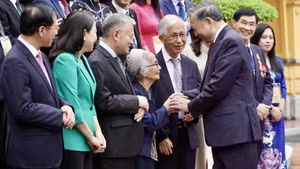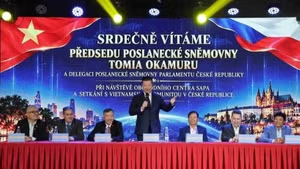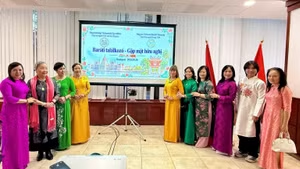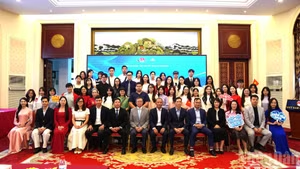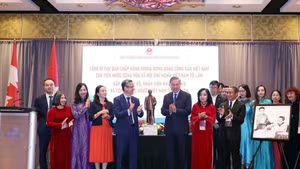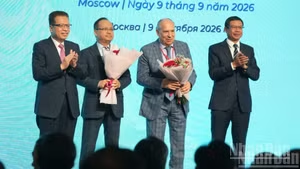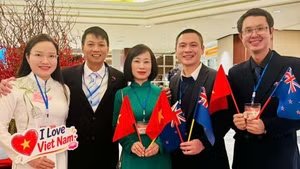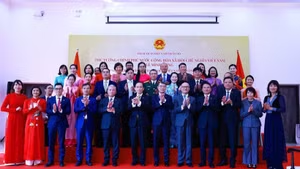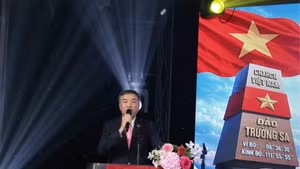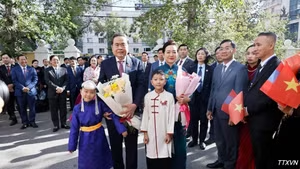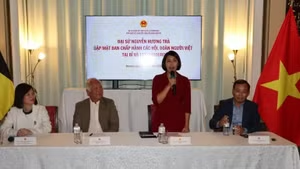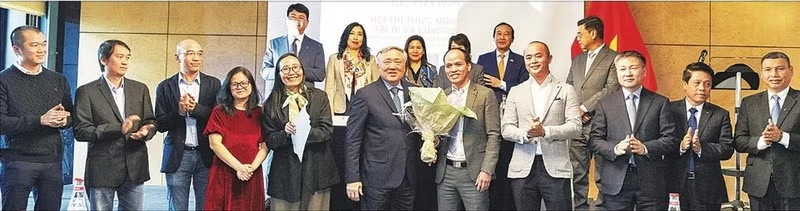
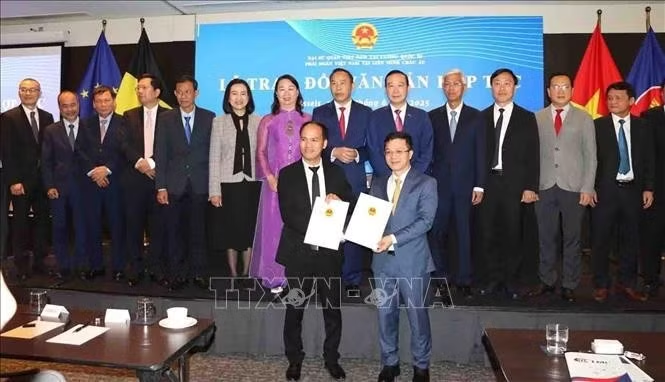
Witnessing the birth of ViLaB were Standing Deputy Prime Minister Nguyen Hoa Binh and Vietnamese Ambassador to Belgium Nguyen Van Thao. From that moment, ViLaBofficially took the field under the national colours, with a clear mission: to connect and channel Vietnamese intellect in Europe back to serve the homeland through practical projects.
A debut marked by the Atomium model
That same car also carried a replica of the Atomium —Belgium’s iconic atomic structure — presented by ViLaBrepresentatives as a meaningful gift to Standing Deputy Prime Minister Nguyen Hoa Binh. The message was unmistakable: as Vietnamese intellectuals venture out into the world, they continue to feel the pull of their homeland.
After nine months since its establishment, ViLaB has connected and reached concrete agreements through more than seven projects, numerous successful training programmes, and policy recommendations that have been highly recognised by ministries, sectors and the media.
Dr Phung Quoc Tri
No sooner had it debuted than ViLaB’s spearhead fields —nuclear medicine and nuclear energy — made their first moves: launching a project on the application of radioisotopes for cancer diagnosis and treatment with Military Hospital 108 and Hospital 19-8; participating in teaching programmes for nuclear power plant construction training for PTSC Oil and Gas Exploitation Services Joint Stock Company in Vung Tau; submitting key recommendations on nuclear power and radioactive waste management; and transferring technologies in in vitro fertilisation and nuclear medicine.
ViLaB members, led by Dr Phung Quoc Tri (currently working at the Belgian Nuclear Research Centre), returned to Viet Nam in August 2025 for in-depth exchanges with Military Hospital 108 on nuclear medicine and biotechnology. In November 2025, the core team again travelled home to work with Hospital 19-8 to assess the potential for nuclear medicine cooperation with Belgium.
Dr Phung Quoc Tri, President of ViLaB, reflected: “After nine months since its establishment, ViLaB has connected and reached concrete agreements through more than seven projects, numerous successful training programmes, and policy recommendations that have been highly recognised by ministries, sectors and the media.
Two standout areas —nuclear technology and AI — already have projects running in practice and aligned with national priorities. We are currently finalising profiles of nearly 100 Vietnamese experts, scientists, engineers and entrepreneurs working in Belgium, Luxembourg and neighbouring countries such as France and the Netherlands, to participate in scientific consultancy for partners in Viet Nam.”
The ‘golden formula’ in Luxembourg: husband in IT, wife in financial management
On that same trip to Luxembourg, the author of this article heard about an intriguing model: the husband works in information technology (IT), while the wife specialises in financial management. This accurately reflects the distinctive intellectual structure of the Vietnamese community in this small yet formidable country. Luxembourg is the world’s second-largest financial investment market, a European leader in communications satellites, home to the headquarters of major corporations such as Amazon, and among the global frontrunners in AI, advanced materials and space resource exploitation.
Many Vietnamese women intellectuals here began by studying finance and accounting at the University of Luxembourg, then quickly joined major European banks, investment funds and financial corporations. Within the Vietnamese community, quite a few women hold pivotal roles in some of Europe’s most complex financial systems.
Interestingly, contrary to the familiar notion of “the wife counting money for the husband”, in many Vietnamese families here it is the husbands who manage household finances. The reason is simple: the wives are already overwhelmed by figures and financial decisions at work, so their husbands step in to ease the pressure once they return home.
Who is AI?
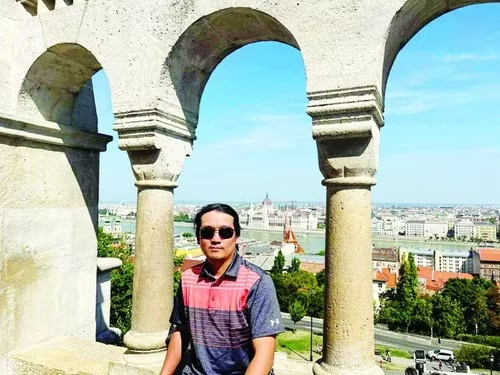
If finance and accounting are the “defensive midfielder,” then AI is the “playmaker” in the lineup of Vietnamese intellectuals in Belgium and Luxembourg. Yet here, AI is not merely the glossy face of a trending medal. A common trait among those forming the core of this spearhead within ViLaB is caution and discretion. A single opening question is enough to reveal the keywords that define them: AI safety, model quality, and long-term mental health impacts— especially as the EU tightens regulations on AI, social media, and the protection of younger generations.
While AI applications are increasingly widespread in Viet Nam, the number of institutions that truly understand the technology in depth, deploy it properly, and rigorously control system quality remains limited. In particular, issuesrelated to safety, reliability, and accountability in AI applications have not received consistent attention.
Dr Mai Xuan Phu offered his perspective: “I think Viet Nam should soon establish a National Centre for Software and AI Certification. This centre would be responsible for developing internationally aligned quality standards for software and AI, issuing advanced testing guidelines, providing transparent testing and certification services, and gradually introducing mandatory requirements for AI systems — while also leveraging and disseminating best practices from leading domestic enterprises. I am ready to contribute my expertise to help enhance software quality and promote the sustainable development of Viet Nam’s technology sector.”
From European laboratories to Vietnamese fields
The pull of home for ViLaB’s intellectual community also extends deep into agriculture and biotechnology — fields considered vital for Viet Nam in the context of climate change.
Having previously worked at the Viet Nam Academy of Agricultural Sciences before receiving a Rockefeller Foundation scholarship to pursue a PhD in Belgium, biotechnology expert Nguyen Ninh Thuan continues to “stay close to the fields” in her own way. She currently works for BASF (Agricultural Solutions Belgium NV), a group specialising in the research, development and commercialisation of agricultural solutions, and also leads ViLaB’s biotechnology spearhead.
For Thuan, the old saying “the first is the seed, the second is the fertiliser” remains fully relevant in the era of Industry 4.0: “The products with the highest commercial potential are high-yield crop varieties, bio-fertilisers and biological crop protection solutions. The key issue is not ideas, but the research toolkit — molecular biology, cell technology, and rapid product development processes. Whoever reaches the market first sets the pace of the game.”
Expanding the operational line-up
It is time to view overseas Vietnamese intellectuals not merely as a “potential resource”, but as co-creation partners. Co-creation also requires new connectors to strengthen two-way links and enhance practical effectiveness.
Recently, ViLaB invited Dr Nguyen Quoc Dinh (Deputy Head of the Office of International Cooperation, PhenikaaUniversity) to serve as an adviser on education, science and technology cooperation. In Belgium, Eric Van Vaerenbergh, Chief Executive Officer of ATENAS Belgium - the country’s electrical safety certification body - and a lecturer in equipment and high-voltage engineering at the École Centrale des Arts et Métiers, has agreed to act as a special adviser to ViLaB.
Returning to that car journey from Antwerp to Luxembourg on the afternoon of March 20, 2025, the driver was Nguyen Thanh Vinh, President of the Viet Nam Business Association in Belgium. This serendipitous journey paved the way for a major capacity-building event at the start of the new year: the Vietnamese Embassy in Belgium and Luxembourg, the Vietnamese Intellectuals Association in Belgium and Luxembourg, and the Vietnamese Business Association in Belgium will jointly organise a seminar on promoting Viet Nam–EU cooperation in science, technology, and trade on March 7, 2026.
The seminar is expected to bring together some 70–100 scholars, sector leaders, diplomats and entrepreneurs. It represents an important step in cooperation, laying the groundwork for knowledge and experience exchange, opening up opportunities for connectivity, and fostering scientific, technological, and commercial projects between Viet Nam and Europe.