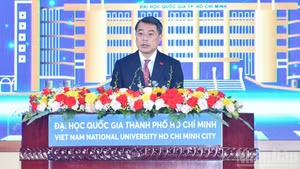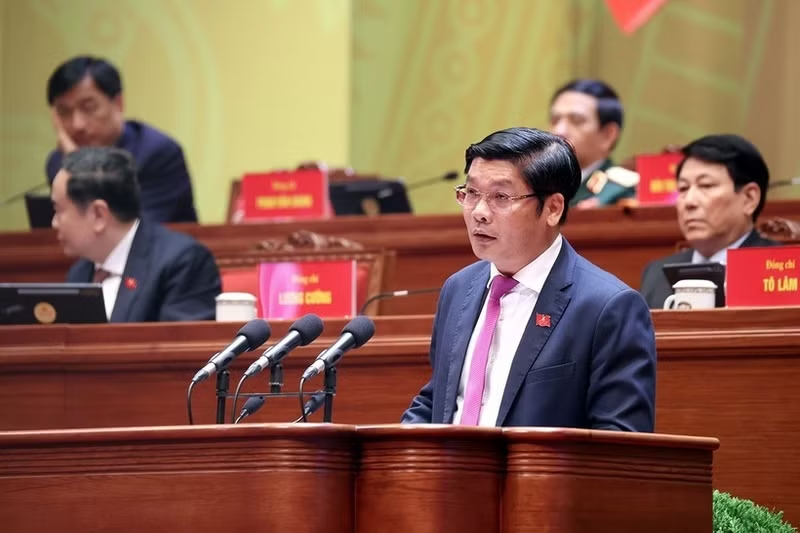
His paper offered practical perspectives on leveraging heritage values and developing Vietnamese culture and people, while proposing solutions for cultural and tourism development in the country’s new era.
According to Tai, Hue is a land with more than seven centuries of history and development, and the only locality nationwide to possess eight cultural heritages recognised by UNESCO. Hue’s heritage space encompasses a rich system of royal architecture, traditional festivals, court arts, music and cuisine, together with the refined, compassionate lifestyle of its people.
By 2030, the city has set the goal of becoming a distinctive heritage city of Viet Nam, a major cultural and tourism centre, a hub for specialised healthcare, science and technology, and a high-quality, multi-disciplinary education and training centre. It plans to adopt a new, sustainable and breakthrough-oriented development strategy for culture and tourism, based on an assessment of opportunities and challenges, and closely aligned with Politburo Resolution No. 80-NQ/TW on the development of Vietnamese culture – which identifies culture and people as the foundation, an important endogenous resource, a powerful driving force, a pillar and a regulator for rapid and sustainable national development.
This strategy will rest on three key pillars: conserving heritage in conjunction with developing a heritage-based economy; building a tourism ecosystem and cultural industries; and promoting human factors together with Hue’s cultural identity.
To effectively implement these orientations, the city will focus on a number of specific measures in the coming period.
First, it will continue to raise awareness and strengthen the sense of responsibility across society regarding the role of culture and heritage in development. The conservation and promotion of heritage values is not solely the task of cultural authorities or government bodies, but of the entire political system, with local residents playing a particularly important role. Conservation efforts must go hand in hand with value enhancement, ensuring sustainable development grounded in Hue’s cultural foundations and identity, alongside effective exploitation and utilisation measures.
Second, the city will prioritise investment to develop Hue into one of Southeast Asia’s leading cultural and tourism destinations. This will be pursued by improving service quality, creating new tourism products, attracting investment in eco-tourism, resort tourism, coastal and lagoon tourism, spiritual and medical tourism, developing the night-time economy, strengthening the East-West economic corridor and regional linkages, enhancing heritage and cultural promotion through digital technologies, and establishing a smart eco-tourism system.
Third, continued mobilisation of resources will be directed towards the restoration and conservation of the city’s monument system, particularly the Complex of Hue Monuments.
Fourth, the city will strongly promote cultural industries and the creative economy by developing creative spaces, performance centres, digital museums and open libraries, while encouraging businesses, organisations and individuals to create high-value cultural products. These efforts aim to generate employment, foster economic growth and preserve cultural identity in parallel.
Fifth, Hue will preserve and promote traditional art forms while encouraging contemporary artistic creativity imbued with local characteristics, with particular emphasis on training and developing high-quality human resources.
To realise these strategic objectives, the city called on central authorities to introduce appropriate mechanisms and policies to harness the strengths of heritage cities, especially policies on social mobilisation in exploiting heritage values for tourism development, and to support international cooperation programmes in heritage conservation.