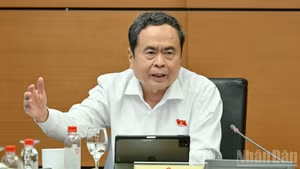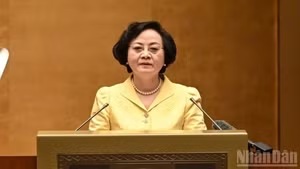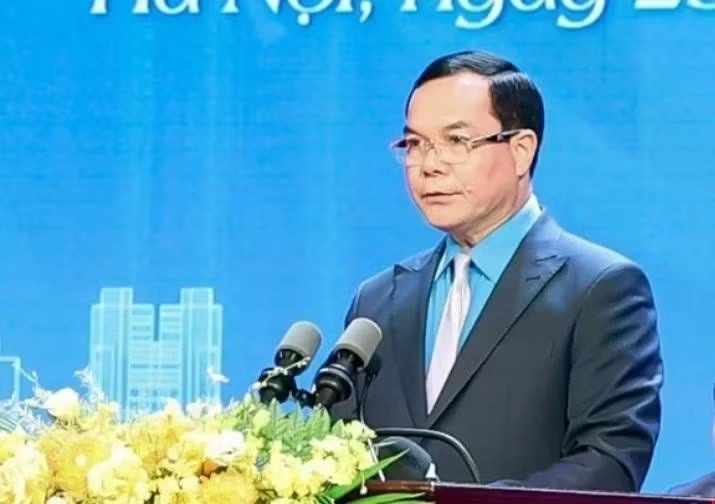
Speaking to the press on the occasion of the 14th National Party Congress, Khang, who is also Secretary of the Party Committee and President of the Viet Nam General Confederation of Labour (VGCL), said that since its inception, especially over the past four decades of the Doi moi (Renewal) process, the Vietnamese working class has consistently fulfilled its historic mission and affirmed its role and position as the class leading the revolution through its vanguard, the Communist Party of Viet Nam.
Entering a period of accelerated industrialisation, modernisation and international integration, the working class continues to play a pivotal role, directly sustaining and developing production, creating the bulk of material wealth and making major contributions to the state budget, he added.
According to the National Statistics Office, Viet Nam currently has around 17.5 million workers in the industry-construction sector and 21.2 million workers in services, accounting for about 39% of the population and 73.6% of the national labour force. The proportion of trained workers rose from 64.5% in 2020 to 70% in 2025. Notably, a new generation of young labourers capable of mastering science and technology is taking shape, reflecting the new dynamism of the Vietnamese working class in the digital era. Khang noted that to build a modern and strong Vietnamese working class, the VGCL has proposed five key priorities to the Party Central Committee and the 14th Congress.
First, a comprehensive strategy on building the working class should be issued in close alignment with the socio-economic development strategy, concretising the goal of building a modern, strong working class linked to advances in science, technology and innovation. Priority should be given to improving education levels, professional qualifications, vocational skills, industrial working styles and labour discipline. Second, there must be a more harmonious distribution of benefits among workers, employers and society, with the introduction of a minimum living standard to replace the current minimum wage framework. Social welfare and social security systems should be expanded, with greater attention paid to social insurance, housing, childcare facilities, health care, education and workers’ cultural and spiritual life. Corporate social responsibility should be strengthened, encouraging fair benefit-sharing, sustainable job creation, living wages and investment in human development.
Third, working hours should be gradually reduced to improve workers’ quality of life, in tandem with efforts to raise labour productivity and national competitiveness.
Fourth, greater emphasis should be placed on theoretical research and review of working-class development reality. The entire political system should be directed to review 20 years of implementing Resolution No. 20-NQ/TW of the 10th Party Central Committee on continuing to build the Vietnamese working class in the period of accelerated industrialisation and modernisation, as a basis for formulating new policies in the new era.
Fifth, the Party leadership should be renewed and strengthened, alongside closer coordination and support from the State and the political system, to better promote the role of the trade union in building a modern and strong working class. Mechanisms should be improved to proactively prevent the abuse of workers’ rights to establish organisations for the purpose of dividing the class or undermining the Party, the State and the trade union. Attention should also be given to admitting outstanding trade union members into the Party, especially in enterprises where grassroots Party organisations have yet to be established.