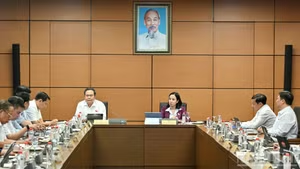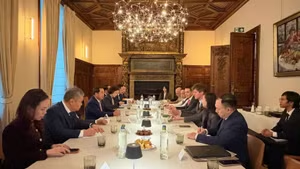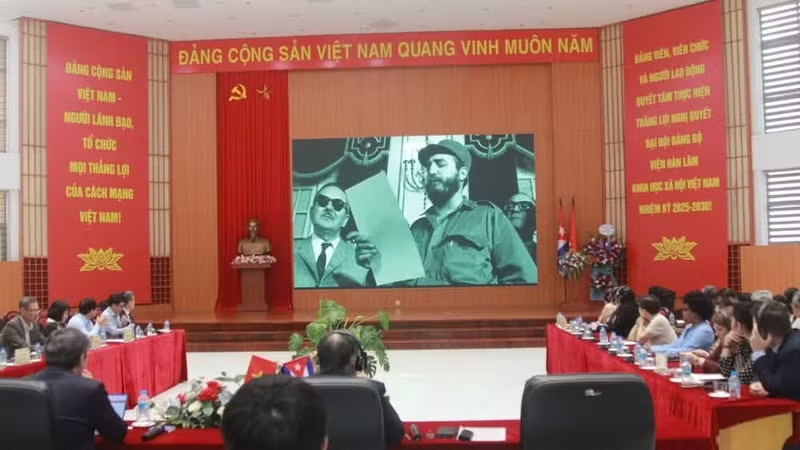
The event was organised by the Viet Nam Academy of Social Sciences in collaboration with the Embassy of Cuba in Viet Nam to mark the centenary of Fidel Castro’s birth (August 13, 1926 – August 13, 2026).
In his opening remarks, Professor Dr Le Van Loi, Member of the Party Central Committee and President of the Viet Nam Academy of Social Sciences, emphasised that studying Fidel Castro’s legacy holds not only theoretical significance but also contributes to deepening the relationship and theoretical exchanges between the two countries.
“The seminar also serves as a forum for the two Parties and two countries to deepen understanding of the theoretical values bequeathed by President Fidel Castro, creating a vital foundation for leaders, policymakers, strategists, experts, scientists, and practitioners to gain a better understanding of the ideology of this historic leader.
His ideology holds not only theoretical significance but also embodies crucial values regarding politics, foreign affairs, the economy, socio-cultural matters, education, ethics, social welfare, and the struggles for national, class, and human liberation,” said Professor Dr Le Van Loi.
One of the key topics highlighted at the seminar was the enduring legacy of Fidel Castro in the relationship with Viet Nam. Cuban Ambassador to Viet Nam Rogelio Polanco Fuentes emphasised the profound affinity between Fidel Castro and President Ho Chi Minh, and the Cuban leader’s steadfast support for Viet Nam’s fight for independence and national reunification.
“From the very moment the foundations of the relationship between our two nations were laid, Fidel Castro was in complete harmony with the revolutionary ideology and actions of President Ho Chi Minh. That affinity transformed the Cuban leader into a symbol of loyalty and unwavering commitment to Viet Nam’s cause.
Throughout the years of the Vietnamese people's struggle for national salvation, Fidel dedicated himself with unshakeable resolve to championing the people’s heroic resistance and Viet Nam’s leadership in the mission of national liberation and reunification, while simultaneously fostering a broad international solidarity movement in support of the Vietnamese people’s cause.”
The conference also explored prospects for cooperation and the theoretical exchange regarding Ho Chi Minh Thought in Cuba and Fidel Castro’s ideology in Viet Nam, thereby contributing to the ongoing study and promotion of the values upheld by both leaders within the context of Viet Nam–Cuba relations.
Today’s international academic seminar serves as a bridge spanning the ocean — connecting Ha Noi and Havana, linking theory with practice — ensuring that Fidel’s ideology and the Viet Nam–Cuba friendship remain an enduring stream that continuously nourishes the aspirations for independence, human dignity, and solidarity.