GDP scale surpasses 500 billion USD
According to information from the Party Central Committee’s Commission for Policies and Strategies, Viet Nam’s economy recorded many positive signals in 2025. GDP growth is projected to exceed 8%, lifting the size of the economy to around 510 billion USD and ranking it 32nd globally. Per capita income is estimated at 5,000 USD, officially placing Viet Nam in the group of upper-middle-income countries.
The consumer price index has been kept below 4%, while macroeconomic stability has been maintained and major economic balances ensured. State budget revenue exceeded 2.4 quadrillion VND (91.3 billion USD), surpassing the annual estimate by more than 25%.
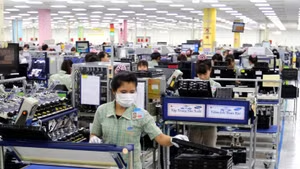
Public debt fell sharply to around 36% of GDP. Foreign direct investment attraction reached approximately 42–45 billion USD. The stock market was upgraded from frontier market to emerging market status, with total market capitalisation exceeding 9.6 quadrillion VND (380 billion USD).
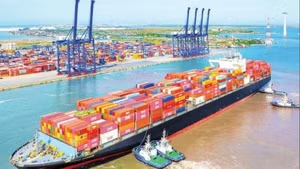
Notably, Viet Nam’s total import–export turnover exceeded 900 billion USD, with exports estimated at over 470 billion USD and a trade surplus of more than 22 billion USD. This is an encouraging outcome in the context of global trade volatility caused by reciprocal tariffs announced by the US in April 2025. Investment flows continued to rise strongly across public investment, private capital and foreign direct investment.
Nguyen Duc Hien, Deputy Head of the Party Central Committee’s Commission for Policies and Strategies, observed that these results demonstrate the economy’s proactive and resilient capacity to overcome “headwinds” in a year marked by significant global economic turbulence.
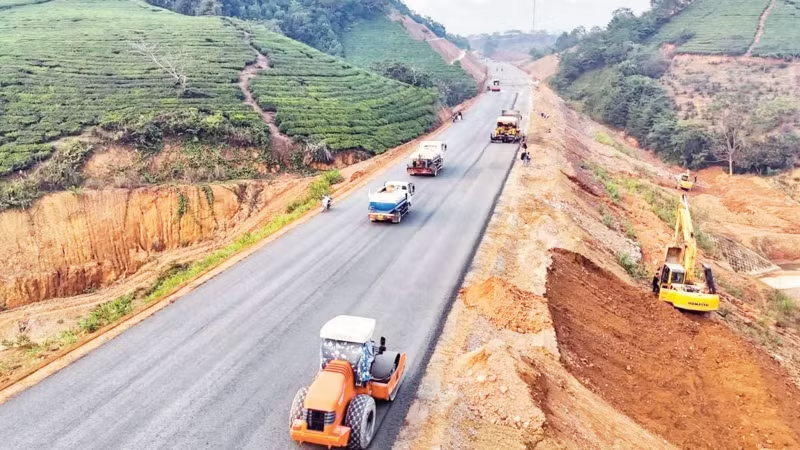
According to economist Le Duy Binh, public investment has been one of the key drivers contributing to the positive signals of the economy. Data from the Ministry of Finance show that the total public investment plan using state budget funds assigned by the Prime Minister, together with additional balanced budget capital for localities, brought total public investment in 2025 to more than 1 quadrillion VND (around 38 billion USD).
By convention, disbursement of public investment capital tends to accelerate towards the end of the year, as contractors require time to carry out construction and accumulate sufficient volume for acceptance and payment. By the end of December 2025, public investment disbursement exceeded 70% of the plan assigned by the Government. This figure has continued to be updated weekly in order to tighten discipline and promote disbursement during the final sprint through to the end of January 2026.
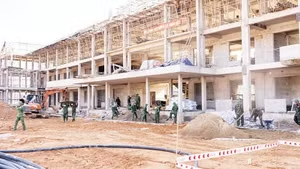
A notable hallmark of public investment in 2025 was the simultaneous commencement and completion of many key infrastructure projects, opening up new growth space while expanding aggregate demand and creating additional room for economic growth.
In 2025, with socio-economic development results meeting and exceeding all 15 out of 15 key targets, including GDP growth of over 8%, Viet Nam’s economy recovered strongly and entered a trajectory of high growth.
Overall nationwide, 564 key projects and works were commenced or inaugurated in 2025, with total investment exceeding 5.1 quadrillion VND (194 billion USD). Of this, state budget investment accounted for more than 1 quadrillion VND (38 billion USD), representing over 25%, while private capital amounted to more than 3.8 quadrillion VND (around 148 billion USD).
The year 2025 also recorded a strong recovery in the business sector, with more than 300,000 enterprises newly established or resuming operations nationwide, with total registered capital exceeding 6 quadrillion VND (around 230 billion USD). These figures represent increases of 30% and 71% respectively compared with the same period in 2024. As a result, Viet Nam now has around 1.1 million active enterprises, indicating a return of business confidence.
Momentum from “policy breakthroughs”
The year 2026 marks the first year in which the economy enters a trajectory of double-digit growth, expected to continue throughout the 2026–2030 period. Correspondingly, the National Assembly has approved ambitious economic targets: GDP growth of 10% or more alongside macroeconomic stability; per capita income of 5,400–5,500 USD; an average consumer price index increase of around 4.5%; and a share of processing and manufacturing industry in GDP of approximately 24.9%.
Vo Tri Thanh, Director of the Institute for Brand and Competitiveness Strategy (BCSI), noted that setting a double-digit growth target reflects the strong determination of the National Assembly and the Government to realise the Party’s vision of transforming Viet Nam into a developing country with modern industry and upper-middle income status.
To achieve double-digit growth from 2026, an urgent requirement is to establish a new growth model based on science and technology and innovation, with economic activities shifting from “brown” to “green”. This process needs to be supported by institutional reforms to remove the “bottleneck of bottlenecks”, increased investment in infrastructure and human resource training, and the establishment of sandbox mechanisms for open economic models, the circular economy and innovation.
In Official Dispatch No. 241/CD-TTg dated December 17, 2025 on the implementation of tasks to promote economic growth in order to comprehensively fulfil the 2025 socio-economic development plan and to create momentum and foundations for the implementation of the 2026 plan, the Prime Minister requested ministries, sectors and localities to urgently review and propose sufficiently strong “policy breakthroughs” to transform opportunities into tangible results. This move demonstrates the Government’s decisiveness, proactiveness and flexibility in leadership and governance, creating impetus for economic growth in 2026.
According to Nguyen Thi Huong, Director General of the General Statistics Office (Ministry of Finance), to realise the double-digit growth target in 2026 it is necessary to prioritise growth promotion while firmly maintaining macroeconomic stability, controlling inflation, ensuring major economic balances, and keeping public debt and budget deficits within prescribed limits. These are seen as critical foundations for economic breakthrough.
At the same time, support should focus on the business community, particularly small and medium-sized enterprises. Efforts should be intensified to attract FDI linked to high value chains, shifting the focus from the quantity of capital to technological content, localisation rates and value added, while strongly promoting new growth drivers such as the green economy, digital economy, circular economy, semiconductor industry and artificial intelligence.
In a context where consumer demand has not grown as strongly as expected, targeted stimulus measures are needed to boost sustainable consumption, encourage demand for domestically produced goods with high value added, and support service consumption through safe tourism programmes and conditional promotions. In parallel, institutional reform should be accelerated to reduce costs, specifically by abolishing unnecessary business conditions and cutting by 50% the time required to resolve administrative procedures related to investment and business establishment.
According to Can Van Luc, Chief Economist of BIDV, from 2026 it is necessary to restructure public investment, prioritising areas that lay the foundation for a new growth model rather than focusing solely on hard infrastructure. At the same time, financial market reform is needed to increase the proportion of capital supplied to the economy through the stock market and the International Financial Centre, which officially came into operation at the end of December 2025, thereby helping to reduce the burden on the banking system.
In the context of a global economy forecast to continue facing difficulties and uncertainty, Viet Nam has nonetheless maintained high economic growth and macroeconomic stability, creating favourable conditions for production and business activities. This constitutes a solid pillar for the economy to achieve a breakthrough.