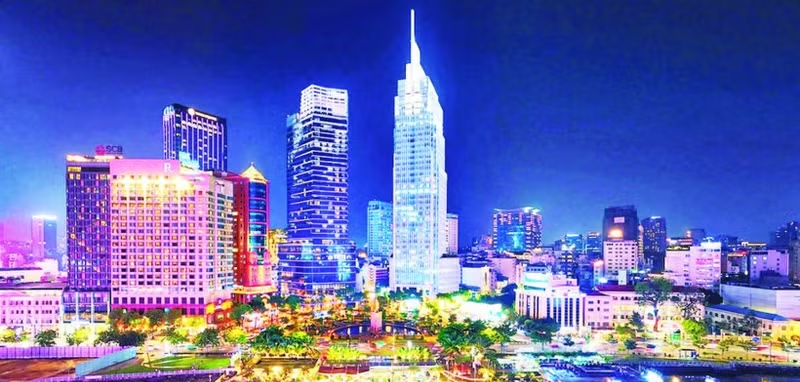
Outstanding incentives for investors
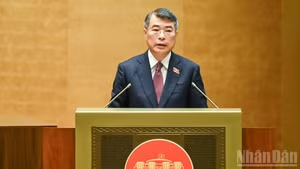
At a recent conference announcing the establishment of the International Financial Centre (IFC) in Viet Nam, Politburo member and Permanent Deputy Prime Minister Nguyen Hoa Binh introduced eight decrees to implement National Assembly (NA) Resolution No. 222/2025/QH15. He stressed that the eight important decrees have basically formed a legal corridor for the operation of the IFC in Viet Nam, with regulations that are notably preferential, competitive, and comprehensive.
Under Decree No. 323/2025/ND-CP, the IFC will be developed at two locations: Ho Chi Minh City and Da Nang. The governance model is designed towards maximum decentralisation to the local executive authority. Ho Chi Minh City is oriented to become a comprehensive, diversified financial centre providing traditional financial services.
Other decrees set out a wide range of highly preferential and competitive policies for the centre, particularly in finance and taxation. Specifically, enterprises implementing new investment projects arising within the centre in priority sectors and occupations are eligible for a corporate income tax rate of 10% for 30 years, with an exemption for up to four years and a 50% reduction in the tax payable for up to the subsequent nine years.
Meanwhile, new investment projects in the IFC that do not fall under priority sectors and occupations will enjoy a 15% corporate income tax rate for 15 years, including a tax holiday of up to two years and a 50% reduction in payable tax for up to the following four years. Managers, experts, scientists, and other highly skilled professionals will be granted personal income tax exemptions through 2030, subject to specified conditions. Equipment, machinery, and components serving the centre will also be exempt from import duties.
The decree also allows banks, financial institutions, and insurers to apply international financial regimes and operate pilot mechanisms. Alongside this are mechanisms to mobilise capital via green bonds and community bonds; special mechanisms to select strategic investors; and provisions on risk-sharing. Member registration procedures are simplified, with processing time not exceeding seven days. The Deputy Prime Minister said that in the future the processing time could be shortened further — possibly to three days or even one day.
Prime Minister Pham Minh Chinh affirmed that bringing the IFC into operation marks the beginning of a process of renewal — in both scale, quality, and efficiency — for financial market development, with far-reaching spillover effects across all sectors, fields, and stakeholders nationwide.
Announcement of strategic investors
At the conference, the Ho Chi Minh City People’s Committee officially announced the list of strategic investors and partners participating in the initial phase of the centre based in the city. This is seen as an important kick-off step, laying the groundwork for an integrated modern financial ecosystem deeply connected with the global market.
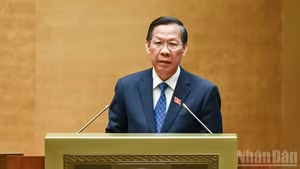
Chairman of the Ho Chi Minh City People’s Committee Nguyen Van Duoc said the southern hub has held discussions and exchanges with more than 50 founding investors and partners at home and abroad, from which it selected organisations with strong financial capacity, international experience, and significant influence to take part from the very first phase of building the centre. Notable names include major global and Vietnamese players such as Nasdaq, Binance, Circle, the Onchain Alliance, Dragon Capital, Tether, TikTok, Viettel, FPT, MB Bank, Vietcombank, and VietinBank.
In the initial phase, the executive body of the centre will be located at 8 Nguyen Hue Street (Sai Gon Ward). After 2027, the headquarters is expected to be placed in a modern building in the Thu Thiem New Urban Area.
In terms of organisational arrangements, the city will select a leadership team and specialist staff with strong professional expertise, foreign-language proficiency, and a solid understanding of the global financial environment. For the chief operating officer position in particular, the city plans to invite international professionals with experience at major financial centres in the region and worldwide.
According to the city’s orientation, the IFC will be developed on three main pillars: flexible institutions with controlled piloting mechanisms; modern finance-and-technology infrastructure for new-generation financial models; and competitive cost advantages linked to the real economy, especially industry, logistics, and a free trade zone. From this structure, the centre is expected to become a bridge between international capital flows and the domestic economy, supporting the restructuring and upgrading of existing FDI flows, while also attracting portfolio investment, innovation capital, and long-term capital.
With support from investment funds such as VinaCapital, consular agencies, diplomatic partners, and domestic and international training partners, Ho Chi Minh City has expanded cooperative ties with major financial centres such as New York, Frankfurt, Singapore, and Dubai.
Chairman of the Ho Chi Minh City People’s Committee Nguyen Van Duoc emphasised: “Viet Nam’s IFC is not merely a purely financial space, but also a symbol of a new development mindset, a spirit of daring to pilot, daring to innovate, and daring to break through — helping enhance Viet Nam’s position on the regional and global financial map.”