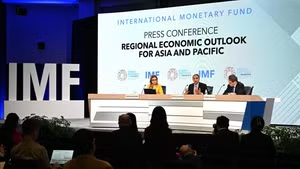
Within the framework of the annual Spring Meetings of the World Bank Group and the International Monetary Fund recently held in Washington, DC, the US, Srinivasan said that the growth of the Asia-Pacific region was estimated at 5% in 2023 — much higher than the 3.9% recorded in 2022 and 0.4 percentage points higher than the IMF forecast in October 2023.
In addition, the IMF also forecast that the region's growth will reach 4.5% in 2024, with the Asia-Pacific set to contribute about 60% of global growth. Promoting growth depends on each country. In China and India, the IMF expected investment to contribute a lot to growth. In emerging Asian countries beyond China and India, strong private consumption has remained the main driver of growth. In some advanced economies, such as the Republic of Korea, the IMF expected positive momentum from exports.
Growth in Asis is said to be growing strongly this year, despite unstable factors from the external environment. The end of the interest rate hike cycle in most economies as well as the continued recovery in goods exports following an upturn in the semiconductor manufacturing cycle will support growth.
According to the Asian Development Bank (ADB), the growth of developing economies in Asia this year is forecast to be slightly higher than the previous forecast, thanks to strong domestic demand in many economies. China is still a "bright spot" in the picture of the region's growth prospects. It is forecast that China's economy will grow 4.8% this year, higher than the 4.5% forecast made in December last year, but lower than the 5.2% growth rate in 2023. ADB also forecast regional inflation will decrease to 3.2% this year from 3.3% in 2023 and decrease further to 3% in 2025.
Asian economies can grow more positively as productivity has improved and efficiency has increased. The WB believes that although the growth rate of Asian economies is slower than the period before the COVID-19 pandemic broke out, it is still faster than other regions in the world. A recovery in global trade and an easing of financial conditions as central banks begin cutting interest rates will help offset weaker growth in China.
Growth in Asis is said to be growing strongly this year, despite unstable factors from the external environment. The end of the interest rate hike cycle in most economies as well as the continued recovery in goods exports following an upturn in the semiconductor manufacturing cycle will support growth.
Meanwhile, the region's economy is still facing lingering challenges such as rising geopolitical tensions, including conflicts in the Middle East, which could disrupt supply chains and cause inflation. The WB report clearly pointed out that a number of risks affect the growth of the Asian economy, including the US Federal Reserve (FED) and a number of other major central banks being likely to maintain interest rates higher than pre-pandemic levels, as well as nearly 3,000 trade barriers such as higher tariffs or subsidies enacted in 2023.
Notably, most of these measures were imposed by the US, China, and India. Public debt, trade barriers, and policy uncertainty are factors that prevent Asian economies from achieving positive growth rates as expected. According to the WB, Asia's economic growth forecast may only reach 4.5% in 2024, lower than the 5.1% recorded in 2023.
Faced with factors that are expected to weaken the region's economic dynamism, experts recommend that governments introduce more measures to address long-term problems, including weak social security network and lack of investment in education. Regarding inflation, the IMF recommended that Asian central banks focus on providing solutions to handle domestic inflation and avoid making policy decisions that are overly dependent on FED movements.
If central banks rely too much on the FED's forecasts, it could undermine domestic price stability. Regarding monetary and fiscal policy challenges, the IMF recommended that governments focus on consolidation to limit the increase in public debt and rebuild financial buffers.
With the resilience of the Asian economy after the COVID-19 pandemic, the world economy has continued to witness positive growth dynamics. According to experts, Asia is performing better than most of the rest of the world but has not yet reached its full potential. Positive forecasts for Asian economies are considered a growth driver for the world economy although there are still risks and challenges ahead.