Establishing a strategic vision
The merger of the former Phu Yen province into Dak Lak province has created a development space, generating new resources and impetus, and connecting the strengths of the coastal-forest-highland areas, linking the strengths of different economic regions. Therefore, adjusting the provincial plan is a unique opportunity to integrate value chains: bringing Central Highlands agricultural products to international seaports and bringing tourism services and marine industries inland.
The goal of adjusting the plan is to redefine the viewpoints, objectives, orientations, set key tasks, breakthroughs, and tasks and solutions to promote socio-economic development in the period up to 2030, with a vision to 2050, towards rapid and sustainable development of the province.
Organising the economic and social development space of the province in a unified and effective manner, based on exploiting unique advantages, ensuring synchronous connection of infrastructure systems, linked with the sustainable exploitation and use of natural resources; developing key sectors and regions; mobilising, allocating, and using resources effectively; and enhancing provincial competitiveness.
This serves as a basis for organising the preparation of detailed sectoral plans, urban and rural plans in the province to meet the requirements of administrative unit rearrangement and the organisation of a two-tiered local government; ensuring the consistency, uniformity, and long-term strategic nature of the planning system…
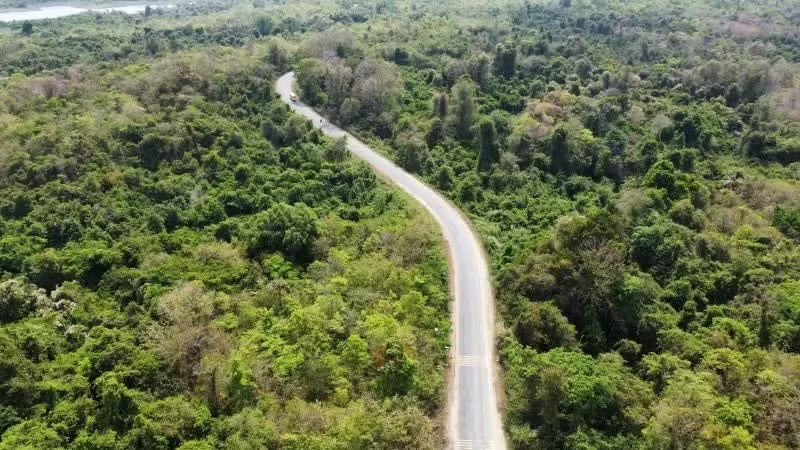
Striving to make Dak Lak a dynamically developing province of the country by 2030; to become a centre for green economic development and a hub for logistics, healthcare, education, tourism, culture-sports, and science-technology services in the South-Central Coast and Central Highlands regions; a unique, distinctive, and attractive destination for domestic and international tourists.
By 2050, Dak Lak strives to become a moderately developed province in the country, with a modern economy, a rational structure, green growth, and sustainable development. The province affirmed its position as a key development nucleus and important connecting core of the Central Highlands sub-region, playing a strategic role in closely linking the Central Highlands with the South Central Coast region and national economic corridors, contributing to the formation of an effective inter-regional development space, while positioning itself as a liveable, modern, smart, and distinctive city, developing harmoniously between people, technology, and nature.
The socio-economic infrastructure system is invested in a comprehensive and modern manner, ensuring seamless connectivity between production areas, urban centres, service centres, seaports, airports, and important transportation hubs; enhancing transportation and logistics capacity and linking domestic and international markets.
The province has become an important centre for agricultural production, processing, and logistics services in the central sub-region of the South-Central Coast and Central Highlands; strongly developing processing industries, renewable energy, trade, logistics, and tourism, gradually forming an economic structure oriented towards modern industry and services.
Agriculture is developed in an ecological direction, applying high technology, linking value chains, and adapting to climate change; forest, land, water resources, and biodiversity are managed, protected, and used sustainably. The unique traditional cultural values of ethnic groups are preserved and promoted in conjunction with the development of cultural industries and tourism…
Breakthroughs from new development spaces
To achieve the set goals, Dak Lak focuses on targeted and strategic development; forming dynamic regions and economic corridors with high linkage and spillover effects. The development space is organised towards expanding regional-sectoral linkages, effectively exploiting east-west, north-south, and trans-regional economic corridors to form closely linked value chains, effectively connecting with neighbouring localities and regions.
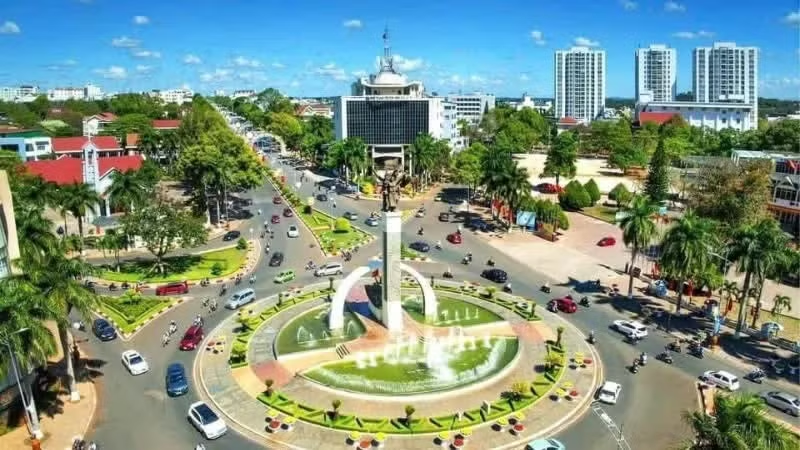
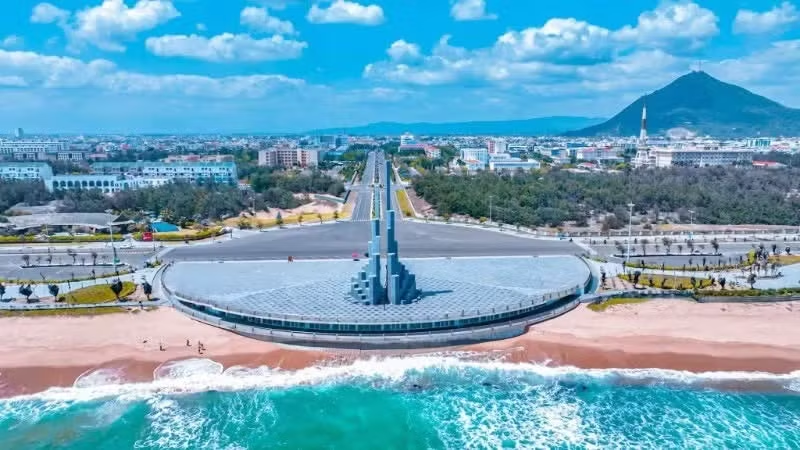
The urban system is developed according to the model of a central city and satellite cities; in which Buon Ma Thuot is the core city of the Central Highlands sub-region, and the Tuy Hoa area is the eastern coastal centre.
Attention has been paid to prioritise investment in a synchronous and modern infrastructure system; gradually build Dak Lak into a high-quality centre for healthcare, education and training, science and technology, and services in the South-Central Coast and Central Highlands regions; closely integrate economic and social development with strengthening national defence and security, ensuring political stability and social order; with economic development as the focus and national defence and security as a prerequisite.
The revised Dak Lak Provincial Planning outlines three breakthroughs for development: focusing on the comprehensive development of science, technology, innovation, and digital transformation across all three pillars: digital government, digital economy, and digital society; accelerating administrative reform, improving the investment environment, and developing a synchronous and modern digital infrastructure.
Focusing on the development of human resources, especially high-quality human resources, to meet the requirements of rapid and sustainable economic and social development. Focusing on perfecting the institutional framework and operational mechanisms to ensure the effective, efficient, and effective operation of the two-tiered local government apparatus.
Maximising the mobilisation of resources to invest in the construction of a synchronous economic and social infrastructure, especially strategically important infrastructure such as transportation, urban areas, economic zones, industrial parks, and seaports.
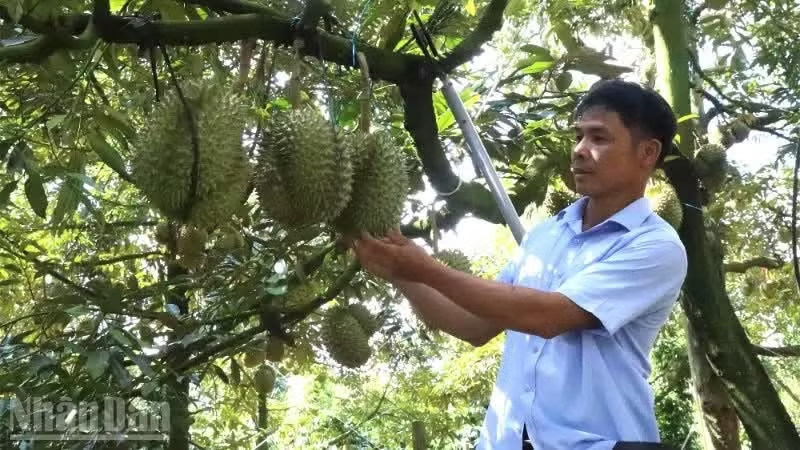
Notably, in the revised planning for the 2021-2030 period, with a vision to 2050, the province is divided into 3 economic zones: Zone 1 (Western Highlands Dynamic Zone) comprises 46 communes and wards; with an area of 8,262.61 km2 and a population density of 230 people/km2; including all the central highland areas of the province connected to the national highway axis passing through central urban areas such as Buon Ma Thuot, Buon Ho, Ea Drang, Buon Don, the border area connected to the Ho Chi Minh Highway and Highway 02, and the hub of routes CT.23, CT.24, and National Highway 14C. It focuses on developing renewable energy industries, deep processing industries, and multi-value agriculture and forestry; becoming the urban core of the world's coffee capital.
Zone 2 (Eastern Marine Economic Dynamic Zone) comprises 30 communes and wards; with an area of 4,106.66 km2, a population density of 243 people/km2; includes the entire space of communes and wards along National Highway 1, CT.01, the national railway, and the high-speed railway; extending from Song Cau-Tuy Hoa-Dong Hoa and the sea area belonging to the province. It focuses on developing a comprehensive marine economy, metallurgical and petrochemical industries, port services, offshore energy, etc.; developing into a regional and national-level marine and island tourism centre.
Zone 3 (Transitional Midland Zone) comprises 26 communes; with an area of 5,729.04 km2 and a population density of 88 people/km2, the province encompasses the entire area of communes stretching from Son Hoa-M’Drak-Ea Kar-Lien Son Lak; its development is oriented towards becoming a supporting region linking the eastern coastal region and the western highlands, and connecting with Khanh Hoa province; focusing on forest protection, developing multi-value agriculture and forestry, and logistics.
In addition, the province has planned three economic corridors: the North-South Central Highlands Economic Corridor: connected to the Ho Chi Minh Highway, the western North-South Expressway (CT.02 will be formed in the future), and the Central Highlands railway line.
This is an important economic corridor connecting production and urban centres of the Central Highlands sub-region, strengthening links between this sub-region and Da Nang city, the North Central region to the north, and the Southeast region to the south. Focus on developing renewable energy industries, deep processing of agricultural and forestry products linked to large-scale raw material areas in the Central Highlands sub-region, and forest economy. Form urban chains and service centres along the corridor and create a distinctive tourism route, the “Central Highlands Green Route”.
Eastern North-South Economic Corridor: linked to strategic transportation axes including the eastern North-South expressway, National Highway 1A, the North-South national railway line, and the North-South high-speed railway (to be developed in the future).
It is a comprehensive economic corridor connecting urban centres, industrial centres, tourism centres, and major coastal logistics hubs. Focus on developing heavy industries, energy, marine economy (seaports, coastal tourism, etc.), and logistics services linked to a multimodal transport system and coastal urban chains.
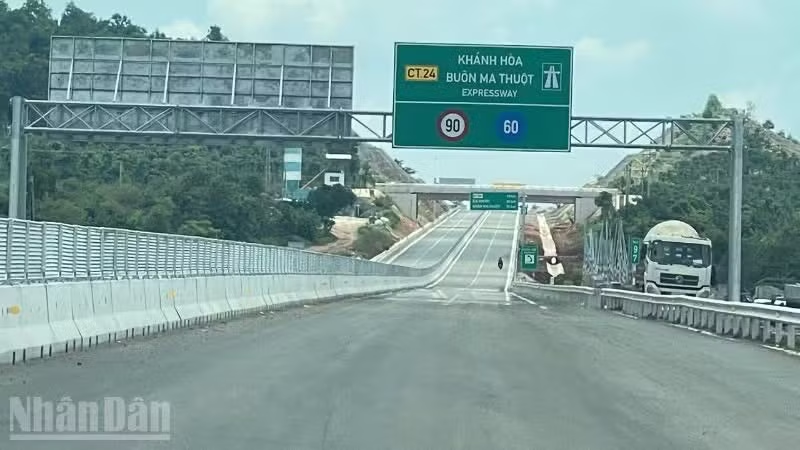
East-West Economic Corridor: linked to the Phu Yen-Dak Lak Expressway (CT.23) and the future Buon Ma Thuot-Khanh Hoa Expressway (CT.24). This is a crucial economic corridor connecting the Central Highlands with the South-Central coastal region. It focuses on developing industrial, service, commercial, and tourism cities, concentrated specialised farming areas, deep processing industries for agricultural, forestry, and mineral products, and renewable energy.
The province also plans two dynamic centres: The Western Highlands Dynamic Centre, comprising the major cities of Buon Ma Thuot-Buon Ho and surrounding areas; serving as the administrative and urban centre. It focuses on developing new economic sectors such as the night-time economy and the digital economy; and developing urban areas towards a green, smart, modern, and distinctive direction.
The Eastern Coastal Dynamic Centre: comprising the cities of Tuy Hoa-Dong Hoa and surrounding areas. Focus on developing industries linked to economic zones and international seaports, trade, services, and coastal tourism.
In addition, the province has also planned three growth poles: The Ea Drang and surrounding areas urban growth pole: the northern gateway urban centre of the western region of Dak Lak province. Focus on developing TOD (Transit-Oriented Development) urban areas, commerce, services, processing industries, and supporting agricultural production.
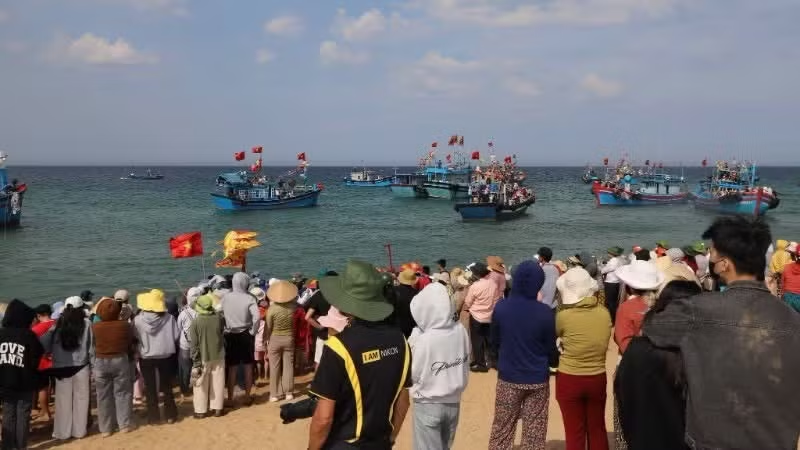
The Song Cau and surrounding areas urban growth pole: the eastern gateway urban centre of the province, focusing on developing TOD urban areas and climate change-adaptive urban areas. Focus on developing a comprehensive marine economy.
The M’Drak and surrounding areas urban growth pole: a centre for processing industries, logistics combined with ecotourism and cultural tourism.
Cao Thi Hoa An, Member of the Party Central Committee, Standing Deputy Secretary of the Provincial Party Committee, and Chairwoman of the People’s Council of Dak Lak Province, affirmed: The announcement of the adjusted planning of Dak Lak province for the period 2021-2030, with a vision to 2050, is of special importance.
This plan aims to clearly establish the vision and growth drivers, serving as a tool to guide development in allocating resources correctly, attracting investment, and definitively addressing bottlenecks.
At the same time, the plan has realised the directive of General Secretary and President To Lam during his visit and working session with provincial leaders in early February 2026: Dak Lak needs to innovate its thinking, shifting from managing the area to creating a strategic development space, affirming its role as a hub connecting the Central Highlands with other economic regions and national corridors…