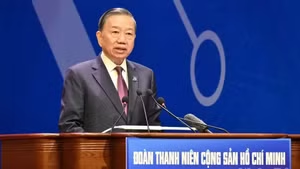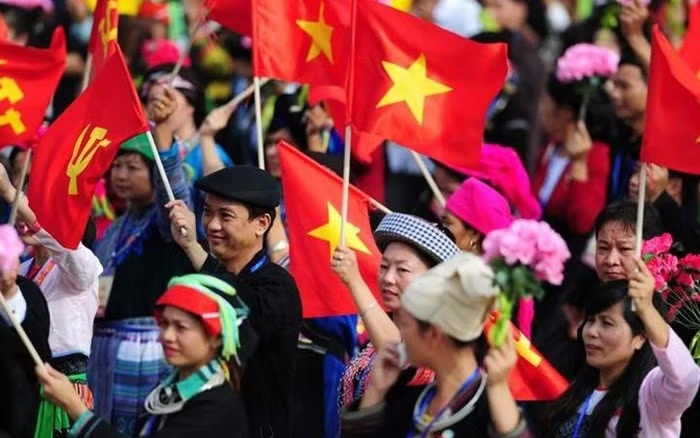
Recently, in the article “The light of Ho Chi Minh illuminates our path” marking the 136th birth anniversary of President Ho Chi Minh (May 19, 1890–May 19, 2026), Party General Secretary and State President To Lam affirmed that “every official must take the people’s satisfaction, trust, and happiness as the measure of their work”.
This also underscores that the people’s happiness has consistently remained one of the foremost concerns of the Party and the State throughout the revolutionary process of winning, safeguarding, and defending the nation’s independence and freedom.
The shaping of “happiness” within the national value system
The journey towards realising the people’s happiness is now unfolding amid a “new turning point and a new opportunity of historic significance”. Rivalry among major powers and ongoing arms races not only threaten peace but also directly erode social welfare achievements. Simultaneously, challenges arising from climate change, pandemics, and growing inequality are creating new forms of insecurity for humanity.
In this context, the Party remains steadfast in its principle that “the people are the root”, recognising the people as the subject and centre of national renewal, development, and defence. All policies and guidelines of the Party and the State must genuinely stem from the people’s needs, aspirations, rights, and legitimate interests, taking their happiness and satisfaction as both a benchmark and a goal.
Earlier, addressing a national conference on the implementation of Politburo Resolutions No. 59-NQ/TW, No. 70-NQ/TW, No. 71-NQ/TW, and No. 72-NQ/TW on September 16, 2025, Party General Secretary To Lam stated: “The determined and synchronised implementation of these four resolutions will generate new drivers and strong momentum to achieve our strategic objectives, making our country increasingly prosperous and civilised, and our people increasingly happy.” Consequently, the happiness of the people emerged as a key priority.
Speaking to us, Associate Professor, Dr Ly Viet Quang, Head of the Ho Chi Minh and Party Leaders Institute at the Ho Chi Minh National Academy of Politics, noted that the Party’s viewpoint at the 14th National Congress clearly reflects the orientation of creating happiness for the people in the new era.
Happiness is fostered through building a clean and strong Party and political system; promoting rapid and sustainable economic growth; developing a healthy cultural and social environment; advancing comprehensive human development; ensuring social welfare; strengthening national defence and security; expanding foreign relations; and building a contingent of officials with sufficient qualities, competence, and prestige to meet the demands of their responsibilities.
In other words, the people’s happiness is the comprehensive outcome of a national development strategy that centres on the people, recognising them as the subject, objective, and driving force of development.
Identifying six groups of issues in realising and safeguarding value of people’s happiness in new era of development
First, building a clean and strong Party and political system – the fundamental condition for ensuring the people’s sustainable happiness
The people’s happiness depends not only on sound development goals but also directly on the Party’s leadership and governing capacity, and the effectiveness of the political system. A clean and strong Party ensures correct and unified policies, while a streamlined, efficient, and effective political system facilitates the prompt and smooth implementation of policies and guidelines, bringing tangible benefits to the people.
Therefore, in the new era, it is necessary to continue comprehensively strengthening and rectifying the Party in political, ideological, ethical, organisational, and personnel aspects; resolutely combat degradation, corruption, wastefulness, and other negative phenomena; uphold discipline, order, and the exemplary responsibility of officials and Party members, especially leaders.
Simultaneously, efforts should continue to streamline the organisational apparatus, clearly define functions, tasks, powers, and responsibilities, and promote decentralisation and delegation of authority alongside inspection, supervision, and control of power.
The role of the Viet Nam Fatherland Front and socio-political organisations in representing and protecting the legitimate rights and interests of the people, as well as conducting supervision and social criticism, must also be enhanced.
More importantly, the entire political system must shift decisively towards a service-oriented mindset, taking the people’s satisfaction, trust, and tangible benefits as the measure of performance. When the Party is strong, the administrative system functions effectively, officials are responsible, and authorities remain close and responsive to the people and promptly address grassroots issues, social trust will be strengthened, creating a solid political foundation for achieving the goal of a prosperous, civilised, and happy nation.
Second, sustainable economic development – the material foundation of happiness
If living conditions remain difficult, employment is unstable, incomes are low, and opportunities for advancement are limited, happiness will remain out of reach for many people. Therefore, sustainable economic development is of particular importance as the material foundation for raising incomes, improving the quality of education, healthcare, housing, living environments, and essential social services.
Moreover, when the economy develops sustainably, people gain better access to knowledge, technology, markets, and resources, thereby expanding opportunities for development and improving their quality of life.
In the new era, the foremost priority is to continue advancing industrialisation and modernisation; promoting rapid and sustainable growth, the green economy, and the digital economy; strengthening scientific research and technological application; fostering innovation and digital transformation; developing strategic and digital infrastructure; and enhancing the economy’s self-reliance and resilience.
The nation must prioritise developing key sectors with high added value and strong growth-driving potential, including core technologies, the semiconductor industry, chip design and manufacturing, artificial intelligence, big data, cloud computing, biotechnology, renewable energy, smart logistics, high-tech agriculture, and high-quality services.
Third, cultural and human development – the spiritual foundation of happiness
A nation may become materially prosperous, but if the spiritual life of its people is impoverished, social morality deteriorates, and the nation’s positive cultural values are eroded, happiness cannot be sustained. Therefore, cultural and human development plays a particularly important role in safeguarding and enhancing the people’s happiness.
To make cultural and human development the spiritual foundation of happiness, it is first necessary to thoroughly grasp and effectively implement the Party’s views on the development of Vietnamese culture (Resolution No. 80-NQ/TW) and on political and ideological work within the Party (Regulation No. 19-QD/TW).
This will help raise awareness and strengthen action throughout the Party, the political system, and society regarding the vital role of culture and people in national development and in ensuring the people’s happiness.
On that basis, the national value system, cultural value system, family value system, and standards for Vietnamese people in the new era must be translated into concrete criteria and standards applicable to families, schools, agencies, organisations, communities, and cyberspace.
At the same time, values such as patriotism, compassion, solidarity, integrity, responsibility, discipline, creativity, and the aspiration to contribute must be integrated into education, communications, cultural activities, and social life.
Efforts must focus on building a healthy, civilised, and safe cultural environment while promoting the exemplary role of officials and Party members in preserving ethical standards and lifestyles and spreading positive values.
Cultural industries should be further developed, national cultural identity preserved and promoted, and the finest achievements of world cultures embraced. Furthermore, society must resolutely combat political and ideological degradation, moral decline, unhealthy lifestyles, pragmatism, indifference, and deviant behaviours.
When ideological work is strengthened, a healthy cultural environment is fostered, and Vietnamese people are comprehensively developed in physical health, intellect, character, resilience, civic awareness, and aspirations for contribution, the people’s happiness will rest on a solid spiritual foundation.
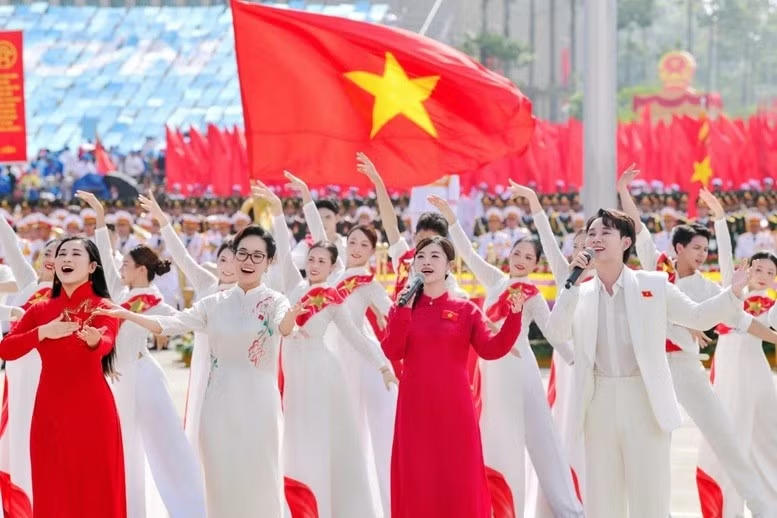
Fourth, building a multi-tiered, inclusive, and humane social security system – the “safety net” protecting the people’s happiness
In modern society, individuals may face risks such as unemployment, illness, natural disasters, pandemics, ageing, market fluctuations, climate change, and career transitions. Therefore, sustainable happiness is not generated solely through economic growth but must also be protected by an effective social security system.
A happy society is one in which vulnerable groups are protected, the poor are given opportunities to improve their lives, citizens receive support when facing difficulties, and everyone has a foundation for personal development.
To realise this goal, it is necessary to improve a multi-tiered social security system, expand coverage, and enhance the quality of social insurance, health insurance, and unemployment insurance.
Effective measures must be implemented to reduce multidimensional poverty, care for people with meritorious service, and support older persons, children, persons with disabilities, and other vulnerable groups.
Authorities must promote social housing development while continuing efforts to eliminate temporary and dilapidated housing. Access to education, healthcare, clean water, information, employment, and essential social services should also be expanded.
Simultaneously, the quality of education, vocational training, and healthcare services should be improved; high-quality human resources developed; healthy life expectancy increased; and workers equipped with digital skills, vocational skills, and adaptability.
When people have good health, knowledge, skills, employment, and opportunities for advancement, they become active creators of happiness for themselves, their families, and the nation.
Fifth, national defence, security, and foreign affairs – the “shield” protecting the people’s happiness
A peaceful, stable, independent, and self-reliant nation with an increasingly strong international standing creates broad opportunities for development, enabling people to work, study, innovate, establish careers, and contribute with confidence.
At a time when the world is experiencing significant turbulence, peace cannot be taken for granted, stability is not automatic, and a favourable environment for development must always be safeguarded through the nation’s comprehensive strength.
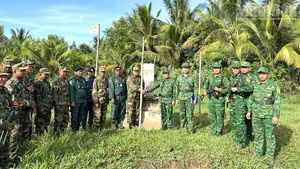
Therefore, it is necessary to continue building an all-people national defence posture, a people’s security posture, and a strong “people’s hearts and minds posture”; to protect the Fatherland early and from afar, before threats emerge; and to safeguard independence, sovereignty, unity, territorial integrity, and a peaceful, stable environment for national development.
It is also important to proactively identify, prevent, and effectively address both traditional and non-traditional security threats; ensure political security, social order and safety, cybersecurity, economic security, cultural security, and human security; and avoid passivity or strategic surprise under any circumstances.
At the same time, the foreign policy of independence, self-reliance, peace, friendship, cooperation, and development must be implemented consistently. International relations must continue to be diversified and multilateralised, while comprehensive, extensive, and effective international integration is actively promoted.
Efforts should also focus on enhancing Viet Nam’s position and prestige on the international stage. When national defence is strong, security is stable, and foreign relations are broad and open, the country will enjoy favourable conditions for sustainable development, and the people’s happiness will be protected from the earliest stage and at its very foundation.
Sixth, building a contingent of officials and Party members who are truly pioneering and exemplary – the key condition for realising the people’s happiness
In the new era, the people’s happiness depends not only on sound policies and guidelines but also to a large extent on the quality of implementation by officials and Party members. Officials are the ones who bring the Party’s policies and the State’s laws into practice; they serve as the bridge between the Party and the people; and they are responsible for resolving concrete issues directly affecting the people’s rights, livelihoods, and trust.
Therefore, every official and Party member must genuinely stay close to the people, understand them, respect them, and remain accountable to them. They must match words with actions, dare to think, dare to act, and dare to take responsibility for the common good, while resolutely combating bureaucracy, indifference, corruption, wastefulness, and group interests.
When the contingent of officials and Party members is clean, dedicated, capable, and driven by a spirit of contribution, all people-centred policies will be implemented more effectively, public trust will be strengthened, and a solid foundation will be created for building a prosperous, civilised, and happy society.
The historical experience of the Vietnamese revolution since the founding of the Communist Party of Viet Nam has demonstrated that national independence, freedom, prosperity, and happiness for the people are the Party’s highest objectives.
From the aspiration for national liberation to the process of Doi Moi (Renewal), every policy and guideline of the Party has been directed towards people, placing them at the centre, recognising them as both the subject and the driving force of development.
In the new era, the Party remains steadfast in its viewpoint that the people’s aspiration for happiness is both the goal and the source of strength that will propel the country towards prosperity, strength, and enduring development.