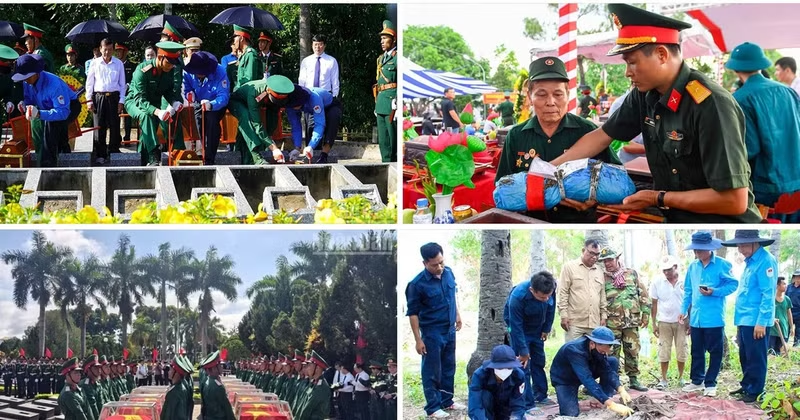
The Party, the State, the people and the Vietnam People's Army have consistently regarded the search for, recovery and identification of the remains of fallen soldiers as a task of exceptional political significance, reflecting the nation's enduring moral values and collective conscience.
The work has been carried out through a range of determined and coordinated measures, with stronger international cooperation serving as a crucial component in improving coordination in the search for and recovery of fallen soldiers' remains both within Viet Nam and overseas.
Although the war ended decades ago, today's generations continue the mission of searching for, recovering and identifying the remains of fallen soldiers with a profound sense of responsibility, gratitude and what has been described as "a calling from the heart". The effort has mobilised the entire political system in the shared aspiration of bringing the nation's fallen heroes home to rest in their homeland.
The 500-Day Campaign to accelerate the search for, recovery and identification of the remains of fallen soldiers is now entering its peak implementation phase nationwide.
The strong determination demonstrated by military units and local authorities reflects not only a professional responsibility but also the fulfilment of this "calling from the heart", as an estimated 175,000 fallen soldiers' remains have yet to be located, while more than 300,000 martyrs' graves remain unidentified. These figures represent an enduring source of grief for countless families and a matter of deep concern for the Party, the State, the armed forces and the Vietnamese people.

According to the National Steering Committee for the Search for, Recovery and Identification of Fallen Soldiers' Remains, thanks to the close attention of the Party and the State, together with the concerted efforts of ministries, sectors and local authorities, the remains of more than 1.075 million fallen soldiers have so far located and recovered.
During the 2021–2025 period, through the determined efforts and strong sense of responsibility of the Party, the armed forces and the people, particularly those directly engaged in search and recovery operations, 6,959 sets of remains were recovered, including 3,122 within Viet Nam, 938 in Laos, and 2,899 in Cambodia.
However, the search for, recovery and identification of fallen soldiers' remains continues to face considerable challenges.
It is estimated that more than 175,000 sets of remains still need to be located, including around 165,000 within Viet Nam and 10,000 overseas. In addition, nearly 300,000 graves in military cemeteries remain unidentified.
The task has become increasingly complex because the war was prolonged and fought under extremely harsh conditions, while the circumstances surrounding individual casualties varied greatly. Witnesses with first-hand knowledge are becoming fewer with the passage of time. Since the end of the war, many military units and local administrative bodies have been dissolved, merged, divided or undergone organisational restructuring.
In addition, the management, registration and handover of records relating to fallen soldiers, cemetery maps and recovery dossiers remain inadequate in some localities. Changes in terrain and landmarks over time, rapid urbanisation, the construction of industrial parks, and the continued presence of unexploded ordnance in many areas have further complicated search and recovery operations.
Furthermore, many relatives of fallen soldiers are now elderly and in poor health, while numerous fallen soldiers no longer have surviving next of kin. Natural factors have also significantly impacted the deterioration of remains. At the same time, Viet Nam's domestic capacity for DNA storage, preservation and analysis remains limited, creating additional challenges in the identification of fallen soldiers' remains.
")
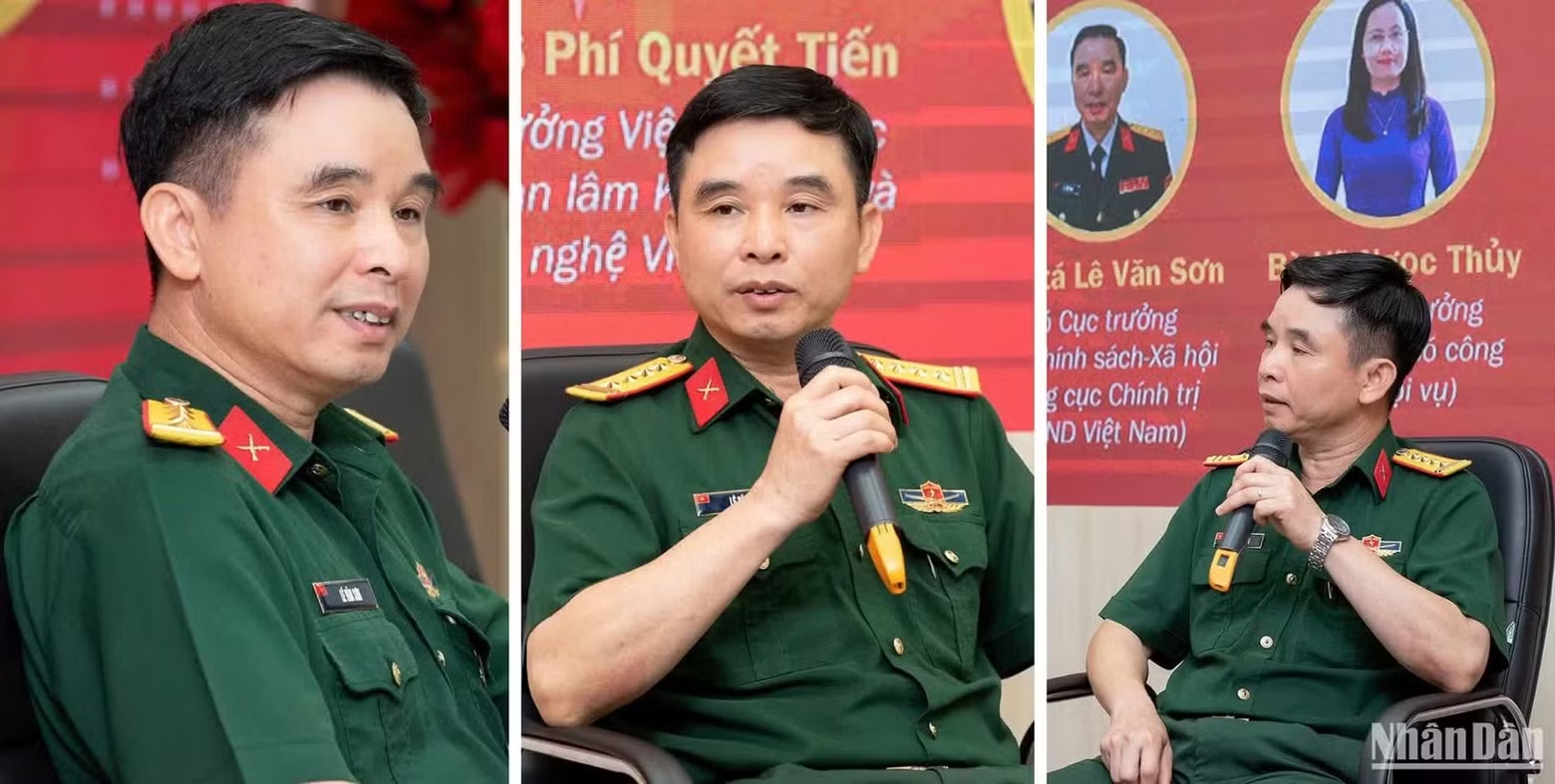
At the seminar entitled "Searching for, Recovering and Identifying the Remains of Fallen Soldiers – A Calling from the Heart", recently organised by Nhan Dan Newspaper, Colonel Le Van Son, Deputy Director of the Department of Policy and Social Affairs under the General Department of Political Affairs of the Viet Nam People's Army and Deputy Chief of Office of the National Steering Committee for the Search, Recovery and Identification of Fallen Soldiers' Remains, said the campaign had set five ambitious and comprehensive objectives.
These include recovering approximately 7,000 sets of fallen soldiers' remains; completing the collection of samples from around 230,000 unidentified martyrs' graves in military cemeteries as well as newly recovered remains; conducting DNA analysis on approximately 18,000 samples; establishing, completing and bringing into operation a genetic database of relatives of unidentified fallen soldiers to support DNA matching and identification; and accelerating the clearance of landmines and unexploded ordnance to facilitate search and recovery operations, particularly in key locations and core operational areas such as Vi Xuyen in Tuyen Quang Province, Lao Cai Province, Lang Son Province, and other areas where information on burial sites is available.
"These objectives and targets place extremely high demands on all relevant agencies and require an exceptional sense of responsibility. They call for decisive action through concrete programmes and implementation plans, as well as the concerted efforts of the entire political system, particularly the steering committees at all levels, with the Ministry of National Defence and the Ministry of Public Security playing the leading role," said Colonel Le Van Son.
To achieve the campaign's objectives, the Ministry of National Defence has assigned recovery targets to relevant units for the 2026–2027 period while maintaining the operations of 24 specialised search and recovery teams working in Viet Nam, Laos and Cambodia.
According to Colonel Le Van Son, under the leadership of the Party, the State and the National Steering Committee, together with the determined efforts of ministries, sectors, local authorities and the entire political system, the 500-Day Campaign has already delivered encouraging initial results.
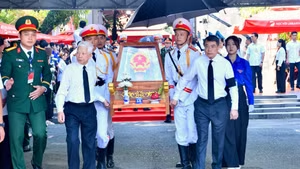
Nearly 100 days after its launch, the campaign has recovered 1,150 sets of fallen soldiers' remains, including 226 within Viet Nam, 139 in Laos, 745 in Cambodia, as well as three mass graves in Tuyen Quang Province. Memorial and burial ceremonies have also been held with solemn respect following each recovery, attended by leaders of the Party, the State, the armed forces, local authorities, socio-political organisations and members of the public paying tribute to the fallen.
To support search and recovery efforts through mine clearance, the Ministry of National Defence has established 360 clearance teams, comprising nearly 5,000 personnel and equipped with 1,131 pieces of specialised equipment. To date, they have cleared 4,076.6 hectares of a total 22,725 hectares, equivalent to 17.94% of the target area. In the core operational area of Vi Xuyen in Tuyen Quang Province, 1,994.5 hectares out of 4,460 hectares have been cleared, reaching 44.72% of the planned area. The participating units are striving to complete mine clearance in this priority area during 2026.
Regarding DNA sample collection, 34 provinces and centrally governed cities have established nearly 300 specialised sampling teams, involving more than 3,700 personnel. Pilot sample collection has already been completed and reviewed to draw operational lessons. Local authorities are now accelerating large-scale sampling of unidentified remains buried in military cemeteries nationwide.
Expanding international cooperation has become one of the key measures for improving the effectiveness of the search for and recovery of fallen soldiers' remains.
Colonel Le Van Son noted that Viet Nam has continued to cooperate closely with Laos and Cambodia in searching for and recovering the remains of Vietnamese volunteer soldiers and military experts who sacrificed their lives in those two countries. At the same time, Viet Nam has worked with countries whose armed forces participated in the war in Viet Nam to gather information on the original burial locations of fallen Vietnamese soldiers.
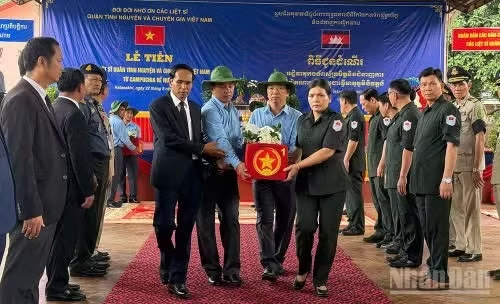
With regard to Laos, since 1993 the Governments of Viet Nam and Laos have established Special Task Committees to coordinate the search for and recovery of the remains of Vietnamese volunteer soldiers and military experts who lost their lives in Laos. Each year, the Special Task Committees of the two governments convene to review progress and agree on cooperation plans for the following year.
To date, the Special Task Committees of the Governments of Viet Nam and Laos have signed 31 records of discussions, while the Ministry of National Defence continues to maintain eight specialised recovery teams operating across all provinces of Laos in search of the remains of Vietnamese volunteer soldiers and military experts.
Meanwhile, the Governments of Viet Nam and Cambodia signed an agreement in 2000 establishing Specialised Committees to conduct the search for and recovery of the remains of Vietnamese volunteer soldiers and military experts who sacrificed their lives in Cambodia.
The Specialised Committees of the two governments have held annual meets to assess the results of cooperation and plan activities for the following year. To date, they have signed 24 records of discussions, while the Ministry of National Defence maintains 11 recovery teams operating throughout Cambodia.
At present, Viet Nam has, in essence, completed the search for and repatriation of the remains of Vietnamese volunteer soldiers who fell in Laos and Cambodia.
The Deputy Director of the Department of Policy and Social Affairs also noted that, with regard to countries whose armed forces participated in the war in Viet Nam, such as the US, Australia and Thailand, the Department of Policy and Social Affairs has advised the Ministry of National Defence and the National Steering Committee to further strengthen cooperation by requesting these countries to review and provide information relating to Vietnamese soldiers who were killed or went missing during the war, particularly personal effects and information concerning their original burial locations.
The Ministry of National Defence has signed a Memorandum of Understanding with the US Department of Defense and the US Department of State on addressing the consequences of war, which includes provisions for the sharing of information held by the US military on the burial sites of Vietnamese soldiers.
The Department of Policy and Social Affairs (under the General Department of Political Affairs of the Viet Nam People's Army), acting as the Office of the National Steering Committee, has also signed a Memorandum of Understanding with the Office of the United States Defense Attaché in Viet Nam on collecting and sharing information and personal artefacts relating to Vietnamese soldiers who were killed or went missing during the war in Viet Nam.
Since 1993, foreign individuals and organisations have provided Viet Nam with approximately 800,000 pages of documents containing information on the burial locations of Vietnamese soldiers. Based on these records, nearly 1,000 sets of fallen soldiers' remains have been recovered.
According to Colonel Le Van Son, in the coming years, the Department of Policy and Social Affairs will continue advising on the expansion of cooperation with countries whose armed forces participated in the war in Viet Nam, encouraging them to provide any information they possess regarding the burial sites of Vietnamese soldiers. He also proposed incorporating this area of cooperation into the overseas activities of senior Party and State leaders.
Talking about the decisive factor in enabling agencies, military units and local authorities to fulfil the objectives of the 500-Day Campaign, Colonel Le Van Son stressed that the foremost requirement is the active involvement of the entire political system, broad public support and, above all, the leadership of those in charge. When leaders at all levels attach importance to the mission, all sectors participate actively and the people lend their support, agencies, military units and local authorities will be able to accomplish the campaign's objectives.
He added that, throughout the implementation of the campaign, all relevant agencies, units and localities should pursue a comprehensive range of coordinated measures while focusing on several key priorities.
First, they should closely follow the Party's guidelines and the State's policies on the search for, recovery and identification of fallen soldiers' remains, as well as the campaign's objectives, while fostering a strong sense of determination among participating forces by recognising that this is not merely a political task but "a calling from the heart."
Second, they should accurately identify the challenges involved in achieving the campaign's objectives and formulate detailed, practical implementation plans. This includes identifying priority tasks and breakthrough measures, while ensuring adequate professional expertise, manpower, equipment, funding and logistical support.
Third, close coordination among all participating agencies is needed. All tasks should be carried out in accordance with the principle of "six clear requirements with responsibilities assigned to each force for every specific task. Progress should be reviewed regularly so that lessons can be drawn promptly and implementation effectiveness continuously improved.
With strong determination, decisive action and the united efforts of all participating forces, the 500-Day Campaign is expected to achieve positive results, fulfil its stated objectives and lay a solid foundation for future progress.