Defining strategic objectives
Never before has the issue of a Master Plan attracted such widespread public attention. From the close interest and decisive direction of the highest-level leadership of the Party and Government, as reflected in directives and resolutions such as Resolution No. 02-NQ/TW of the Politburo on “Building and Developing Ha Noi Capital in a New Era”, to the vibrant, dedicated and responsible exchanges, critiques and contributions from professional associations, architects, urban experts, journalists and all strata of the capital’s population, these inputs will be referenced and are awaiting approval by the Municipal Party Committee in the near future.
This highlights both the importance and the appeal of a strategic Master Plan aimed at reshaping and restructuring urban space so that Ha Noi becomes a “Cultured - Civilised - Modern - Happy” city, serving as the political–administrative centre of the nation, while also acting as a growth pole and a driving force for the Capital Region, the Red River Delta, the northern midland and mountainous regions, and national and international economic corridors. Looking ahead 100 years, Ha Noi is envisioned as a global city, a mega-urban centre that is “Cultured – Smart – Creative - Ecological”, exemplary on the world stage.
This is the first time in the history of urban planning in Viet Nam that Ha Noi Capital, the heart of the nation, has proactively proposed - and been granted by the central authorities - special authority to develop a Master Plan, in line with the reorganisation of administrative boundaries and the implementation of a two-tier local government system, replacing the two previously approved plans: the Capital Plan for the 2021–2030 period with a vision to 2050, and the adjusted General Master Plan to 2045 with a vision to 2065.
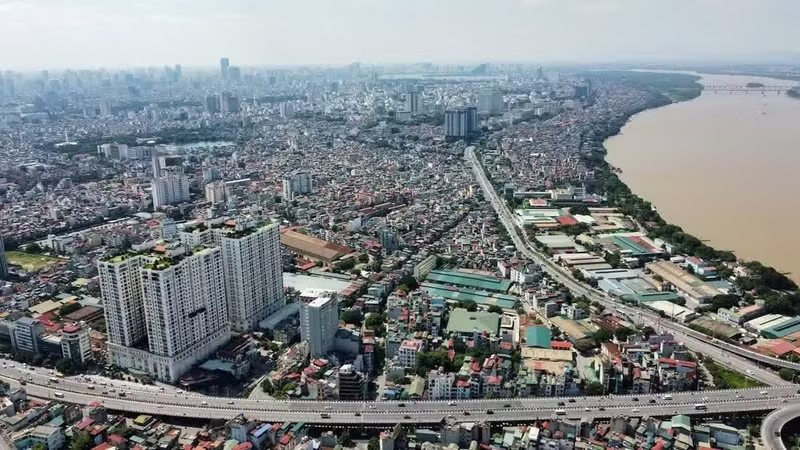
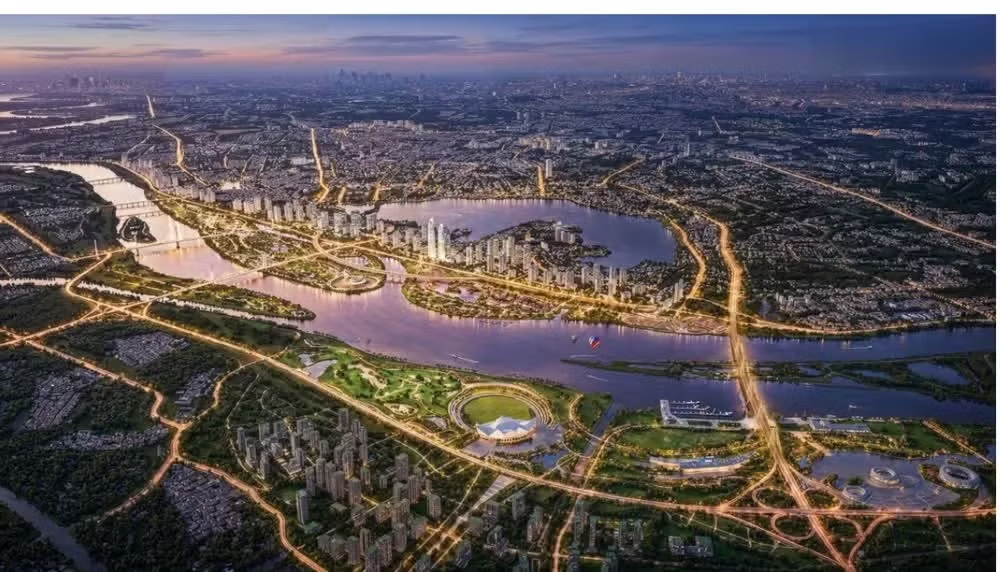
This Master Plan not only integrates previous plans but also defines strategic objectives with a long-term 100-year vision for Ha Noi to develop stably within an open spatial framework, shifting from “static” planning to modern “dynamic and open” planning, and from a “single-centre concentration” to a “multi-polar, multi-centre” urban model. This is associated with a “multi-layered, multi-tiered” urban structure aimed at rationally distributing population, production space, and service infrastructure, alongside the application of digital technology, artificial intelligence (AI), big data, and smart urban simulation platforms. In this vision, the Red River will serve as the main ecological–cultural landscape axis, shaping Ha Noi’s urban development space and closely linking it with the Capital Region.
The concept of “multi-polar, multi-layered, multi-tiered, multi-centre” as reflected in the Master Plan embodies a modern spatial and urban governance mindset, intended to replace the single-centre, sprawling planning model that has overburdened the urban core and revealed numerous limitations hindering Ha Noi’s sustainable development over recent decades. Accordingly, Ha Noi will no longer rely solely on a central core in the historic inner city but will form multiple growth poles in different directions, such as the western pole (My Dinh - Hoa Lac), the northern pole (Dong Anh - Soc Son), the eastern pole (Long Bien - Gia Lam), and the southern pole (Phu Xuyen…), thereby alleviating pressure on the central urban area (including the Old Quarter, the French Quarter, the Hoan Kiem Lake area, Ba Dinh, the Thang Long Imperial Citadel…), and creating spillover growth momentum for the Capital Region, in line with development trends in major Asian cities (megacities) such as Seoul (the Republic of Korea) and Tokyo (Japan).
A multi-centre model refers to reorganising the functional structure of the city. Each centre will have a primary function such as administration, finance, culture, logistics, education, or science–technology and innovation. The “multi-tiered, multi-layered” approach is a strategic structure to optimise space, addressing the challenges of urban development in a city with very high population density and increasingly limited land resources, while preserving heritage structures and avoiding encroachment on water bodies and green spaces. Instead, it promotes vertical utilisation of spatial resources (multi-tiered), including underground space, low-rise space and high-rise space, and integrates core values that define Ha Noi’s urban identity - namely, the thousand-year Thang Long cultural–historical heritage, landscape ecosystems, high-level economic ecosystems, and digitalisation within a unified spatial framework (multi-layered).
Addressing key challenges thoroughly
For the Master Plan to be implemented in practice, the city must undertake a wide range of tasks. First, the identification of multiple new growth poles remains largely at the level of spatial orientation, while mechanisms for resource allocation, specific economic roles, and the degree of autonomy of each pole have yet to be clearly defined. Without sufficiently strong financial and institutional policies, these “poles” may remain dependent on the existing central core, resulting in a situation of “formal multi-polarity but substantive mono-polarity”. Lessons from several Asian cities show that only when new poles have sufficient attractiveness in terms of employment, services and infrastructure can they truly become independent centres, as seen in Seoul’s satellite cities or Tokyo’s rail-based centre network.
Second, the “multi-layered” concept - one of Ha Noi’s strengths due to its rich historical depth - is facing the risk of being interpreted more as static preservation than dynamic integration. While the classification of heritage, modern urban areas and ecological spaces is necessary, without mechanisms for “layer interaction”, the city may become fragmented or even freeze heritage areas. In reality, many historical spaces in Ha Noi are being preserved in a static manner, lacking vitality. Therefore, the issue is not to maintain separate layers, but to create flexible mechanisms for transformation between them, so that heritage becomes a resource for development rather than merely an object of preservation.
Third, the “multi-tiered” approach is appropriate in the context of limited land resources but poses major challenges in terms of technology, finance and governance. The development of underground spaces, metro systems, or vertical urban organisation requires extremely large investment resources and complex operational capacity. Under current conditions, when Ha Noi’s technical infrastructure system still faces many shortcomings, there is a risk that the “multi-tiered” model will be implemented inconsistently, leading to conflicts between spatial layers, particularly between underground transport and drainage systems.
Fourth, there is a lack of a compatible governance framework. By nature, a multi-polar, multi-centre structure is a complex network system requiring regional coordination mechanisms, inter-sectoral linkages and strong decentralisation. However, Ha Noi’s current urban management system remains heavily administrative and territorially based, and has yet to meet the requirements of governance based on functional space. This may result in a lack of overall connectivity, reducing the effectiveness of the entire system. The Master Plan has not sufficiently taken into account market factors and social behaviour. While planning can define poles and centres, it is the choices of people and businesses that are decisive. If new areas are not attractive in terms of quality of life, employment and services, flows of people and capital will continue to concentrate in the central core.
Fifth, although the Master Plan reflects a breakthrough in long-term strategic thinking, it still has structural limitations, not only in content but also in its approach and feasibility. The plan sets highly ambitious objectives, yet the tools to translate these objectives into concrete actions remain unclear, such as issues of flood control, water security, and the restructuring of populations outside the dyke areas in implementing the Red River landscape boulevard axis. The lack of phased development scenarios, mechanisms for resource allocation, and especially “trigger points” with a leading role may cause the plan to remain at the level of general orientation.
Another issue is that the multi-polar urban model, while theoretically sound, lacks sufficient practical grounding. The identified growth poles in the Master Plan do not yet have strong enough socio-economic foundations to operate independently. At present, the central urban core still dominates in terms of employment, services and infrastructure. Without decisive mechanisms for reallocating resources, the multi-polar model risks existing only on paper, while in reality the city remains an expanded mono-centric urban area. The Master Plan has not thoroughly addressed the relationship between Ha Noi and the Capital Region. The role of neighbouring provinces in economic value chains, population distribution and infrastructure sharing has not been clearly defined. This creates the risk that Ha Noi will continue to “absorb” resources and population, while surrounding areas fail to develop correspondingly. Similarly, while the Master Plan pursues a compact urban model and the protection of green belts, it has not provided sufficiently strong mechanisms to control land conversion pressures from the real estate market. Without effective management tools, ecological spaces are highly vulnerable to encroachment, leading to environmental imbalance - an issue that long-term planning must address proactively.
To ensure that the Master Plan does not remain merely on paper, a corresponding governance model is required. Issues related to decentralisation, urban finance, data governance and community participation need to be concretised. These very factors will determine whether the plan can flexibly adapt to unpredictable changes brought about by climate change and global geopolitical developments, which impact the sustainable development of the country as a whole and Ha Noi in particular.