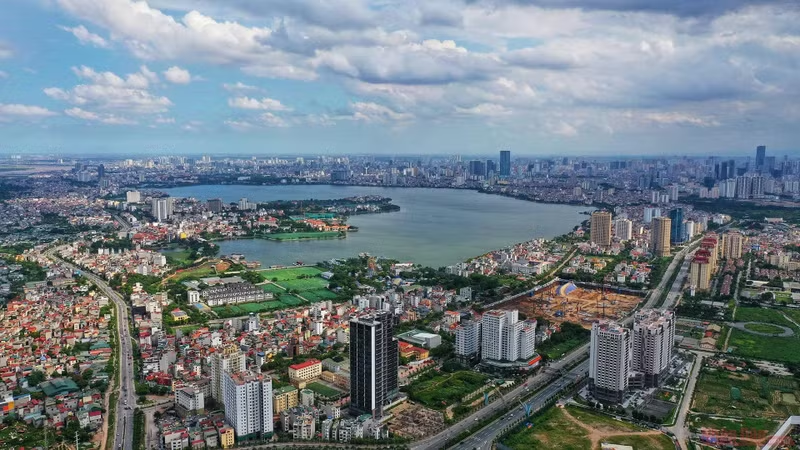
With a vision extending to 100 years for this capital master plan—instead of the 20 or 30 years typical of previous schemes—this strategy is designed to lay a solid foundation for the city’s sustainable development and prosperity.
Ha Noi has previously set ambitious goals, but various influencing factors have meant that many schemes have not been deemed truly successful, particularly in their implementation.
Amid challenges such as chronic traffic congestion, frequent flooding, worsening environmental pollution, and the gradual erosion of its urban identity, the new master plan—with its long-term vision—represents a fundamental shift from “preservation and renovation” to “value reconstruction.” It forms a new spatial structure to unlock land resources, create fresh developmental values, and fundamentally address infrastructure bottlenecks.
The new master plan—with its long-term vision—represents a fundamental shift from “preservation and renovation” to “value reconstruction.”
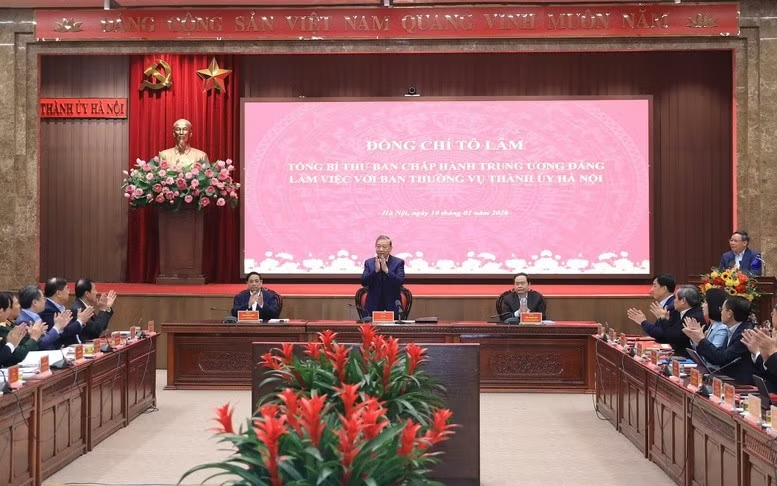
At a working session with the Standing Board of the Ha Noi Party Committee on January 10, 2026, Party General Secretary To Lam requested that Ha Noi’s 100-year master plan must embody intelligence, responsibility, and development aspirations, adding that today’s planning will shape the capital 50 to 100 years into the future.
He broadly endorsed the major directions of the master plan and emphasised seven key principles: integrating the capital into the national development strategy; placing people at the centre, with quality of life as the ultimate benchmark; balancing modernity with tradition and expansion with preservation; planning with a long-term, forward-looking vision; positioning Ha Noi as a national hub of creativity, knowledge, and innovation; ensuring defence, security, and social safety; and conducting a scientific, democratic, transparent, and inclusive planning process free from short-term or vested interests.
Nguyen Duy Ngoc, Politburo member and Secretary of the Ha Noi City Party Committee, requested that the spatial development proposals for Ha Noi in the Capital Master Plan must be stable, comprehensive, strategic, sustainable, with a 100-year vision and beyond.
The Ha Noi Party chief affirmed that the capital's development orientations must be placed within inter-regional and neighbouring local relationships, shaping the capital's leading and locomotive role.
On that basis, the capital master plan should propose truly superior, unique mechanisms and policies for the city, addressing major issues with no precedent, going beyond the current legal institutional framework to promote strong, comprehensive powers for the capital to realise the 100-year vision and properly fulfil its position, making contributions to the nation's development in this era of national rise.
Ha Noi’s 100-year master plan must embody intelligence, responsibility, and development aspirations, adding that today’s planning will shape the capital 50 to 100 years into the future.
Party General Secretary To Lam
Deputy Permanent Chairman of the Ha Noi People's Committee, Dang Duc Tuan, stressed that the scheme needs to address pressing issues facing the city, particularly traffic congestion, flooding, environmental pollution, green space management, public spaces, and population distribution.
In reality, a long-term vision is not mere “theory” but has been proven in developed cities worldwide, where long-term planning brings sustainable prosperity, high resilience, and superior quality of life.
Singapore is evidence of such a vision with its long-term planning framework. Singapore's urban planning system, managed by the Urban Redevelopment Authority (URA), is built on two main levels: the long-term strategic plan and the detailed land use plan.
Accordingly, the Long-Term Plan sets strategic development directions for the next 40 to 50 years and beyond. This provides the overarching framework for the country's physical transformation. The Detailed Planning level corresponds to the medium- and short-term implementation phase.
The master plan ensures land is rationally allocated for housing, industry, commerce, transport, and green spaces, while providing forecasts for population and future economic needs. To maintain scientific rigour and flexibility, the master plan is reviewed every 10 years, allowing adjustments based on actual changes.
Dr Architect Dao Ngoc Nghiem, former Director of Ha Noi's Department of Planning-Architecture, noted that Ha Noi needs to clarify the 100-year direction to define the vision and goals clearly.
The capital has gone through eight general planning exercises; these will be very valuable lessons to evaluate and learn from for this planning round.
Architect Tran Ngoc Chinh, Chairman of the Viet Nam Urban Planning and Development Association, has paid special attention to solutions for the current traffic congestion situation. He believes that with a population of over 10 million, Ha Noi must have a modern, synchronised public transport system, particularly a transit-oriented development (TOD) urban model to connect satellite cities.
The capital's development orientations must be placed within inter-regional and neighbouring local relationships, shaping the capital's leading and locomotive role.
According to experts, developing satellite cities not only solves population dispersal but also creates conditions to develop and sustain a large-scale public transport system. Alongside that, it also establishes an ecosystem of employment, services, and synchronised infrastructure.
Ha Noi’s 100-year vision plan faces major existing challenges such as inner-city population pressure, implementation discipline, and financial resources.
With a long-term strategy, not only transport infrastructure, social infrastructure, and smart urban development, Ha Noi must also realise the important goal of preserving and promoting heritage and cultural values, including green spaces and traditional craft villages.
With changes in vision, planning mindset, and those obtained from special policies, Ha Noi can establish a special planning framework with major directions and aspirations. To realise the master plan, the city needs to ensure flexibility and practical updates, but effectively prevent arbitrary planning adjustments.
The implementation of a scheme with a 100-year vision requires a consistent roadmap with a prerequisite condition—not letting short-term thinking flare up in planning.