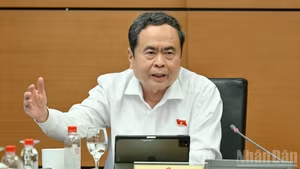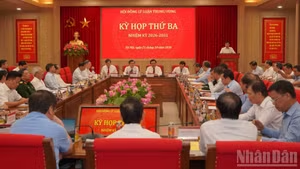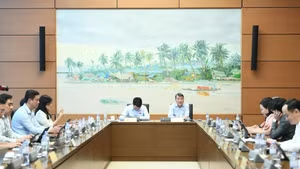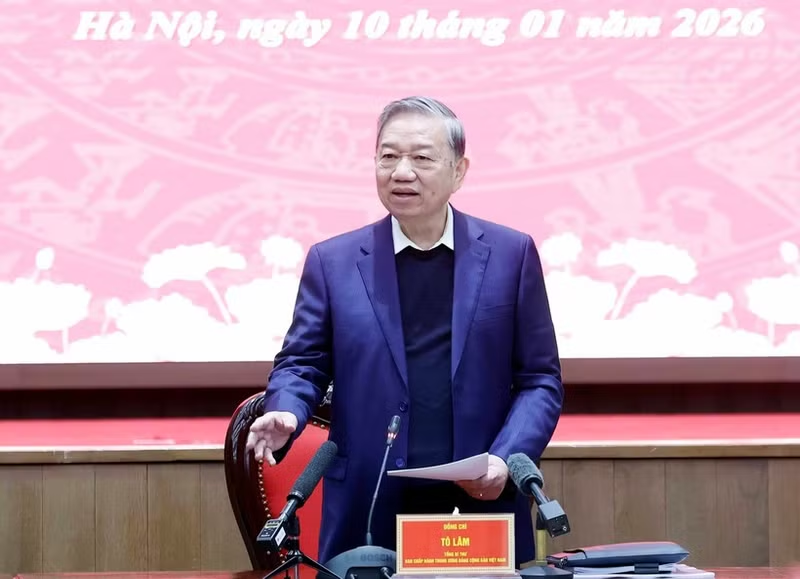
The Party chief made the requirement at a working session with the Standing Board of the Ha Noi Party Committee on January 10 to discuss a proposal for a master plan with a 100-year vision for the capital city, institutional reforms, a projected socio-economic development model, and double-digit growth target.
During the meeting, the Party leader applauded Ha Noi for its comprehensive development achievements in 2025, noting that the municipal Party Committee had focused its leadership on addressing long-standing and pressing issues of the capital, including traffic congestion, environmental pollution, flooding, urban order, and food safety.
He highlighted the rapid and urgent progress in land clearance and the implementation of long-delayed urban infrastructure projects, saying these changes demonstrate that Ha Noi is developing a leadership and governance approach grounded in discipline and tangible effectiveness.
General Secretary Lam noted that despite its vast untapped potential, Ha Noi continues to face challenges in traffic, environmental management, resource-use efficiency and governance quality, stressing that recent improvements must be further strengthened and translated into concrete and measurable results to meet the capital’s development requirements and contribute to implementing the 14th National Party Congress’s resolution.
Vietnam is at a historic development turning point, in which Ha Noi plays a particularly critical role, he said, stressing that the capital cannot develop with the mindset of a large locality but must be positioned and operated as a national development hub, playing a leading role in shaping new development models and mindsets.
According to the Party chief, Ha Noi’s success in areas such as urban governance, spatial planning, traffic, pollution and flood control, public investment discipline, administrative reform, and digital transformation will shape the approaches and practices of other localities nationwide. Any delay in Ha Noi’s progress could hold back the entire country, he stressed.
Ha Noi’s 100-year master plan must embody intelligence, responsibility, and development aspirations, he said, adding that today’s planning will shape the capital 50 to 100 years ahead.
General Secretary Lam broadly endorsed the major directions of the master plan, and emphasised seven key principles for the plan - integrate the capital into the national development strategy; place people at the centre with quality of life as the ultimate benchmark; balance modernity with tradition and expansion with preservation; plan with a long-term, forward-looking vision; position Ha Noi as a national hub of creativity, knowledge, and innovation; ensure defence, security, and social safety; and conduct a scientific, democratic, transparent, and inclusive planning process free from short-term or vested interests.
Regarding institutional development, he hailed Ha Noi’s proactive efforts in reviewing, evaluating, and proposing a new resolution of the Politburo on Ha Noi’s construction and development, replacing Resolution No. 15-NQ/TW dated on May 5, 2022 of the Politburo, which set development directions through 2030 with a vision to 2045, thereby strengthening the city’s political foundation. He also commended the proposed amendments to the Capital Law, comprising four major groups and 31 policy mechanisms.
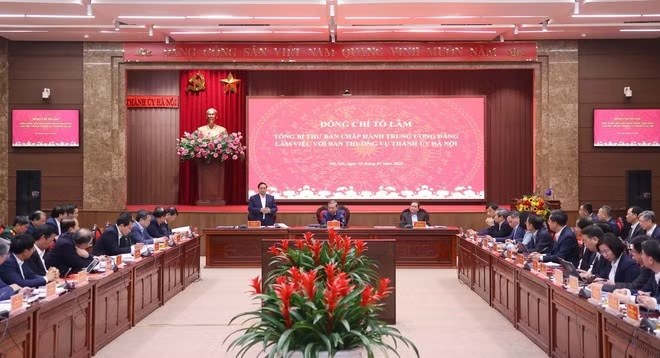
Building and perfecting the institutional framework for Ha Noi’s development is a key breakthrough, crucial for its long-term growth and quality, he stressed, noting that without suitable institutions, there can be no effective planning, and without outstanding institutions, there can be no exceptional development space.
General Secretary Lam stated that the current amendments to the Capital Law must ensure the guiding principle of “greater empowerment – more comprehensive decentralisation – clearer accountability.”
Amending the Capital Law is not solely Ha Noi’s responsibility but a shared duty of the National Assembly, the Government, and relevant ministries and sectors to remove legal barriers and ensure a consistent and unified legal system, he said, urging central agencies to support and enable Ha Noi with sufficient legal space, tools, and authority to fulfill its role as the driving hub for development of the capital region and the whole country.
He requested the municipal Party Committee and central agencies to closely coordinate in finalising these key documents, submit a new resolution on capital development to the Politburo for promulgation; and present the new Resolution 15, the amended Capital Law, and the Ha Noi’s master plan to the NA.
For establishing a new growth model and measures to achieve double-digit growth, the Party leader asked Ha Noi to unlock new drivers and remain committed to continuous double-digit growth, with an immediate target of at least 11% growth in 2026.
He emphasised that achieving this target does not depend on expanding scale at any cost, but on establishing a new growth model driven by labour productivity through knowledge, science and technology, innovation, digital transformation, and high-quality human resources.
Ha Noi’s new growth model must be closely linked to institutional reform, a significantly improved business environment, talent attraction and retention, the creation of growth hubs, innovation spaces, and ecosystems, thereby generating sustainable development momentum.
Supporting Ha Noi’s measures to enhance decentralisation and address five major bottlenecks—flooding, traffic congestion, urban order, environmental pollution, and food safety—the Party chief stressed the need to grant the maximum authority for Ha Noi to act independently rather than await multi-level approvals.
According to reports presented at the session, Ha Noi’s master plan will explore expanding interaction spaces with the Red River Delta, the Northern midlands and mountainous regions, and the Ha Noi urban area. Beyond regional planning, it will focus on addressing the city’s bottlenecks related to transport and urban infrastructure, urban management, and the environment.
Regarding socio-economic development and double-digit growth, the city plans to pursue a coordinated approach across three pillars - economy, environment, and society. For 2026–2030, it identifies science and technology, innovation, and the digital economy as main growth drivers. Technological innovation will generate new economic productivity through four pillars - institutions; digital infrastructure and smart platforms; effective governance and digital government; the digital economy and new growth drivers; and digital society and social welfare.
Development will be based on an integrated approach linking culture, economic space, and people, while effectively leveraging cultural values, heritage, and landscapes. Tourism, particularly cultural tourism, will serve as a key economic sector.
Attention will also be paid to improving the investment and business environment; attracting investment; using public investment to drive private and foreign direct investment projects; developing the private sector; enhancing the efficiency of state-owned enterprises; and promoting production and business activities.
The capital city plans to generate new growth drivers through its two-tier local administration, with each commune and ward developing economic plans to fully tap local potential and comparative advantages, participate in supply chains, and promote linked production and business development.