To ensure that this determination quickly translates into tangible results and has an effective impact on people’s lives, many experts believe that Hanoi needs a comprehensive action program, with a leading agency possessing full organizational, coordination, and implementation capabilities.
Determination to address pollution
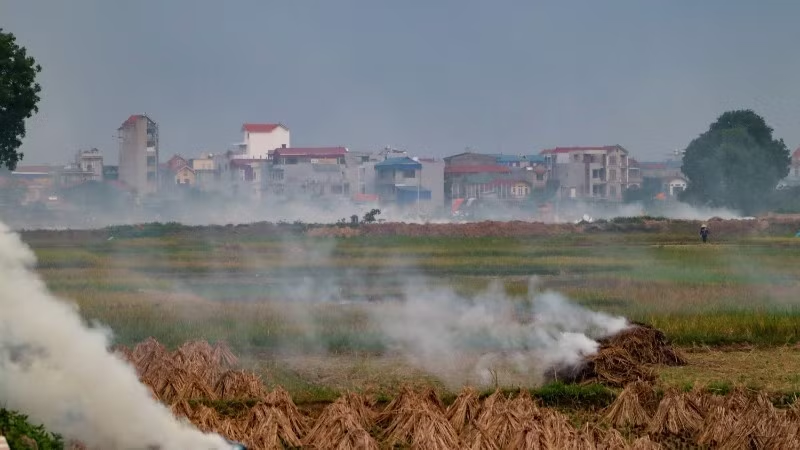
Reports from the Ha Noi People’s Committee, the Ministry of Agriculture and Environment; and research results from experts and scientists… all clearly indicate that the causes of air pollution stem from vehicles; construction activities; burning of waste, scrap materials, and straw by residents; factories and production facilities; and recycling villages near densely populated inner-city areas. In particular, air pollution in Ha Noi also has additional causes from production, recycling, and construction activities in neighbouring localities.
Furthermore, the prolonged air pollution is partly due to the negligence, irresponsibility, and incompetence of some relevant agencies, organisations, and individuals; from the lack of penalties for environmental violations to the lack of uniformity in legal regulations as well as infrastructure and technology…
On July 20, 2025, the Prime Minister issued Directive No. 20/CT-TTg on “Some urgent and decisive tasks to prevent and resolve environmental pollution.” Accordingly, the Prime Minister requested and assigned responsibility to central ministries, agencies, and localities to implement the tasks in a specific, clear, synchronised, and consistent manner throughout the implementation process. On November 19, 2025, the Prime Minister issued Decision No. 2530/QD-TTg approving the National Action Plan on pollution remediation and air quality management for the 2026-2030 period, with a vision to 2045.
This Decision also stipulates the tasks of relevant ministries and agencies to finalise legal documents; set specific goals and responsibilities in the task of preventing and mitigating pollution for each specific criterion in each locality; The Prime Minister assigned the Ministry of Agriculture and Environment to lead the development of a plan to establish a National Steering Committee on Air Pollution Remediation. He also requested the development and operation of a “National Air Pollution Warning, Forecasting, and Control System,” and the strengthening of inspections and strict handling of violations of environmental protection laws.
Decision No. 2530/QD-TTg also clearly states that the Ha Noi Capital Region faces many shortcomings that the National Steering Committee on Air Pollution Remediation needs to decisively address.
Ha Noi needs a comprehensive approach with a roadmap
According to experts, without a breakthrough and a strong transformation in the approach and treatment of the “root cause” of air pollution, the problems of the Capital Region cannot be completely and thoroughly resolved. In March 2025, at the Ha Noi Capital Environmental Protection Workshop, experts and scientists affirmed that addressing air pollution in Ha Noi requires a comprehensive, multi-sectoral, synchronised approach with a clear roadmap. Therefore, solutions need to be designed in large groups, assigning specific responsibilities to each target group and sector.
Ha Noi needs a breakthrough, multi-sectoral, multi-level, and multi-local approach based on digital platforms to improve air quality. First and foremost, strict control of emissions from transportation is crucial, considering this a key breakthrough.
Dr. Hoang Duong Tung, Chairman of the Viet Nam Clean Air Network
Dr. Hoang Duong Tung, Chairman of the Viet Nam Clean Air Network, believed that Ha Noi needs a breakthrough, multi-sectoral, multi-level, and multi-local approach based on digital platforms to improve air quality. First and foremost, strict control of emissions from transportation is crucial, considering this a key breakthrough. Road transport is identified as the largest source of emissions (accounting for 56%). Therefore, controlling vehicle emissions needs to be central to the air quality improvement strategy.
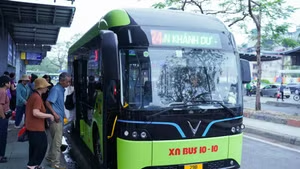
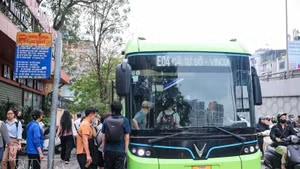
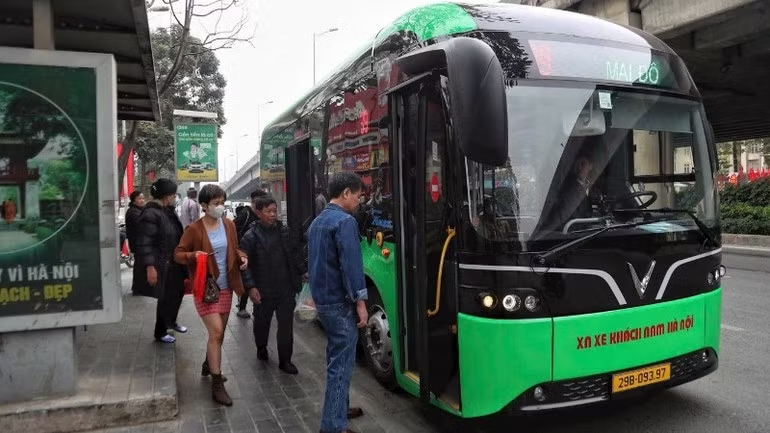
Along with that, it is necessary to strongly develop public transport and promote the transition from fossil fuel vehicles to green vehicles, investing in synchronised infrastructure for charging stations, terminals, and technical conditions, as well as fire prevention and control measures for electric vehicles.
Another important set of solutions is controlling dust and emissions from construction and urban infrastructure activities. Construction and repair projects for transportation infrastructure need to have surveillance cameras, be strictly shielded, and have tight control over the transportation of materials and vehicle washing before leaving the construction site. In addition, increasing the planting of green trees in the inner city, especially in areas along traffic routes with high traffic density and pollution levels, also contributes to absorbing and dispersing emissions.
Regarding pollution sources from industrial production and recycling villages, the focus is on strictly controlling facilities using fossil fuels, establishing a roadmap for transitioning to clean fuels, improving technology accompanied by financial support mechanisms, and gradually eliminating boilers and kilns using coal combustion; Planning and relocating polluting or potentially polluting facilities away from urban areas is necessary. Strict enforcement of regulations prohibiting open burning is required, along with increased public awareness campaigns and the implementation of measures to support rural residents in handling by-products and waste in a circular economy manner.
Improving the air quality monitoring, forecasting, and warning system is crucial. According to Associate Professor Dr. Nguyen Duc Luong, Head of the Environmental Engineering Department at Ha Noi University of Civil Engineering, the current monitoring stations are concentrated only in the inner city, and the data is incomplete, hindering continuous monitoring. Therefore, further investment is needed to improve the network of automatic, continuous air quality monitoring, expanding its coverage to both inner and outer city areas.
Based on this, an early warning and forecasting system should be developed, enabling authorities to proactively respond to severe pollution episodes and provide timely information to the public for prevention. Air quality criteria should be included in resolutions, as one of the socio-economic development criteria of localities, linked to the responsibilities of each level, sector, and leader; and coordination in addressing the issue across regions should be strengthened.
According to Professor Dr. Trinh Van Tuyen, Chairman of the Environmental-Energy Science Council of the Viet Nam Academy of Science and Technology, although various solutions have been proposed, the crucial factor is identifying pollution using complete and reliable measurement data to calculate and select appropriate solutions for each emission source.
Observing Ha Noi’s air pollution control efforts over the past period, Professor Tuyen believes that the solutions lack coordination between different sectors and fields. To definitively solve the problem, a “master architect” is needed for Ha Noi’s air quality. This central authority must have sufficient power and capacity to develop a comprehensive plan, clearly defining the roadmap, resources, and responsibilities of each sector and unit.
This role should be socialised. The State could entrust this task to an organisation or enterprise under strict supervision. This organisation can bring together scientists and experts, and has the full capacity and authority to implement the plan in practice, rather than just making proposals on paper.


![[In Pictures] Bridge columns and underpasses in Ha Noi begin to turn green](https://en-cdn.nhandan.vn/images/nyM650OGFWrOVWc-xajqN-rTZ68Rlmc1fiGJOhBRYHH_N-Xs0TE8Psnfce7ORTs-KVfoJaEblqjNufFrgeF3e2xFkGtLQVaXm04VcmMKBEkANUyiOkpz4zAuIKgydVrrfBxmGez0E_YJIag0u_Uil0E7jpuJXsIxeMmGjoY1-W4/1791863309074-2994714492692222878-2994714492692222878-adb9ff3f4175c70066ed8bb80cfbead9.jpg.avif)