Several areas across the city reported concerning AQI readings: Quang Khanh station recorded 295, Hai Ba Trung station reached 250, and Ha Bang Commune stood at 222. Many other inner-city districts, such as Thanh Xuan, Tay Ho, and Vinh Tuy, also reported levels considered harmful to public health. Previously, Ha Noi had multiple instances of being listed among the ten most polluted cities in the world.
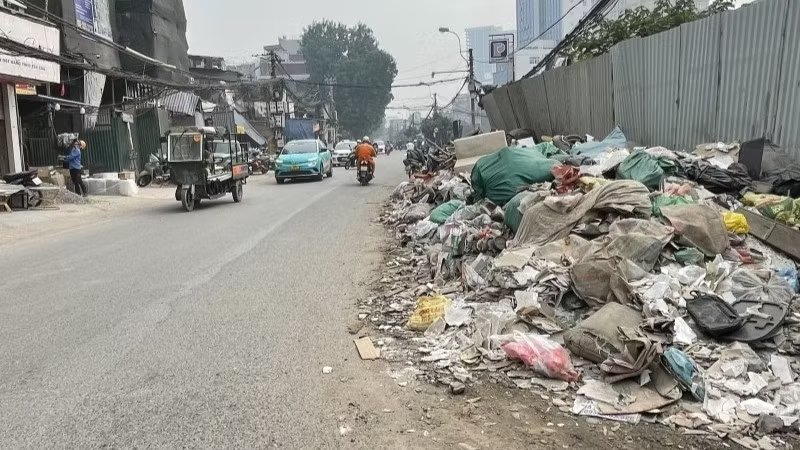
The main causes of air pollution in the capital include emissions from millions of vehicles running on fossil fuels, increased construction and urban refurbishment activities, as well as the burning of straw and votive paper.
In addition, winter weather patterns characterised by low rainfall and still air prevent the dispersion of pollutants, causing them to accumulate at low altitudes for prolonged periods, and resulting in severe pollution.
In recent years, Ha Noi has implemented a wide range of measures to reduce air pollution, including dust reduction and waste management at construction sites; phasing out honeycomb coal stoves; banning the burning of straw and agricultural by-products; and introducing low-emission zones with a focus on encouraging the use of electric cars and motorbikes while restricting petrol- and diesel-powered vehicles.
Most recently, the Ha Noi Party Committee issued a programme to implement the Resolution of the 18th Congress of the Municipal Party Organisation for the 2025–2030 tenure, reaffirming its determination to resolve water and air pollution once and for all.
The Ha Noi People’s Committee has instructed departments, agencies, and localities to strengthen the enforcement of urgent measures on air pollution control.
The city has also drawn up a roadmap and list of industrial production facilities that must be relocated out of the inner districts. The Department of Construction has been tasked with strictly supervising investors and contractors to ensure that 100% of construction sites carry out covering measures, vehicle washing, and mist spraying to reduce dust. Projects covering more than 10,000 square metres are required to install automatic dust-monitoring systems and additional coverings to prevent dust dispersion into the environment.
Traffic Police and Environmental Police have intensified inspections and penalties for vehicles that are overdue for inspection, emit black smoke, or transport materials without proper covering, causing debris to fall onto the road.
Local authorities have increased the frequency of street sweeping, vacuuming, and washing, and strengthened monitoring and handling of illegal burning of household waste, straw, and agricultural residues. The city is using technology to monitor, detect, and strictly penalise unauthorised burning of waste and agricultural by-products.
Despite these efforts, Ha Noi’s pollution-reduction measures have not yet achieved the desired results.
To tighten air pollution control, Ha Noi needs, in parallel with ongoing urgent actions, to prioritise research and improve the quality of studies on emission sources.
Scientific research will provide the basis for suitable solutions to reduce pollutant emissions.
In addition, the city must frankly acknowledge several limitations. For example, the handling of certain pollution-causing activities has not been sufficiently stringent.
Notably, many construction sites and vehicles transporting construction materials or waste only implement superficial and inadequate covering measures without facing penalties; meanwhile, enforcement against motor vehicles emitting pollutants beyond permissible limits remains insufficient.
Only through a combination of rigorous scientific research and strict implementation of measures can a solid foundation for reducing pollution be established.
Ha Noi once struggled with heavily polluted rivers, but the revitalisation of the To Lich River demonstrates that when Party committees and local authorities mobilise resources in a scientific and systematic manner, the aquatic environment, particularly that of the To Lich River, can be significantly improved, meeting public expectations.
The lessons learned from addressing river and lake pollution should be applied to tackling air pollution.