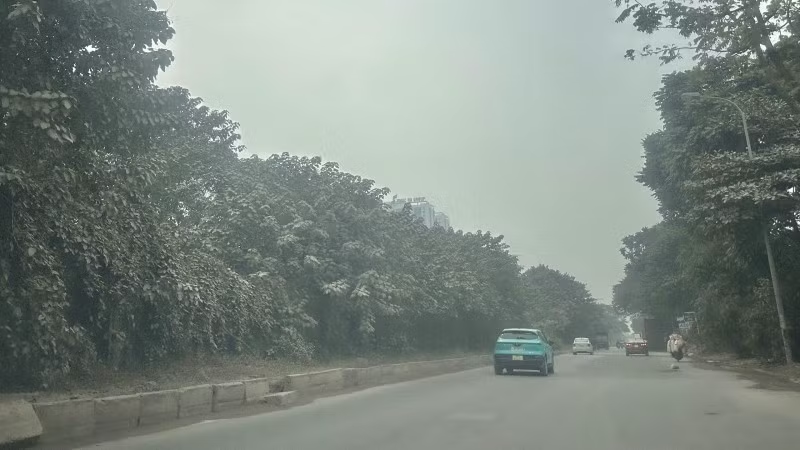
WHO estimates that air pollution contributes to around 7 million premature deaths each year, with nearly 99% of the world’s population living in environments where air quality fails to meet recommended standards.
Synthesised studies published in leading scientific journals such as The Lancet and Nature show that Asia continues to be the most severely affected region, both in terms of exposure levels and the number of deaths linked to air pollution.
In 2025, densely populated cities including Tehran in Iran, Baghdad in Iraq, New Delhi and Kolkata in India were forced on multiple occasions to close schools and suspend public activities when air quality indices exceeded 160, a level considered “unhealthy” for the entire population.
Air pollution is currently the leading cause of premature death in India, the world’s most populous country, with deaths linked to the use of fossil fuels, particularly coal, accounting for around 44%. China, despite making significant progress in controlling pollution in major cities such as Beijing and Shanghai, continues to face high pollution levels in many industrial areas and second-tier cities, where growth and energy consumption still rely heavily on fossil fuels.
The World Bank (WB) has warned that countries such as Bangladesh, Pakistan and Indonesia risk becoming new pollution hotspots in the near future due to rapid urbanisation, rising energy demand and limited environmental management capacity.
Air pollution is also present in developed countries in North America and Europe. Large-scale wildfires in Canada generated dense smoke that blanketed many major cities in the US for weeks. European capitals such as Paris, London and Milan, along with numerous industrial cities in Germany and Poland, have experienced prolonged pollution episodes driven by traffic, fossil fuel-based heating and extreme heat.
The WB estimates that many countries incur billions of USD each year in healthcare costs, reduced labour productivity and economic losses caused by premature deaths related to air pollution.
In recent years, many countries have implemented strong measures to improve air quality. The European Union has promoted energy transition, enforced strict emissions standards and encouraged sustainable transport. China is regarded as one of the countries achieving clear results in reducing air pollution by tightening emissions controls in transport and industry, developing air quality warning systems and shifting towards clean energy while restructuring highly polluting industries.
However, these efforts have so far only slowed the deterioration of air pollution rather than reversing the trend, largely due to constraints imposed by current growth models. In many developing economies, demand for energy, transport and industrial production is rising faster than emissions control capacity. Meanwhile, developed countries, despite leading in environmental policy, remain vulnerable to extreme climate impacts such as prolonged heatwaves and wildfires.
Scientists and international organisations have warned that failure to achieve net-zero emissions by 2050 will expose the world to severe environmental, economic and social consequences, including uncontrollable climate crises with frequent deadly heatwaves, melting ice and sea levels rising by several metres, threatening to erase coastal cities and devastate ecosystems.
Yet without waiting for long-term climate scenarios, hundreds of millions of people worldwide are already experiencing the consequences of air pollution in their daily lives, from school closures and traffic restrictions to rising healthcare costs and declining labour productivity.
Controlling air pollution therefore requires a more comprehensive approach, more timely and decisive action, ranging from energy transition and sustainable transport to improved urban governance, stronger international cooperation and equitable access to clean technologies.