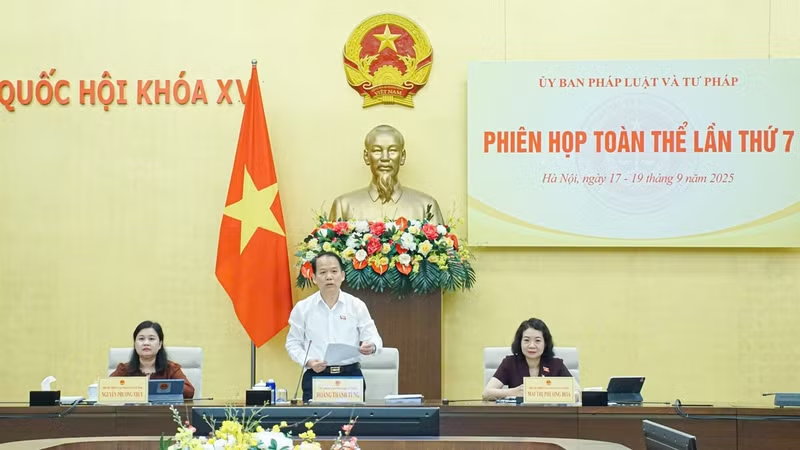
1. To examine draft laws, ordinances, and resolutions of the NA and the NA Standing Committee in the areas of state apparatus organisation, administration, civil and criminal law, judicial procedures, enforcement of judgments, implementation of preventive measures, judicial support activities, anti-corruption and anti-negative practices, mutual legal assistance, extradition, transfer of persons serving prison sentences, and other reports, projects, or proposals within its remit or assigned by the NA or its Standing Committee.
2. To take the lead in reviewing petitions from the Ethnic Council and the Committees of the National Assembly, as well as proposals from the President, the Government, the Supreme People’s Court, the Supreme People’s Procuracy, the Central Committee of the Viet Nam Fatherland Front, central bodies of member organisations of the Front, or National Assembly deputies concerning legal documents that show signs of being inconsistent with the Constitution.
3. To take the lead in reviewing proposals concerning the establishment or dissolution of ministries, ministerial-level agencies, and other bodies established by the National Assembly; proposals concerning the establishment or dissolution of People’s Courts, Military Courts, People’s Procuracies, and Military Procuracies, as well as military regional security investigation agencies and equivalent bodies, military regional criminal investigation agencies and equivalent bodies, and regional criminal investigation agencies; proposals on the establishment, dissolution, merger, division, boundary adjustment, and renaming of administrative units; proposals of the Chief Justice of the Supreme People’s Court regarding the approval of the appointment, dismissal, or removal of Justices of the Supreme People’s Court; and proposals of the President regarding general amnesty.
4. To supervise the implementation of the Constitution, laws, and resolutions of the NA, and ordinances and resolutions of the NA Standing Committee; to oversee the activities of the Government, ministries, ministerial-level agencies, the Supreme People’s Court, and the Supreme People’s Procuracy within the areas under the Committee’s responsibility; and to supervise the detection and handling of acts of corruption and negative practices.
5. To supervise normative legal documents issued by the Government, the Prime Minister, ministers, and heads of ministerial-level agencies, the Chief Justice of the Supreme People’s Court, the Prosecutor General of the Supreme People’s Procuracy, and the Council of Judges of the Supreme People’s Court within the areas under the Committee’s responsibility.
6. To propose matters related to improving the organisation of the state apparatus; issues concerning administration, civil and criminal law, judicial procedures, enforcement of judgments, implementation of preventive measures, judicial support activities, anti-corruption and anti-negative practices, mutual legal assistance, extradition, transfer of persons serving prison sentences, protection of the Constitution and the law, ensuring the consistency of the legal system, and other matters within the areas under the Committee’s responsibility.
7. To submit draft laws and resolutions to the NA, and draft ordinances and resolutions to the NA Standing Committee in fields under the Committee’s responsibility.
8. To perform other duties as assigned by the NA and the NA Standing Committee.