Through various communication channels, ethnic minority communities have clearly understood the election schedule and the list of candidates, and are eagerly awaiting the day to vote in order to exercise their rights and obligations as citizens.
Diversifying forms of communication
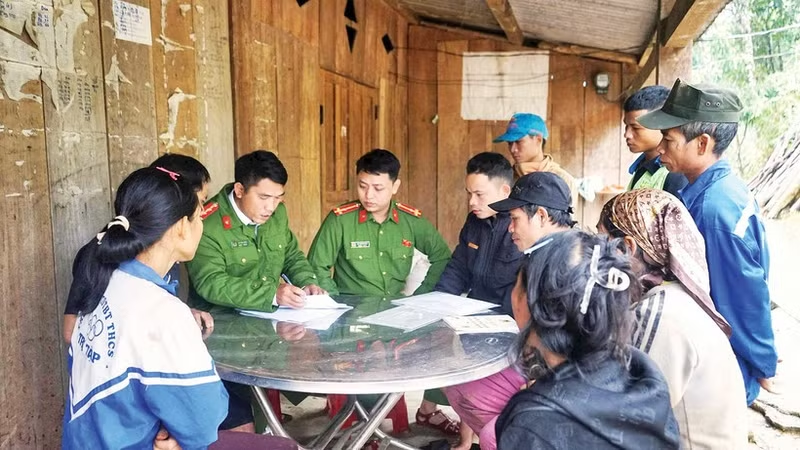
In recent days, Truong Thi Luon, Secretary of the Party Cell of Hamlet 1, Tra Tap Commune, Da Nang City, together with Party members, has actively visited each village to directly explain the Law on Election, as well as the rights and obligations of citizens. In the places they visited, the Party cell guided residents to sing traditional songs of the Xo Dang ethnic group, incorporating messages about the national election day, thereby reminding people to vote on time and in full.
“At present, some villages do not have mobile phone coverage, so residents find it difficult to access information about the election day, and some people do not fully understand the Election Law. Therefore, direct communication to help people clearly understand is the responsibility of every Party member in the Party cell,” Secretary Truong Thi Luon shared.
Tra Tap is one of the mountainous communes of Da Nang City with nearly 8,400 residents, of whom 98% are ethnic minorities such as Ca Dong and Xo Dang. Local transport infrastructure remains underdeveloped; many villages lie in areas without mobile signal, and some still lack access to the national power grid. In order to ensure that people can exercise their rights and obligations on the national election day, local authorities have proactively selected convenient polling locations and carefully reviewed voter lists to ensure that no one is omitted.
Le Trung Thuc, Chairman of the People’s Committee of Tra Tap Commune, said that in the election of deputies to the 16th National Assembly and People’s Councils at all levels for the 2026–2031 term, Tra Tap Commune has 4,763 voters casting ballots at 15 polling stations. Up to now, voter cards have been printed, and plans have been prepared to supply electricity at two polling points. With the characteristics of a highland area with many hamlets and villages located far from the centre, the locality pays special attention to direct communication to each household.
“The locality has compiled communication documents about the election day in Ca Dong and Xo Dang languages and developed the loudspeaker system of the commune so that residents can easily access information. In addition to members of election teams, the locality has received strong support from more than 200 local officials and teachers in communicating with voters,” Le Trung Thuc said.
In Tra Van Commune, Da Nang City, along the roads leading to the commune centre and residential areas, Party flags, national flags, banners, slogans, and posters about the election are displayed solemnly against the green mountains and forests. According to the Commune Election Committee, Tra Van has 3,286 voters participating at nine polling areas in this election. Up to now, polling stations have been arranged conveniently for residents, especially in hamlets far from the centre.
Through many communication channels, ethnic minority communities have clearly understood the election schedule and candidate lists, and are looking forward to the day to vote and fulfil their civic rights and duties.
Nguyen Tan Thanh, Chairman of the People’s Committee of Tra Van Commune, said that voter cards have been printed and are being distributed according to polling areas, while the locality continues to review, update, and print additional cards where necessary.
“Tra Van Commune has 98% of ethnic minority residents, mainly Ca Dong and Xo Dang. We identify communication in local languages as the key solution to help residents easily understand. We assign communicators who are fluent in ethnic languages and knowledgeable about local cultural traditions to explain matters to the people. In addition, we use social networks and technological applications in election communication. All efforts aim at ensuring that after receiving information, each citizen voluntarily goes to vote, exercising their rights and obligations and contributing to the selection of capable representatives to promote socio-economic development in ethnic minority-inhabited areas,” Nguyen Tan Thanh said.
Ensuring comprehensiveness, democracy, and equality
After the merger of administrative units, Da Nang City now has 34 mountainous communes with 37 ethnic minority groups, with about 157,000 residents.
According to the Da Nang City Election Committee, based on the current review and compilation of voter lists, the city has more than 2 million voters, including about 100,000 ethnic minority voters, accounting for over 4% of the total. All eligible voters under the law have been listed, publicly posted, and created favourable conditions to exercise their voting rights.
The Municipal Election Steering Committee and the Municipal Election Committee have directed agencies, units, and localities to implement communication work in a synchronous and diverse manner, suitable to the characteristics of each area.
Tran Thi Kim Hoa
Director of the Department of Home Affairs and Secretary of the Da Nang City Election Committee
Tran Thi Kim Hoa, Director of the Department of Home Affairs and Secretary of the Da Nang City Election Committee, said that the Municipal Election Steering Committee and the Municipal Election Committee have directed agencies, units, and localities to implement communication work in a synchronous and diverse manner, suitable to the characteristics of each area, especially focusing on diversifying communication forms, combining mass media, grassroots broadcasting systems, electronic portals, direct communication, and mobile communication in residential areas, hamlets, and neighbourhood groups. Localities have also promoted the role of village elders, reputable community figures, mass organisations, and the Fatherland Front in mobilising and raising awareness among ethnic minority communities about their rights and duties in the election.
“Initial assessments show that communication work in ethnic minority-inhabited areas has been carried out timely and in a manner suitable to local conditions, contributing to raising voters’ awareness, creating consensus, and a joyful atmosphere among the people,” Tran Thi Kim Hoa said.