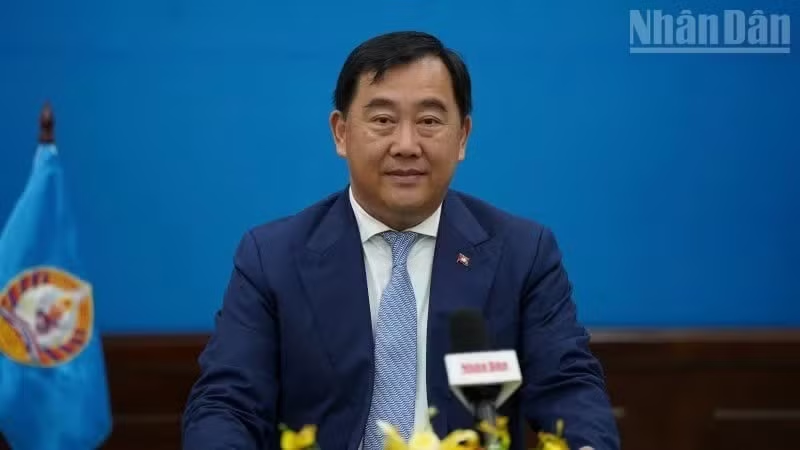
On the occasion of the 75th anniversary of the founding of the CPP (June 28, 1951–2026), Nhan Dan Newspaper’s correspondents in Cambodia interviewed Sous Yara, CPP Central Committee member, spokesperson, First Vice Chairman of the CPP's External Relations Commission, and Chairman of the Commission on Foreign Affairs, International Cooperation, and Information of the Cambodian National Assembly.
Speaking about the CPP’s history, Sous Yara said that the CPP, formerly known as the Khmer People's Revolutionary Party, was established on June 28, 1951, to bolster the political forces supporting Cambodia's struggle for national independence.
Over the past 75 years, particularly following the overthrow of the genocidal Pol Pot regime on January 7, 1979, the CPP has played a central role in rebuilding the country, safeguarding peace, and promoting national development.
Reviewing the Party's historical journey, Sous Yara highlighted a number of its major achievements, including preventing the return of the genocidal regime; restoring the fundamental rights and freedoms of the Cambodian people; playing a leading role in the process of national reconciliation, unity, and reunification, culminating in the signing of the Paris Peace Agreements on October 23, 1991; and bringing decades of conflict to an end on December 29, 1998, through the successful implementation of the Win-Win Policy initiated by Samdech Techo Hun Sen.
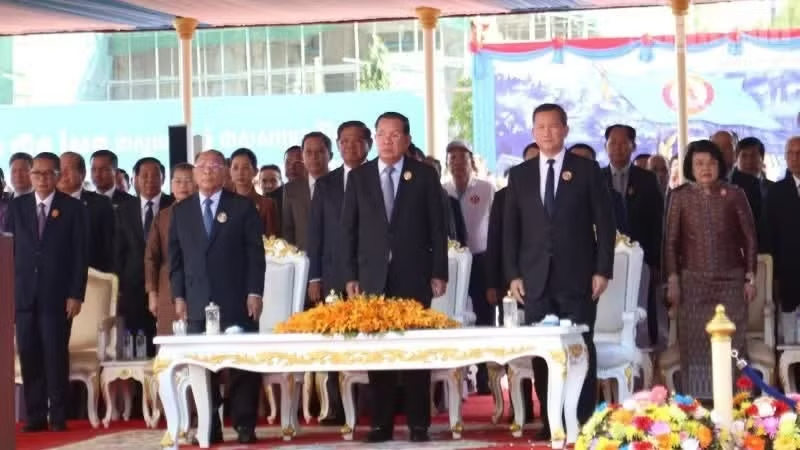
Sous Yara also highlighted the CPP's achievements in consolidating liberal democracy and the rule of law; promoting and protecting human rights; organising regular national and local elections; implementing comprehensive state reform programmes to improve governance; restoring and developing the economy and society; strengthening Cambodia's national resilience across all sectors; maintaining peace, political stability, security, and public order; and enhancing the country's standing and reputation on the international stage.
Noting that the global economy faces ounting uncertainties, that geopolitical tensions are rising worldwide and regionally, and that the rules-based international order is weakening, Sous Yara said that the CPP remains committed to leading Cambodia along the path of peace, democracy, and development, while successfully maintaining political stability, macroeconomic resilience, steady economic growth, and improving people's livelihoods.
Cambodia's economy is forecast to grow by 4.2% in 2026, with GDP per capita reaching approximately 3,064 USD. The country is expected to maintain exchange rate stability, keep inflation under control at around 3.8%, and increase its foreign exchange reserves to nearly 30 billion USD. At the same time, trade activities and state budget revenues are expected to continue expanding, demonstrating the economy's resilience and providing a solid foundation for future development, and the capacity to respond to emerging challenges.
According to Sous Yara, since August 2023, under the leadership of the CPP, the Royal Government of Cambodia, headed by Prime Minister Samdech Moha Borvor Thipadei Hun Manet, who also serves as a Vice-President of the CPP, has been implementing its Political Platform and the Pentagonal Strategy – Phase I (2023–2028). The strategy forms part of a 25-year vision aimed at realising Cambodia Vision 2050 and transforming the country into a high-income nation.
In the short and medium term, the Royal Government, under CPP leadership, has also focused on designing and implementing reform programmes that are specific, practical, clearly defined, and highly feasible. Since 2023, the Government has introduced six priority policy programmes covering healthcare, social protection, skills development, support for the informal economy, and agricultural development. It has also established the Committee for the Promotion of the Resolution of Private Sector Issues to ensure that businesses' practical concerns and obstacles are promptly considered and addressed.
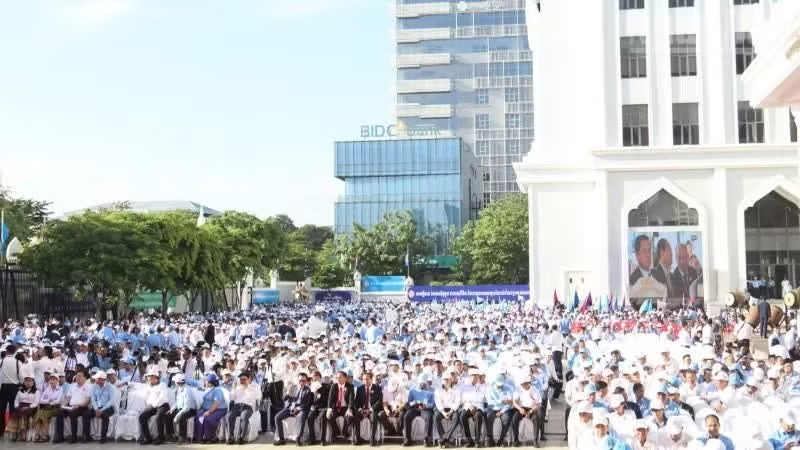
The CPP spokesperson added that the Government is implementing the Programme to Enhance Competitiveness, Promote Diversification and Strengthen Resilience for Economic Growth amid Global Uncertainty, together with the Programme to Improve Cambodia's Business and Investment Environment for the 2025–2028 period. These initiatives are expected to provide fresh momentum for medium- and long-term economic growth. He also noted that the Government views current border-area challenges as an opportunity to stimulate domestic production and encourage greater consumption of locally produced goods.
Sharing his views on the traditional relationship between the CPP and the CPV, as well as on Cambodia–Viet Nam relations, Sous Yara said the two countries share a long-standing friendship forged through their common struggle for national independence and liberation from colonialism and imperialism. Rooted in shared historical experiences, geographical proximity, and close political ties, Cambodia, Viet Nam, and Laos have consistently supported and assisted one another over the years.
The Cambodia–Viet Nam Friendship Monument stands as a symbol commemorating the sacrifices made by the Cambodian people in support of Viet Nam's national reunification during the 1960s and 1970s, as well as the sacrifices of the Vietnamese military and people in helping Cambodia overthrow the genocidal Pol Pot regime during the 1970s and 1980s.
Sous Yara noted that the annual commemoration on December 2 honours the patriotic forces of the Kampuchean United Front for National Salvation, the predecessor of the Cambodian Front for National Development, together with the Vietnamese volunteer soldiers who heroically sacrificed their lives in the struggle to overthrow the genocidal Pol Pot regime. He stressed that this historical truth must never be forgotten and should continue to be preserved and passed on to future generations.
According to the CPP spokesperson, cooperation between the CPP and the CPV has consistently been one of the key pillars underpinning relations between the two States and peoples. Since the establishment of diplomatic relations on June 24,1967, bilateral ties have withstood numerous historical challenges and continued to develop in line with the guiding principles of "good neighbourliness, traditional friendship, comprehensive cooperation, and long-term sustainability."
Both sides have agreed to further strengthen cooperation through all Party, parliamentary, ministerial, governmental, front, and mass organisation channels, while also expanding people-to-people exchanges and cooperation between local authorities, particularly in border areas.
He emphasised that high-level visits and exchanges between the leaders of the two Parties and the two States have continued to consolidate political trust, providing a solid foundation for guiding bilateral cooperation and effectively addressing practical issues of mutual concern.
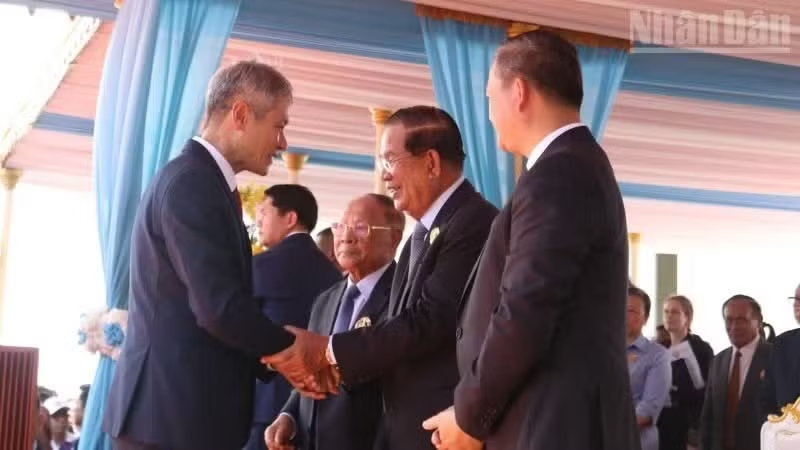
The State visit to Cambodia by Party General Secretary To Lam in February 2026, followed by the visit of Politburo member and Permanent Member of the CPV Central Committee's Secretariat Tran Cam Tu in April 2026, and the official visit to Viet Nam by Cambodian Prime Minister Samdech Moha Borvor Thipadei Hun Manet in June 2026, further demonstrate the determination of the two countries' leaders to deepen their traditional friendship and elevate bilateral relations to a new level.
During the high-level meeting between the two Parties in February 2026, both sides agreed to strengthen cooperation in trade, investment, energy, infrastructure connectivity, and supply chains, with the shared goal of increasing bilateral trade to 20 billion USD.
The two Parties also agreed to further promote cooperation in education and human resource development under the spirit of "connecting young people, connecting generations, and connecting leaders." They highly appreciated the Cambodia–Viet Nam–Laos Young Leaders Training Programme, describing it as an important platform for nurturing future leaders and enhancing mutual understanding among the three countries.
Sous Yara reaffirmed that Cambodia and Viet Nam remain committed to strengthening cooperation within Mekong cooperation mechanisms, upholding ASEAN unity and centrality, and promoting the peaceful settlement of disputes in accordance with international law, thereby contributing to lasting peace, stability, and prosperity in the region.