Diplomatic relations between Viet Nam and Cambodia were established and have continued to develop steadily over more than half a century.
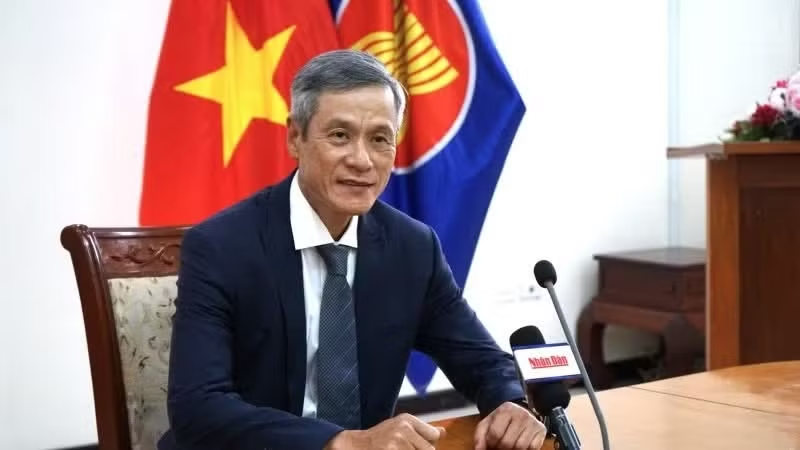
On the occasion of the 59th anniversary of the establishment of Viet Nam-Cambodia diplomatic relations (June 24, 1967–June 24, 2026), Vietnamese Ambassador to Cambodia Nguyen Minh Vu shared with Nhan Dan correspondents in Cambodia an overview of bilateral relations, as well as prospects and key directions for future cooperation.
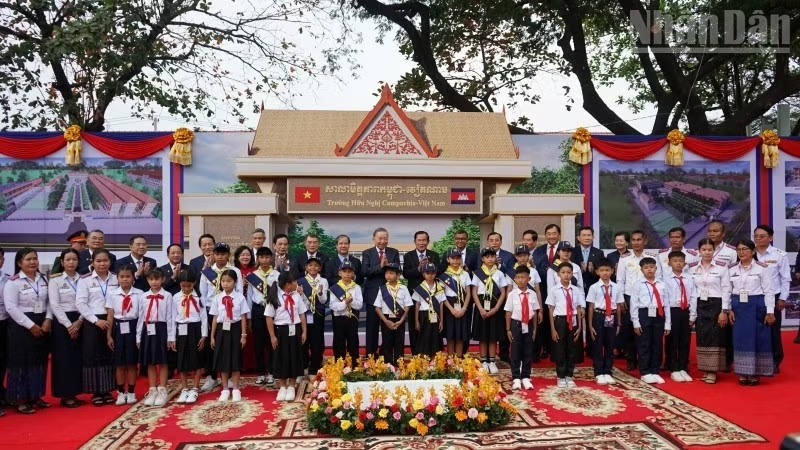
Emphasising that Viet Nam-Cambodia relations continue to be strengthened across all fields, Ambassador Nguyen Minh Vu noted that both sides are actively implementing the strategic orientations agreed by the senior leaders of the two Parties and two countries during General Secretary To Lam’s state visit and participation in the high-level meeting of the two Parties (Viet Nam and Cambodia) and the three Parties (Viet Nam, Cambodia, and Laos) in Phnom Penh on February 6, 2026.
High-level exchanges and contacts have remained highly dynamic. In May 2026, Prime Minister Le Minh Hung held discussions with Cambodian Prime Minister Hun Manet on the sidelines of the ASEAN Summit in Cebu, the Philippines.
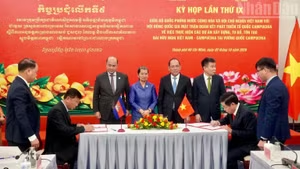
In June 2026, Prime Minister Hun Manet attended and delivered remarks at the third ASEAN Future Forum hosted by Viet Nam; paid courtesy calls on General Secretary and State President To Lam, National Assembly Chairman Tran Thanh Man, and Permanent member of the Party Central Committee's Secretariat Tran Cam Tu; and held talks with Prime Minister Le Minh Hung, during which the two leaders witnessed the signing of several cooperation agreements.
Tran Cam Tu, Politburo member and Permanent member of the Party Central Committee's Secretariat, and Trinh Van Quyet, Politburo member and Head of the Party Central Committee’s Commission for Information, Education, and Mass Mobilisation, paid official visits to Cambodia in April and May 2026, respectively.
Samdech Men Sam An, Vice-President of the Cambodian People’s Party, along with many Cambodian ministers and leaders at various levels, also visited and held exchanges with their Vietnamese counterparts. These activities have further consolidated and deepened political trust, a key factor in advancing bilateral relations.
The Vietnamese Ambassador noted that economic, trade, and investment cooperation continues to be a bright spot in bilateral relations. Viet Nam is Cambodia’s third-largest trading partner and its second-largest export market.
Viet Nam is also among Cambodia’s leading investors, with 223 valid projects worth nearly 3 billion USD in registered capital, ranking fifth among countries and territories investing in Cambodia.
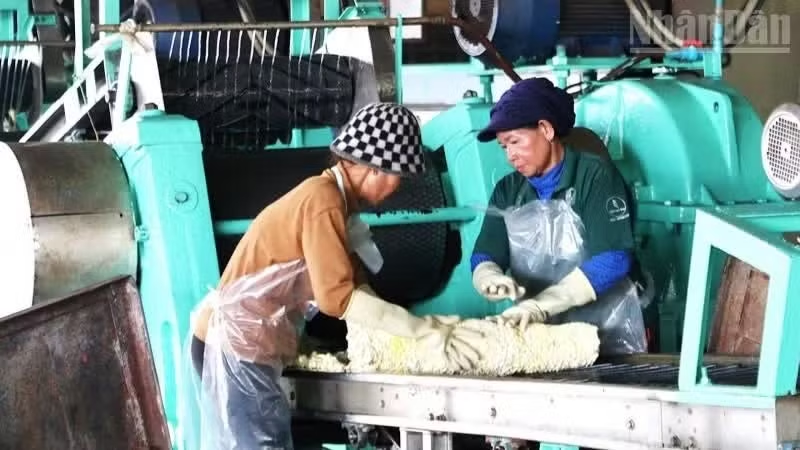
Enterprises such as Metfone, rubber companies under the Viet Nam Rubber Group (VRG), Vietnamese banks, and Thaco Agri continue to operate successfully in Cambodia, making positive contributions to the host country’s socio-economic development. Metfone (Viettel Cambodia) was Cambodia’s largest taxpayer in 2025.
Tourism cooperation between the two countries has also expanded significantly. Viet Nam is Cambodia’s leading source of international visitors, while Cambodian arrivals to Viet Nam consistently rank among the key markets for Viet Nam’s tourism industry. These developments provide a favourable foundation for the two countries to further expand comprehensive economic cooperation in the coming years.
Defence and security cooperation remains an important pillar of bilateral relations. Both sides have effectively implemented activities under the annual cooperation plans between the two Ministries of Defence and between Cambodia’s Ministry of Interior and Viet Nam’s Ministry of Public Security, particularly in combating transnational crime, cybercrime, drug trafficking, human trafficking, and online fraud. These efforts contribute to maintaining a peaceful and stable environment in both countries and the wider region.
The two sides have also strengthened cooperation in information, communications, culture, and people-to-people exchanges. Viet Nam and Cambodia successfully organised Viet Nam Cultural Week in Cambodia in May 2026, helping to foster deeper understanding of the cultures, countries and peoples of both nations.
Ambassador Nguyen Minh Vu noted that Viet Nam-Cambodia relations are facing new opportunities while also navigating major changes in the regional and international landscape. Regarding future prospects for cooperation, he outlined several key priorities that both sides should continue to promote.
First, he stressed the need to further strengthen political trust and maintain regular high-level contact mechanisms, thereby providing a solid foundation for broader cooperation in other areas.
Second, the two countries should enhance economic, trade, and investment connectivity in a practical, effective, and sustainable manner, while promoting links in transport infrastructure, logistics, border gates, border economies, and supply chains.
Third, cooperation should be expanded in emerging areas such as digital transformation, innovation, the green economy, renewable energy, and the development of high-quality human resources to meet the demands of a new stage of development.
Fourth, the two countries should continue strengthening cooperation in defence, security, border management, combating transnational crime, and addressing non-traditional security challenges, thereby contributing to the building of a border of peace, friendship, cooperation, and development.
Finally, both countries should place particular emphasis on people-to-people exchanges, especially among younger generations. He highlighted this as a vital factor in preserving and promoting the valuable traditions of Viet Nam-Cambodia friendship and ensuring the sustainable development of bilateral relations for many years to come.
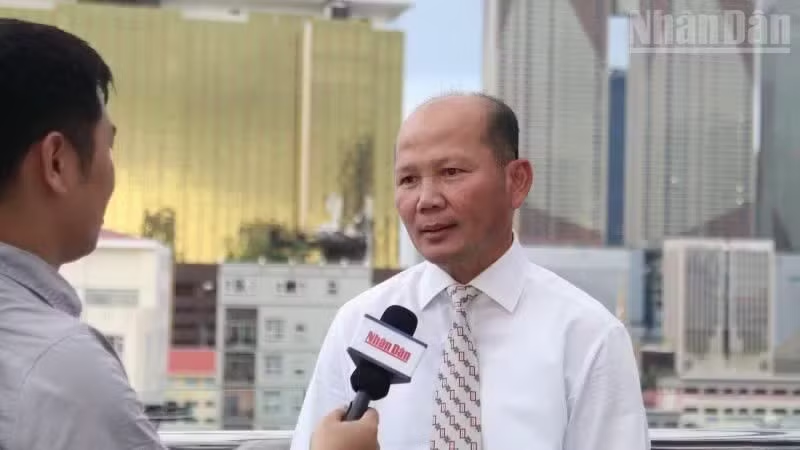
Sharing Ambassador Nguyen Minh Vu’s assessment, researcher Uch Leang, Acting Director of the Department of Asian, African, and Middle East Studies at the International Relations Institute of Cambodia under the Royal Academy of Cambodia (RAC) and President of the Cambodian Alumni of Viet Nam Association (CAVA), said the two countries had achieved comprehensive accomplishments of profound strategic significance over the past 59 years.
Most notably, the two sides have built and maintained a strong foundation of political trust through regular exchanges and contacts between leaders at all levels, enhancing mutual understanding, guiding cooperation, and effectively addressing issues arising in bilateral relations.
Uch Leang noted that economic, trade, and investment cooperation will remain the most important driver of growth. The two countries have set a target of increasing bilateral trade to 20 billion USD in the coming years.

To achieve this goal, the Cambodian researcher said both sides should accelerate cross-border transport infrastructure connectivity, modernise border gates, simplify trade procedures, develop logistics services, and strengthen regional supply chains. In particular, promoting production-linkage models under the “Viet Nam-Cambodia” or “Viet Nam +1” framework would help Cambodia attract additional investment in promising sectors such as agricultural processing, supporting industries, renewable energy, logistics, and the digital economy.
Furthermore, Uch Leang noted that emerging fields including digital transformation, the digital economy, artificial intelligence (AI), innovation, green growth, renewable energy, and the development of high-quality human resources will increasingly become important pillars of cooperation.
The Cambodian researcher also stressed that defence and security cooperation will continue to serve as one of the key pillars of bilateral relations. As non-traditional security challenges continue to grow, the two countries are expected to further strengthen coordination in combating transnational crime, ensuring cybersecurity, preventing drug trafficking, responding to epidemics, and addressing border security issues to maintain a peaceful and stable environment for development.
Meanwhile, cooperation in education, culture, people-to-people exchanges, and tourism is also expected to expand. Joint tourism products, particularly the “Three Countries–One Destination” model linking Cambodia, Laos, and Viet Nam, promise to inject fresh momentum into the tourism sector while enhancing understanding and connectivity among the peoples of the Mekong sub-region.