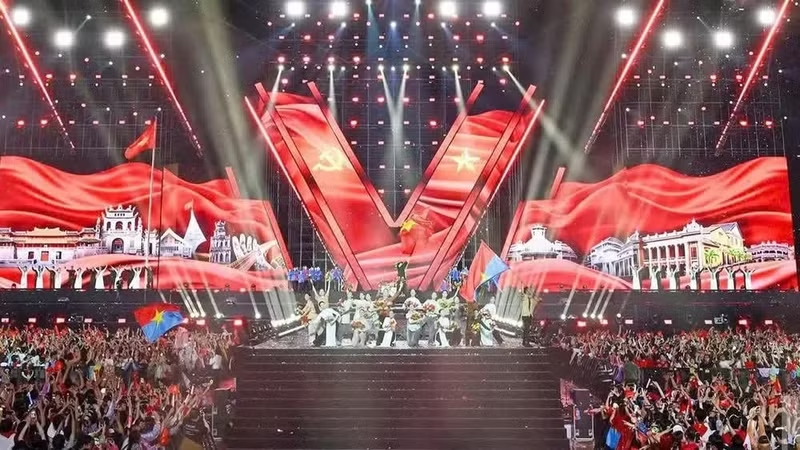
This occasion allows every Vietnamese citizen to reflect on glorious historical milestones, honour the sacrifices made by past generations for the nation’s independence and freedom, and reaffirm the will for independence and the strength of national unity.
However, taking advantage of this context and timing, hostile, reactionary, and extremist forces have stepped up in the dissemination of distorted narratives and skewed perspectives. Their aim is to diminish the significance of the August Revolution and attempt to “whitewash” or rewrite history to deny the leadership role of the Communist Party of Viet Nam.
A familiar narrative being repeated on certain online forums and overseas media channels during this year’s anniversary involves citing Emperor Bao Dai’s signing of the Proclamation of Vietnamese Independence on March 11, 1945.
Proponents of this view argue that Viet Nam was already nominally independent, implying that the Viet Minh’s victory in the August Revolution was merely a stroke of luck — a result of the power vacuum left when Japan surrendered to the Allies. They claimed that victory could have been achieved easily without a revolution, or that peace could have been secured through negotiation rather than a costly war involving heavy loss of life and resources.
In reality, this is a distorted and arbitrary interpretation that contradicts historical facts; it is a deliberate attempt to conflate issues, using the title of a single document to obscure the true state of Viet Nam’s sovereignty at that time.
Even after the Declaration of Independence of Viet Nam, Japanese troops remained stationed throughout Indochina, and the position of “Supreme Advisor” — held by Japanese Ambassador Yokoyama to control and dictate all political decisions — persisted alongside the Hue imperial court. Consequently, the Tran Trong Kim cabinet lacked any real power.
Furthermore, certain parties attempt to distort history in an unscientific manner, framing objective conditions as the sole cause of the victory.
It must be recognised that while Japan’s surrender to the Allies in August 1945 created favourable objective conditions for the Vietnamese revolution, this fact in no way diminishes the immense significance of the August Revolution.
Disregarding historical facts, certain organisations and individuals — under the guise of “scientific research” — cite foreign sources containing unverified information; this leads many people, especially the youth, to mistakenly regard such material as credible and authentic research.
Prof, Dr Pham Hong Tung, Chairman of the Scientific and Training Council at the Institute of Vietnamese Studies and Development Sciences, analyses the matter thusly: no matter how favourable objective conditions may be, they cannot, on their own, guarantee victory for any struggle.
Such conditions present equal opportunities to all forces, yet ultimately, it was the Viet Minh that succeeded in rallying the strength of the entire nation and seizing power.
This demonstrates that subjective factors — specifically leadership strategy, the process of force preparation, and the capacity of each organisation or force to lead and seize the opportune moment — are the truly decisive elements.
In reality, this misrepresentation constitutes a deliberate offensive on the cultural and ideological fronts, employing highly sophisticated tactics to belittle the significance of the August Revolution, tarnish the history of the Vietnamese revolution, and deny the role of the Communist Party of Viet Nam.
Under the guise of a seemingly “scientific” and “neutral” approach, hostile forces deliberately cherry-pick one-sided materials, strip away context, and conflate concepts — equating official history with intentionally edited, fragmentary data — to draw predetermined conclusions and impose subjective views. In doing so, they sow doubt, erode national pride, undermine the ideological foundation, and weaken the strength of great national unity.
Disregarding historical facts, certain organisations and individuals — under the guise of “scientific research” — cite foreign sources containing unverified information; this leads many people, especially the youth, to mistakenly regard such material as credible and authentic research.
History has proven that the victory of the August Revolution and the National Day of September 2 marked the first great triumph of our people under the leadership of the Party; it overthrew a centuries-old monarchy, shattered nearly a century of colonial rule, and placed state power in the hands of the people.
The concept of a “power vacuum”, which originally appeared in certain Western historical studies, has been stripped of its academic context and distorted by extremist elements to misrepresent the Viet Minh’s victory.
Foreign sources are not inherently synonymous with objectivity, the title of “expert” cannot substitute for evidence, and academic terminology does not render a conclusion scientific if the underlying body of data remains unverified.
While scientific research allows for the proposal of new hypotheses and the exploration of new materials, sources must be accurately attributed, events must be placed in their proper context, and above all, the truth must be respected.
History has proven that the victory of the August Revolution and the National Day of September 2 marked the first great triumph of our people under the leadership of the Party; it overthrew a centuries-old monarchy, shattered nearly a century of colonial rule, and placed state power in the hands of the people.
The impact of this event extended beyond national borders, inspiring peoples in colonies to rise up and claim their independence, while simultaneously fortifying the resolve of our own people to continue the fight for independence and national reunification, culminating in the historic Ho Chi Minh Campaign of 1975.
The country achieved complete reunification and independence, and the people attained true freedom and happiness. Precisely because of its profound significance to the nation's quest for independence and self-determination, the August Revolution has consistently been a target for distortion and denial by hostile and reactionary forces during anniversaries.
In the online space, under various guises of the so-called “white revolution”, hostile actors often exploit historical revisionism to distort the true nature of events, deliberately obscuring the Party's leadership role and the strength of the people during the General Uprising.
Common tactics include isolating specific details from their context, absolutising objective factors, exaggerating the roles of certain individuals or organisations, and advancing “contrarian hypotheses” to sow doubt, claiming, for instance, that the August Revolution was “ill-advised” or a “meaningless sacrifice”.
The ultimate goal is not merely to distort perceptions of the past but, more profoundly, to cast doubt on the path chosen by the Vietnamese nation, thereby laying the groundwork for “peaceful evolution” strategies and inciting gatherings, “colour revolution” protests, and subversive riots in Viet Nam.
Historical distortion and revisionism cannot alter verified facts. However, if these erroneous narratives are not promptly identified and refuted with compelling evidence, they can gradually sow scepticism, erode national pride and confidence, and negatively impact the ideological foundation and the strength of the great national unity bloc.
This must be regarded as a regular political task for the entire political system; competent authorities need to provide accurate and timely information to prevent information vacuums that hostile actors could exploit.
In a context where artificial intelligence is being misused to rapidly generate and disseminate fake news, technology itself can also be employed to detect early anomalies online and identify information spread via recurring patterns, thereby providing early warnings about the potential emergence of campaigns aimed at historical distortion or rewriting history.
On this basis, competent authorities and media organisations need to proactively develop content that counters misinformation in ways tailored to specific audiences. Alongside the application of technology, methods of countering false narratives must be innovated to align with how the public currently consumes information.
Rather than merely reacting after misinformation has already spread, it is essential to proactively publish accurate, engaging, and accessible historical content on digital platforms.
A short video, a visual graphic, or a story told in accessible language can help historical truths reach young people more quickly, provided that historical accuracy is never sacrificed for the sake of fleeting engagement. When accurate information is presented vividly and consistently, distorted narratives will be pushed back.
In addition to innovating delivery methods, young people must be equipped with the ability to recognise and verify historical information in the digital environment. History education should not stop at rote memorisation of events; it must help learners understand contexts and know how to cross-reference reliable sources.
Armed with a solid knowledge base and media literacy skills, young people will not be easily swayed by baseless information; instead, they will actively analyse, select, and uphold correct values.
Simultaneously, a team of experts — knowledgeable in history, political theory, and technology — must be assembled to promptly detect and refute misleading content in cyberspace.
Eighty-one years have passed since the historic autumn of 1945. While direct witnesses of the August Revolution are becoming fewer, the memory of the nation rising up to take control of its own destiny endures through the documents, publications, museums, and stories passed down to future generations.
Harmonising to look toward the future does not mean forgetting the past; certainly, historical truth must not be allowed to be obscured or distorted. Cherishing and safeguarding values won at the cost of immense sacrifice is not merely a responsibility toward our forebears; it is also the means by which each generation preserves the nation's faith, resilience, and sense of self-reliance as we build the country for both today and the future.