Unblocking the energy “lifelines”
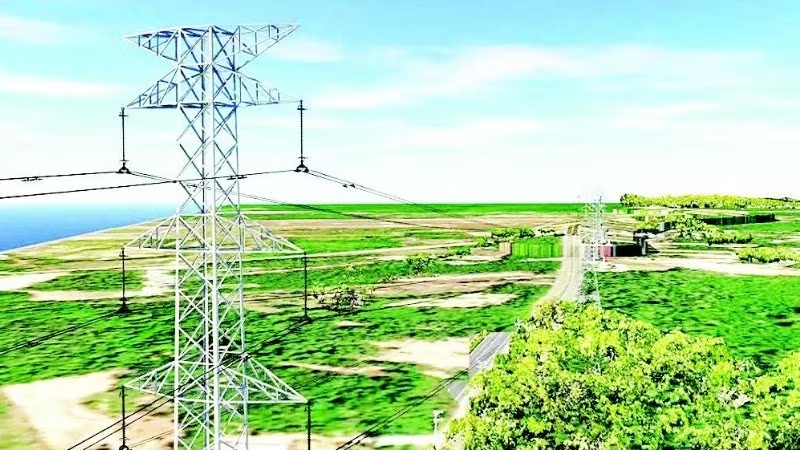
The power system in the Phu Quoc special zone has made rapid progress. From the milestone in 2014, when the 110 kV Ha Tien–Phu Quoc submarine cable first carried national grid electricity across the sea, to 2022, when the 220 kV Kien Binh–Phu Quoc line—the longest oversea overhead transmission line in Southeast Asia—came into operation, a major turning point in energy infrastructure was achieved.
Since then, many investors have chosen Phu Quoc as a long-term destination. To date, An Giang Province has attracted 317 tourism investment projects, covering nearly 10,000 ha with total registered capital of almost 402.2 trillion VND (about 15.3 billion USD).
Today, Phu Quoc’s landscape bears the imprint of numerous projects, developments and entertainment complexes of regional and international scale. According to the An Giang Department of Tourism, in 2025 the province welcomed more than 24 million tourist arrivals, including over 1.9 million international visitors, generating total tourism revenue of nearly 68 trillion VND (2.59 billion USD). Phu Quoc alone was estimated to have received about 8.1 million visitors, including 1.8 million international tourists, with tourism revenue of nearly 44 trillion VND (1.67 billion USD).
Phan Ho Minh Duc, owner of Mai Phuong Resort in Vung Bau–Cua Can Quarter, Phu Quoc special zone, said that with access to the national grid he invested in a resort with dozens of rooms, generating substantial income for his family and creating many jobs for local workers.
Standing Vice Chairman of the An Giang Provincial People’s Committee Nguyen Thanh Phong noted that power projects extended to Phu Quoc have helped the local economy grow rapidly, enabled tourism to break through, and steadily improved people’s living standards.
Phu Quoc marked several important milestones on December 15: becoming the destination of Viet Nam’s 20-millionth international tourist; attracting many large-scale investment projects; and gradually completing transport, urban, seaport and airport infrastructure, ready to serve the APEC 2027 Economic Leaders’ Week.
Not only Phu Quoc, but other islands such as Lai Son in the Kien Hai special zone, Hon Nghe Commune and Son Hai Commune are also undergoing strong transformation thanks to the national power supply. Hon Son Island (Kien Hai special zone) has been connected to the national grid since 2016 via a 110 kV line with a total length of 43 km, including a 24.5 km sea-crossing section. The line currently operates at 22 kV, supplying electricity to more than 2,000 island households. Islanders now not only have power for lighting and daily life but can also develop various tourism services, generating significant income.
General Director of Southern Power Corporation Nguyen Phuoc Duc said that during the 2021–2025 period the corporation invested about 11.74 trillion VND (around 446.6 million USD) in the province, with Phu Quoc alone receiving 4.03 trillion VND (about 153.32 million USD), accounting for 34%. These figures represent not merely investment capital, but a commitment to the sustainable development future of the special zone.
Electricity demand in Phu Quoc has surged from 464 million kWh in 2020 to an estimated 782 million kWh by the end of 2025. An average annual growth rate of 11% vividly demonstrates the boom in tourism, services and urban infrastructure projects on the island.
Sustainable power supply for seas and islands
According to Nguyen Phuoc Duc, under the pressure of rapidly rising demand and lessons learned from submarine cable failures caused by natural disasters, building a stable ring-grid power system has become an urgent requirement. Phan Ho Minh Duc said that the breakage of the 110 kV Ha Tien–Phu Quoc submarine cable on November 29 disrupted his business operations, as the resort’s small backup generators could not meet demand. As a result of the power outage, 50% of guests had to check out earlier than planned.
On December 20, construction of the 220 kV Phu Quoc substation in Ham Ninh, Phu Quoc special zone, commenced, marking a strategic step. With total investment of nearly 900 billion VND (around 34.2 million USD), the project features a transmission line over 19 km long and a capacity of up to 3×250 MVA. When it comes into operation, expected in the fourth quarter of 2026, the substation will receive power from the 220 kV Kien Binh–Phu Quoc line and upgrade the entire operating system from 110 kV to 220 kV.
Nguyen Thanh Phong emphasised: “Investment in the 220 kV Phu Quoc substation is inevitable, strategic and urgent. This is not only a technical project but also the foundation for Phu Quoc to confidently host the APEC 2027 Economic Leaders’ Week, affirming its position as an international-scale tourism and marine economic centre.” The project has been selected as a flagship work to celebrate the 14th National Party Congress, symbolising the spirit of renewal and the nation’s aspiration to reach new heights.
Recently, the 110 kV Lai Son substation in the Kien Hai special zone, with investment of more than 101 billion VND (about 3.88 million USD), has also brought hope to residents of the western sea area. The project is scheduled to be energised before April 30, 2026 and will serve as an important energy “transfer station”, from which the national grid will continue to extend to the Nam Du archipelago through projects commencing in 2026.
Replacing diesel generators with the national grid not only reduces household and production costs for residents but also protects the marine environment—an essential factor for sustainable tourism development. Tran Tan Phu, a resident of Hon Son Island in the Kien Hai special zone, said happily: “Now electricity is no longer a concern for islanders. With strong and stable power, people are confident to invest and develop the economy.”
During the 2026–2030 period, Southern Power Corporation plans to invest an additional 13 trillion VND (494.6 million USD) to upgrade the provincial power system. The objective is clear: to energise 43 projects in the 110 kV grid and complete 220 kV oversea transmission corridors. This systematic investment aims to meet the Prime Minister’s directive to help the province achieve “double-digit” economic growth.
When energy infrastructure moves one step ahead, barriers to investment attraction will be removed. Major projects such as the urban rail line, Duong Dong 2 reservoir, resettlement areas and many international-scale developments in Phu Quoc to serve APEC 2027 will have stable energy supplies, contributing to elevating the pearl island and strengthening the nation’s position on the international stage.