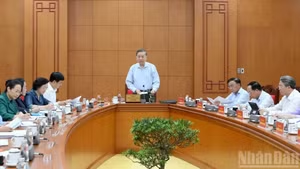
The revised Capital Law represents an important step in institutionalising the spirit of Politburo Resolution No. 02-NQ/TW on building and developing the capital in the new era.
In practice, although provisions on the Capital Region were introduced in the 2012 Capital Law and further inherited and developed in the 2024 version, regional linkages have yet to prove truly effective. According to Report No. 39/2024/QH15 by the Ministry of Justice on the implementation of the law, regional planning coordination has faced difficulties due to disparities in resources among localities, as well as the absence of a unified coordinating mechanism and binding accountability.
Inter-regional infrastructure projects, such as transport and environmental pollution treatment, have often been implemented in a fragmented manner, lacking unified planning and benefit-sharing mechanisms. As a result, Ha Noi has had to bear significant pressure from traffic congestion and air and water pollution, while neighbouring provinces have yet to fully realise their potential as satellite urban areas sharing functions with the capital.
With a 100-year vision, Ha Noi is positioned as the central driver of the region through a “multi-polar, multi-centre urban cluster” model, connected by high-speed transport systems and guided by transit-oriented development (TOD). Therefore, a breakthrough mindset is required to address longstanding limitations in regional linkage. Tran Quang Tuyen, Deputy Director of the Ha Noi Municipal Department of Planning and Architecture, noted: “Ha Noi cannot resolve all of its urban challenges on its own, without regional connectivity and superior legal instruments.”
A key innovation in regional linkage lies in clearly defining a comprehensive coordination mechanism among the six localities in the region, covering transport infrastructure, shared technical infrastructure (clean water, drainage, waste treatment, energy), socio-economic cooperation, environmental protection, and food safety control.
The law also aims to establish a sufficiently robust institutional foundation for the sustainable development of the capital, enabling more proactive governance. The establishment of a Capital Region Development Fund — structured as an off-budget state financial fund — is a notable breakthrough. Funded by the central budget, contributions from Ha Noi and other provinces, and mobilised social capital, it will prioritise investment in inter-regional projects, including transport, key infrastructure, environmental treatment, and disaster response.
The draft law also stipulates that Ha Noi will take the lead in coordinating inter-regional programmes and projects, with clearer mechanisms for resource sharing and accountability. In discussing regional linkage and development, it is necessary to shift from viewing Ha Noi as merely an attractive centre to recognising it as a centre of diffusion — an opinion shared by National Assembly Deputy Ta Van Ha (from Da Nang delegation). According to Ha, without such consideration, Ha Noi could become an overly strong “magnet”, leading to imbalance.
National Assembly Deputy Leo Thi Lich (Bac Ninh delegation) stated that the draft law marks a transition from an administrative boundary-based approach to one based on open economic space, clearly defining Ha Noi’s role as a centre of diffusion. It also introduces mechanisms for inter-regional coordination in planning, infrastructure, environment, and services, alongside frameworks for resource sharing and prioritised investment in inter-regional projects.
However, further clarification is needed regarding benefit-sharing mechanisms, responsibilities, and dispute resolution among localities. At a conference reviewing the implementation of six Politburo resolutions on socio-economic development of six regions to 2030, with a vision to 2045, Vu Dai Thang, Chairman of the Ha Noi Municipal People’s Committee, proposed further research to clearly define the concept of the “Capital Region” and to improve coordination mechanisms, including the regional development fund and inter-regional financial arrangements, in order to effectively address issues related to environment, infrastructure, and resources.
It is essential to clearly define the role of the capital city within the region — not merely as a “centre” but as a “core” that leads and drives growth for surrounding localities. Under the new mechanisms, Ha Noi will be better positioned to leverage its strengths in science and technology, finance, and high-quality services, while supporting other provinces in developing their potential in industry, high-tech agriculture, and eco-tourism.
Meanwhile, provinces in the region will be able to ease the pressures of rapid urbanisation and mitigate challenges, such as inadequate infrastructure and pollution from production activities, thanks to shared functions, improved transport connectivity, and joint environmental projects.
With this new legal framework, the revised Capital Law is expected to create a harmonious and sustainable development space for the Capital Region, providing a strong foundation for accelerated socio-economic development in the coming period.
![[Infographic] Key points from General Secretary and President To Lam’s opening remarks at the 14th PCC’S 4th plenum](https://en-cdn.nhandan.vn/images/j0QNt7m_5iy1OXpnUKiwG61aYhTv_B140GWhfriF26JwZbNNJ8LWetfvXUhz4Az6/1-8220.jpg.avif)