From the mountaintop, rice fields, villages and canals stretch into the distance to form a peaceful rural landscape. Few would imagine that beneath this seemingly ordinary land lie the remarkable vestiges of an ancient civilisation.
The road up Ba The Mountain takes visitors through lush greenery, where they can listen to birdsong and admire the expansive fields below.
At the 226-metre summit, the ancient San Tien Temple and its natural surroundings provide an attractive stop for pilgrims and young visitors seeking to explore the mountain scenery and take photographs.
A journey through heritage
Ba The’s appeal extends far beyond its scenery. This land is closely associated with the flourishing Oc Eo culture. In 1944, French archaeologist Louis Malleret conducted excavations at Oc Eo Mound, where the first spadefuls of earth revealed traces of an ancient kingdom.
Since 1975, Vietnamese scientists have continued archaeological surveys and excavations, gradually shedding light on the history Oc Eo-Ba The.
Between 2017 and 2021, a national research project undertaken by the Viet Nam Academy of Social Sciences yielded numerous important discoveries.
More than 730,000 glass beads and bead-making materials were unearthed at Oc Eo Mound, indicating that the site had once been a major centre for bead production and trade.
Architectural remains of religious structures, inscriptions, and artefacts discovered at other sites have also provided valuable insights into the daily lives, beliefs and trading activities of ancient inhabitants.
The Oc Eo-Ba The complex features Ba The Mountain, which served as the centre of a sacred landscape and a network of religious structures, while the ancient city of Oc Eo included an interconnected system of settlements, architectural structures and canals.
Giong Xoai and Nen Chua were two important satellite sites within the region’s trading landscape. The complex extends along the mountain belt in Trung Son Village.
Following the heritage trail, we reached the Oc Eo ancient urban area, which encompasses six archaeological sites. Among them is Cay Thi B Mound, part of a distinctive architectural complex once known locally as the “buried treasure mound” or “gold vault” — names associated with folk tales of treasure hunting.
Inside the mound, excavation pits and successive layers of ancient bricks, weathered and covered in moss, evoke images of a once-bustling settlement. In the stillness, the rustling breeze seems to carry echoes of a distant past mingling with the tangible legacy of the artefacts that remain.
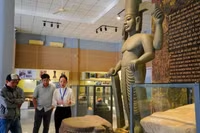
Another prominent stop along the heritage trail is Linh Son Temple, also known as the Four-Armed Buddha Temple, where spiritual traditions coexist with archaeological remains. The temple houses a colossal statue of Vishnu and two ancient stone slabs dating from the Phu Nam culture.
According to Dr Ngo Quang Lang, former Deputy Director of the An Giang Department of Culture, Sports and Tourism, the ancient statue at Linh Son Temple and the statue of Ba Chua Xu on Sam Mountain are two exceptionally rare statues associated with the Oc Eo culture that the province possesses.
We climbed the stone steps to visit the temple and wandered beneath the cool shade of towering, luxuriant trees. Though modest in size, the temple features elegant architecture and is a well-known spiritual tourism destination in the region.
In 1988, Linh Son Temple was recognised as a national architectural and artistic relic. Excavations within its grounds have uncovered numerous artefacts dating from approximately the first century BC to beyond the 12th century AD, helping to illuminate the area’s long history.
Bringing heritage to life
Lam Van Phu, a local resident who has spent all his 83 years in the Ba The area, is a living witness to its transformation, serving as a bridge between local memories and scientists’ efforts to uncover the past.
He recalled that the area was once remote and sparsely populated, with dense reeds covering much of the landscape. Birds and wild animals were abundant. During the tenth lunar month, the local people would even catch pythons and use their skins to make the heads of traditional barrel drums.
Over time, settlers arrived to reclaim land, cultivate rice, and establish orchards, gradually bringing ancient remains to light. While digging, farmers frequently came across jars, vases, pottery fragments, strings of beads, and precious stones.
“At first, we didn’t know they were ancient objects from the Oc Eo period, so we threw them away carelessly. Ceramic artefacts had been buried for centuries, and when I and others, lacking experience, tried to pull them out of the ground, they often broke. I still deeply regret that,” Phu recalled.
According to Phu, after heavy rainfall, local people sometimes discovered gold jewellery and gold ingots as large as eggs exposed on the ground. Rumours of ancient treasure spread rapidly, drawing crowds from elsewhere to dig for gold. Local authorities eventually had to intervene to prevent damage to the archaeological sites and maintain public order.
We then visited the Oc Eo Culture Exhibition House in Oc Eo Commune, managed by the Oc Eo Cultural Relics Management Board, where a substantial collection of Oc Eo artefacts is on display.
Nguyen Van Nhien, Director of the Management Board, said the unit currently holds more than 4,000 artefacts and approximately three million specimens. Among them are four national treasures: the Linh Son Bac Buddha Head, the Linh Son Bac Buddha Relief, the Cay Tram Mound Jar Burial, and the Giong Cat Nandin Ring.
Through public outreach and awareness-raising efforts, the management board has received donated artefacts from nearly 75 organisations and individuals. These include pottery, architectural bricks, precious-stone beads, glass beads, and objects associated with daily life and religious practices.
Preserving ancient remains is a long-term undertaking, but an equally important challenge is helping the public understand and appreciate their significance.
When visitors see only old brick foundations, excavation pits or ancient objects displayed in glass cases, they may struggle to imagine the thriving urban centre and bustling trading activities that once existed here.
The Oc Eo Cultural Relics Management Board therefore aims to combine conservation with improvements in exhibitions, interpretation and visitor services.
Proposed measures include enhancing the landscape, installing additional signage, introducing QR codes and digital technologies, and using 3D reconstructions to help visitors gain a clearer understanding of the ancient city.
For students and other young people, extracurricular programmes, historical discovery tours, artefact identification activities and hands-on archaeological experiences could offer more engaging and accessible ways to explore the past.
Short videos, social media, heritage knowledge competitions, digital content creation and volunteer activities to protect archaeological sites are also among the approaches under consideration.
The management board hopes that visitors to Oc Eo-Ba The will not merely admire the priceless artefacts of an ancient civilisation but also gain a deeper understanding of the daily lives, beliefs, architecture, trade and cultural exchanges of the Oc Eo people.
Its long-term goal is to preserve the values handed down by earlier generations while bringing them to life through storytelling that is more accessible, vivid and engaging.
In this way, heritage will not simply be preserved but will truly become a living part of the community, transforming Oc Eo-Ba The into an increasingly attractive destination for domestic and international visitors.