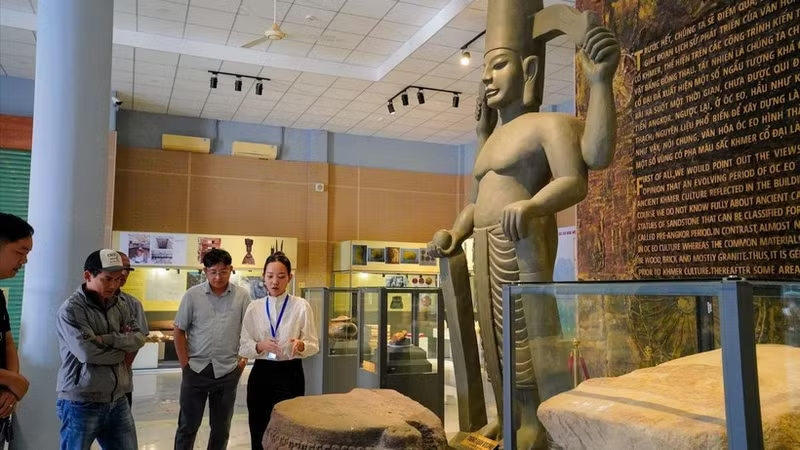
The Oc Eo–Ba The archaeological site covers a total conservation planning area of approximately 433.1 hectares, including nearly 144 hectares in the slopes and foothills of Ba The Mountain (Zone A) and more than 289 hectares in the Oc Eo plain (Zone B).
The Oc Eo–Ba The site represents important evidence of the Oc Eo civilisation, which flourished in southern Viet Nam from the first to the seventh century. It was one of the major trading centres of the ancient Funan Kingdom, featuring a system of canals, architectural remains, and archaeological artefacts that reflect a high level of economic, cultural, and religious development.
Deputy Prime Minister Mai Van Chinh has authorised the Minister of Culture, Sports, and Tourism to conduct a thorough review, finalise and sign the scientific dossier for submission to the UNESCO World Heritage Centre in accordance with regulations, ensuring both quality and compliance with prescribed timelines.
The Ministry of Foreign Affairs and the Viet Nam National Commission for UNESCO are tasked with leading and coordinating with relevant agencies to complete the necessary procedures for submitting the Oc Eo–Ba The archaeological site dossier to the UNESCO World Heritage Centre before January 30, 2026, in line with the 1972 World Heritage Convention and national legislation on cultural heritage. At the same time, they are to promote Viet Nam’s role and position within UNESCO’s governing mechanisms, and actively support the Ministry of Culture, Sports, and Tourism, the An Giang Provincial People’s Committee, and related agencies in implementing measures to build international consensus in support of the site’s recognition as a World Heritage Site.
The An Giang Provincial People’s Committee is responsible for reviewing and taking full accountability for the content, data, and accuracy of the scientific dossier on the “Oc Eo–Ba The archaeological site” in accordance with the 1972 Convention concerning the Protection of the World Cultural and Natural Heritage and Viet Nam’s cultural heritage legislation. The province will also coordinate with the Ministry of Culture, Sports, and Tourism, the Ministry of Foreign Affairs, the Viet Nam National Commission for UNESCO, and other relevant agencies to continue implementing necessary measures to facilitate UNESCO’s evaluation and recognition process, and promptly report to competent authorities on issues beyond its jurisdiction, as prescribed.
It is reported that An Giang Province is home to more than 80 Oc Eo cultural relics, among which the Oc Eo–Ba The site holds a particularly important position. It was once an urban settlement and port city, serving as a major economic and cultural centre of the ancient Funan Kingdom. In 2012, the Oc Eo–Ba The site was designated a Special National Relic by the Prime Minister.
Archaeological discoveries at the Oc Eo–Ba The site have not only shed light on the existence of an ancient state but also confirmed that it was once a bustling international trading hub in the region.









![[Video] Ho Chi Minh City plans 15-minute fireworks display for April 30 anniversary](https://en-cdn.nhandan.vn/images/9f233ae74386156ace55673ec5a8ea373e7bb5df2274800bfd51bda6ec86d9462977f03ce1e53439beef9baaa1a4ab537343d03bcefe748da799886b86545168/banphaohoa-hcm-642026.jpg.avif)