Drawing on that source of strength, the Party organisation, authorities, and people of Ha Tinh are determined to build a strong economy, firm public confidence, and lasting solidarity, with the aim of achieving fast and sustainable development.
A steadfast communist, devoted all his life to the country and the people
Ha Huy Tap was born on April 24, 1906, in Kim Nac Village, Tho Ngoa Canton, now Cam Hung Commune, Ha Tinh Province, into a patriotic Confucian family. Nurtured by traditions of patriotism and revolution, the young man quickly became politically awakened and embarked on the revolutionary path.
From September 1917 to 1919, Ha Huy Tap worked as a tutor while studying at the Franco–Vietnamese primary preparatory school in Ha Tinh Provincial Town; from 1919 to 1923, he received a scholarship to study at Quoc Hoc Hue School. From 1923 to 1928, he taught at the Franco–Vietnamese primary school in Nha Trang, Khanh Hoa Province; later returning to Nghe An Province to teach at Cao Xuan Duc School in Vinh.
In late December 1928, Ha Huy Tap, together with several other comrades, was sent to Guangzhou, China, to discuss the unification of the Tan Viet Revolutionary Party and the Viet Nam Revolutionary Youth League. From July 1929 to April 1932, he was sent to study at the Communist University of the Toilers of the East in Moscow in the former Soviet Union. Around June 1933, he returned to China. From July 1936 to March 1938, he carried out revolutionary activities as General Secretary of the Party.
At the Party Central Committee conference in March 1938, he stepped down as General Secretary but remained a member of the Party Central Committee’s Standing Board. In March 1940, he was arrested by the enemy and imprisoned at Saigon Central Prison. On August 28, 1941, the French colonialists executed him along with several other Party leaders.
With his sharp intellect and political acumen, Ha Huy Tap was also an incisive theorist who drafted many Party documents of great ideological and theoretical value. Though he lived only 35 years and devoted 16 years to revolutionary activity, including nearly two years as General Secretary of the Party, he left a vivid portrait of a steadfast communist, a courageous leader, a brilliant mind, and a great moral figure who devoted his entire life to the country and the people.
During a period of profound historical upheaval, Ha Huy Tap rose from a patriotic intellectual to a revolutionary and became General Secretary of the Party at the age of 30. He demonstrated a clear ability to foresee developments, grasp opportunities, and make the most of favourable conditions, working with the Party’s leadership bodies at the time to formulate appropriate decisions.
With his sharp intellect and political acumen, Ha Huy Tap was also an incisive theorist who drafted many Party documents of great ideological and theoretical value. Though he lived only 35 years and devoted 16 years to revolutionary activity, including nearly two years as General Secretary of the Party, he left a vivid portrait of a steadfast communist, a courageous leader, a brilliant mind, and a great moral figure who devoted his entire life to the country and the people.
Writing onward the aspiration for development
In the middle days of April, sunlight stretches across fields, construction sites, and residential areas, creating a fresh, dynamic, and vibrant landscape on the land of Hong Mountain and La River. Ha Tinh is continuing to write its development story through socio-economic achievements and changes in both the spiritual and material life of its people. That story has been shaped by a strong will to rise and a spirit of keeping the roots firm, cultivated by earlier generations.
The legacy of General Secretary Ha Huy Tap is part of history, yet it is also present in every policy decision of his homeland, helping to shape the mettle and development aspirations of a land rich in revolutionary tradition. From a locality once burdened with hardship, Ha Tinh has gradually made breakthroughs and become a bright spot for growth.
The legacy of General Secretary Ha Huy Tap is part of history, yet it is also present in every policy decision of his homeland, helping to shape the mettle and development aspirations of a land rich in revolutionary tradition. From a locality once burdened with hardship, Ha Tinh has gradually made breakthroughs and become a bright spot for growth.
Economic growth has remained high, reaching nearly 8.8% in 2025 and ranking Ha Tinh 10th among the country’s 34 provinces and centrally run cities. Notably, in the first quarter of 2026, the province rose to the top nationwide with growth of more than 12%, while budget revenue surpassed 21 trillion VND.
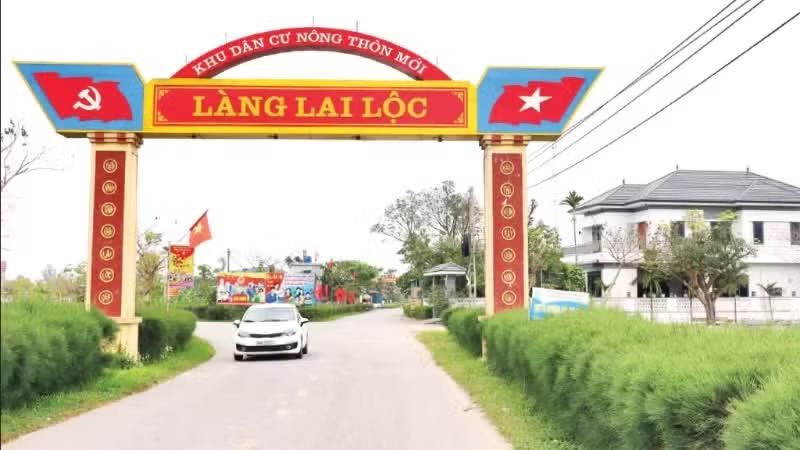
Infrastructure has been developed in a more synchronised manner, and the rural landscape has changed markedly. Social welfare policies have also been implemented effectively, making Ha Tinh one of the first provinces to complete the elimination of temporary and dilapidated housing, while building 105 community cultural houses combined with storm shelters and more than 12,000 solidly built houses for local residents.
Ha Van Hung, Member of the Standing Board and Head of the Communication, Education, and Mass Mobilisation Commission of the Ha Tinh Provincial Party Committee, said that in the face of difficulties and challenges, Ha Tinh sees its real capacity as the most convincing answer, and believes that the essential task is to build a strong economy, firm public confidence, and lasting solidarity. In that spirit, alongside efforts to stabilise people’s lives and create sustainable livelihoods, the province is also implementing measures to tap deeper development potential, unlock new growth poles through more open investment-attraction policies, invite strategic investors, and roll out “leading crane” projects capable of driving and spreading momentum across the wider economy.
In the face of difficulties and challenges, Ha Tinh sees its real capacity as the most convincing answer, and believes that the essential task is to build a strong economy, firm public confidence and lasting solidarity. In that spirit, alongside efforts to stabilise people’s lives and create sustainable livelihoods, the province is also implementing measures to tap deeper development potential, unlock new growth poles through more open investment-attraction policies, invite strategic investors, and roll out “leading crane” projects capable of driving and spreading momentum across the wider economy.
Ha Van Hung, Member of the Standing Board and Head of the Communication, Education, and Mass Mobilisation Commission of the Ha Tinh Provincial Party Committee
Entering a new stage of development, the resolution of the Ha Tinh Provincial Party Congress for the 2025–2030 term clearly defines the province’s future direction as fast and sustainable development based on modern industry, high-quality services, and smart agriculture, with industry serving as the pillar.
To achieve that goal, Nguyen Duy Lam, Member of the Party Central Committee and Secretary of the Ha Tinh Provincial Party Committee, said the province would continue to inherit and promote patriotic and revolutionary traditions; focus on Party building and rectification and on building a clean and strong political system linked to studying and following Ho Chi Minh’s thought, morality, and style; and strengthen the protection of the Party’s ideological foundation.
The province also aims to renew leadership methods, improve the capacity and combativeness of Party organisations, build a contingent of cadres with sufficient quality and capability, promote democracy while maintaining discipline and order, and strengthen the great national unity bloc. At the same time, it seeks to improve the performance, effectiveness, and efficiency of the two-tier local government system, while further renewing leadership methods and enhancing mass mobilisation as well as the work of the Viet Nam Fatherland Front and mass organisations.
Within this overall development orientation, culture is regarded as both a spiritual foundation and an important endogenous driver for the province’s fast and sustainable development. Nguyen Duy Lam added that Ha Tinh is continuing to improve the cultural life of its people, ensuring harmony between economic and cultural development and treating culture as a solid foundation for comprehensive development. The province will continue investing in preserving, reviving, and promoting the cultural heritage values of its homeland, while paying attention to building the cultural value system and human standards of Ha Tinh in the new era.
The lessons of maintaining unity and cohesion within the Party and of remaining steadfast and resilient in the face of every challenge, exemplified by Ha Huy Tap, continue to be upheld and creatively applied by the Party organisation and people of Ha Tinh at every stage of the revolution. The spiritual legacy of General Secretary Ha Huy Tap has not only been preserved and honoured, but has also deeply permeated the leadership thinking, policy formulation, and implementation efforts of later generations. It is a continuous source of strength, linking past and present, tradition and renewal, quietly yet steadfastly sustaining Ha Tinh as it moves with confidence into a new era of development.
![[In Pictures] Party General Secretary and State President To Lam chairs working session with education and training sector](https://en-cdn.nhandan.vn/images/9f233ae74386156ace55673ec5a8ea373e7bb5df2274800bfd51bda6ec86d946773712175db0d2ce918362f1c69e06ae4dc3a2edf89b01151d567efc05b2f019/a1-bnd-7018-6317.jpg.avif)