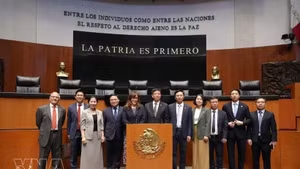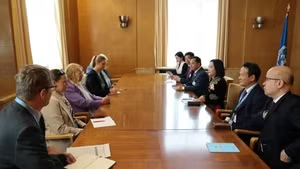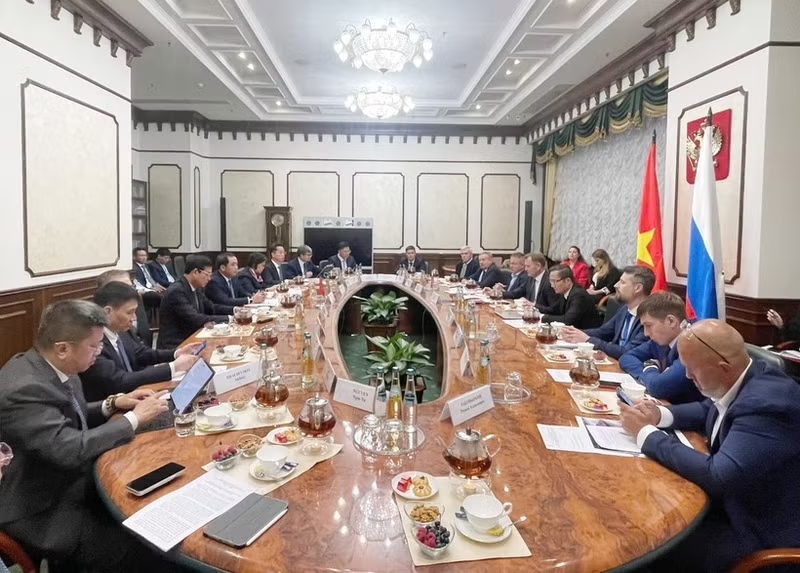
The issue was discussed at a working session between an inter-agency delegation led by Politburo member and Secretary of the Ha Noi Party Committee Tran Duc Thang and Moscow authorities on August 17.
At a meeting with Moscow Deputy Mayor Alexander Gorbenko and a working session with head of the Moscow Department for External Economic and International Relations Sergey Cheremin, Thang stressed the need to realise commitments under the 2025–2027 cooperation plan between Ha Noi and Moscow.
The two sides discussed final steps to implement symbolic projects between the two cities, including the Moscow House project and a Russian multidisciplinary technical school in the Vietnamese capital. The projects were approved in principle earlier, but some technical issues remain unresolved.
Since early 2025, the Comprehensive Strategic Partnership between Viet Nam and Russia has developed strongly, marked by high-level exchanges, including Russian Prime Minister Mikhail Mishustin’s official visit to Viet Nam in January 2025 and Party General Secretary To Lam’s first official visit to Russia in May 2025.
The outcomes of the 25th session of the Viet Nam–Russia Intergovernmental Committee on Economic – Trade and Scientific – Technical Cooperation reaffirmed the two governments’ commitment to promoting bilateral ties across multiple fields. The two countries are actively preparing for the committee’s 26th session in the fourth quarter of this year to establish new cooperation frameworks.
Against this backdrop, Ha Noi strongly supports and is determined to carry out the projects, similar to the Ha Noi–Moscow Trade Centre, which has operated effectively in Moscow for many years.
At the meeting between the Moscow Deputy Mayor and the Secretary of the Ha Noi Party Committee, the two sides held in-depth discussions to quickly agree on practical coordination mechanisms, focusing on the Moscow House project, with a view to completing procedures for approving its investment policy and investor as early as September.
Talking to Cheremin, Thang also outlined specific requirements for the two projects and looked into a cooperation agreement on urban railway development between the Ha Noi People's Committee and the Moscow administration.
The proposed cooperation covers developing standards and technical regulations for Ha Noi’s urban railway system; studying typical and modular designs incorporating the capital’s distinctive architectural, cultural and historical features; and developing solutions for technology integration to ensure seamless operation among urban railway lines, including research into establishing a network operation and control centre.
The Ha Noi official also called for comprehensive investment partnerships with Russian businesses to form consortia for urban railway projects, similar to the Vietsovpetro joint venture. He stressed the importance of mobilising experienced Russian experts to assist in planning, investment and construction of Ha Noi’s urban railway network.
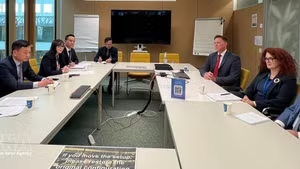
Earlier, Vice Chairman of the Ha Noi People's Committee Truong Viet Dung led an inter-agency delegation on a fact-finding visit to the Moscow Metro control centre and held working sessions with Moscow Metro and several businesses in the sector.