In the past, with support from socialist countries, particularly the Soviet Union, Viet Nam trained many highly qualified nuclear scientists. Upon returning home, they became key personnel at research institutes and universities, helping lay the foundations for Viet Nam’s nuclear science sector. However, most scientists from this generation have now retired, while the next generation has not been developed in sufficient numbers.
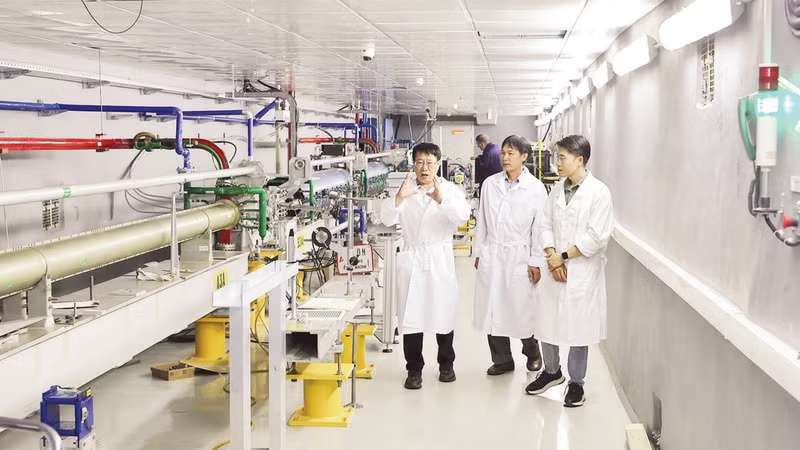
Unlike many other scientific fields, most experiments in nuclear physics can only be conducted using complex and costly equipment. The sector’s main research facilities include particle accelerators, high-intensity neutron sources, research reactors, high-resolution radiation spectroscopy systems, and high-performance computing centres for simulation and data processing.
Viet Nam currently lacks the conditions to develop a comprehensive network of nuclear research facilities on a scale and at a level comparable with advanced scientific centres around the world. This shortfall directly affects the country’s ability to train human resources, master technologies and ensure the sector’s sustainable long-term development.
With domestic resources still limited, international cooperation is a viable way to gradually address these challenges. Among Viet Nam’s international partners, cooperation between the Vietnamese Government and the Joint Institute for Nuclear Research (JINR) in Dubna, known as the Dubna Institute, holds particular importance. This is not merely a conventional scientific partnership, but intergovernmental cooperation that has been maintained continuously for decades.
The Dubna Institute is an international scientific organisation jointly established and developed by 18 member states, with the aim of creating world-class, state-of-the-art research facilities. Viet Nam was one of the Institute’s founding members in 1956 and has made significant contributions to its development.
After more than seven decades of investment and cooperation, the Dubna Institute now operates advanced research facilities that very few countries could develop independently. These include the NICA particle accelerator complex, the IBR-2 pulsed research reactor, the high-intensity IREN pulsed neutron source, modern heavy-ion accelerators, high-precision nuclear spectrometers and supercomputing centres. The Institute’s research facilities, which are among the most advanced in the world, represent shared research infrastructure for all member states, including Viet Nam.
One of the most important benefits of cooperation with Dubna is the favourable environment it provides for training young scientists. By directly participating in international and Vietnamese research programmes, young researchers have opportunities to work with leading experts from around the world, gain access to advanced research methods, and learn from experience in organising and managing large-scale scientific projects.
Accumulating knowledge and experience in an international scientific environment will help build a pool of personnel with strong professional expertise and scientific leadership capabilities, who can in turn become a core force for nuclear research and training programmes in Viet Nam.
In addition to human resources training, the Dubna Institute provides direct access to state-of-the-art research facilities that Viet Nam is not yet in a position to invest in. As an official member of the Dubna Institute, Vietnamese scientists can conduct experiments at international standards, train young researchers using modern equipment, and publish their findings in prestigious scientific journals.
In particular, facilities such as the IBR-2 reactor, the IREN pulsed neutron source and particle accelerators at Dubna are well suited to Viet Nam’s current priority research areas, including neutron physics, nuclear data, nuclear reaction physics, materials research for nuclear power, and radiation applications.
To make more effective use of the Dubna Institute’s potential in the coming period, experts say Viet Nam needs to develop a national cooperation strategy with a comprehensive set of measures. First, a long-term nuclear human resources training programme should be established in connection with research projects at Dubna. At the same time, more young researchers should be sent to work and conduct research there for sufficiently long periods to gain in-depth experience.
Viet Nam should also gradually establish national research groups that work regularly at Dubna’s laboratories, enabling them to proactively propose and implement research directions that serve domestic development needs. Conditions should also be created for Vietnamese scientists working at Dubna to register and conduct research projects using major facilities in line with the Government’s priority tasks...
As Viet Nam gradually prepares for its nuclear power development programme, making effective use of the advantages offered by the Dubna Institute will not only strengthen basic research capacity but also contribute to training high-quality human resources and accessing advanced technologies, thereby laying a solid scientific foundation for the long-term development of the country’s nuclear energy sector.