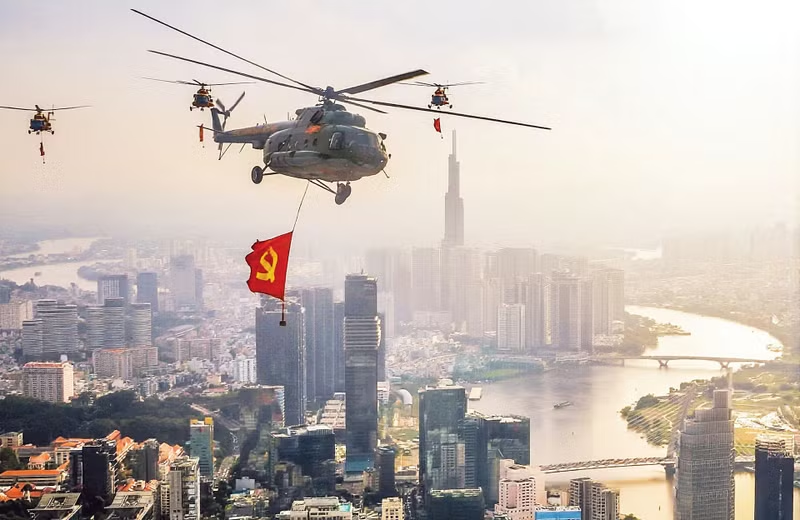
The people’s will, the nation’s momentum
In the past, when meeting a kindred spirit at the beginning of the year, people would reflect upon the state of affairs with simple yet profound words: “When the people’s hearts unite, heaven’s timing will assist.” Today, the sentiment is expressed more succinctly, yet no less resonant and stirring: “The nation’s momentum is rising.”
The spring of 2026 marks the 96th spring since the founding of the Communist Party of Viet Nam (February 3, 1930). Nearly a century has passed in which the Party has accompanied the nation through a historic journey filled with hardship and glory — from leading the people in the struggle for national independence and reunification, to initiating and steering the process of renewal, construction and defence of the Fatherland. It has been a steadfast and continuous journey of a ruling Party that always places itself before the great cause of the nation and the spirit of the age.
The Party’s spring blends into the nation’s spring. Each passing spring is a test of leadership capacity, political mettle and intellectual strength. From the first spring when the light of Marxism–Leninism and Ho Chi Minh Thought illuminated the path of national liberation, to today — the spring of deep integration and sustainable development — the Party has remained steadfast in its supreme goal: Only when the nation is strong can the people feel secure; national independence must be associated with socialism; the happiness of the people is the highest measure of all policies and guidelines.
The world has moved through a quarter of the 21st century amid rapid, complex and unpredictable changes. At the same time, scientific and technological revolutions — especially digital transformation and artificial intelligence — are advancing at a pace beyond all expectations. It is a world where risks and opportunities intertwine, where challenges and breakthroughs coexist. No country can develop if it stands outside this current. International integration is no longer a choice but an objective requirement of development. Yet how to integrate, and with what mindset, depends on the political courage and strategic vision of each ruling party and each nation.
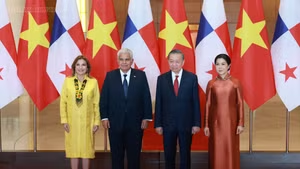
Viet Nam enters integration with proactivity, confidence and prudence. Peace, cooperation, development and international integration remain major trends, yet the world is increasingly unstable, with intensifying conflicts and more direct strategic competition among major powers, affecting globalisation’s course. To date, our country has built a network of strategic and comprehensive strategic partnerships with most major powers and key political–economic centres worldwide, affirming an increasingly solid position on the international stage.
The draft Political Report for the 14th National Party Congress affirms that foreign affairs and international integration stand on equal footing with national defence and security as regular and vital tasks. Integration is thus an organic component of renewal. It is not merely the signing of new-generation free trade agreements, but comprehensive participation in the world’s economic, political, cultural and scientific-technological life. Integration is for learning, absorbing the quintessence of humanity and strengthening internal capacity — not for dependence or loss of identity.
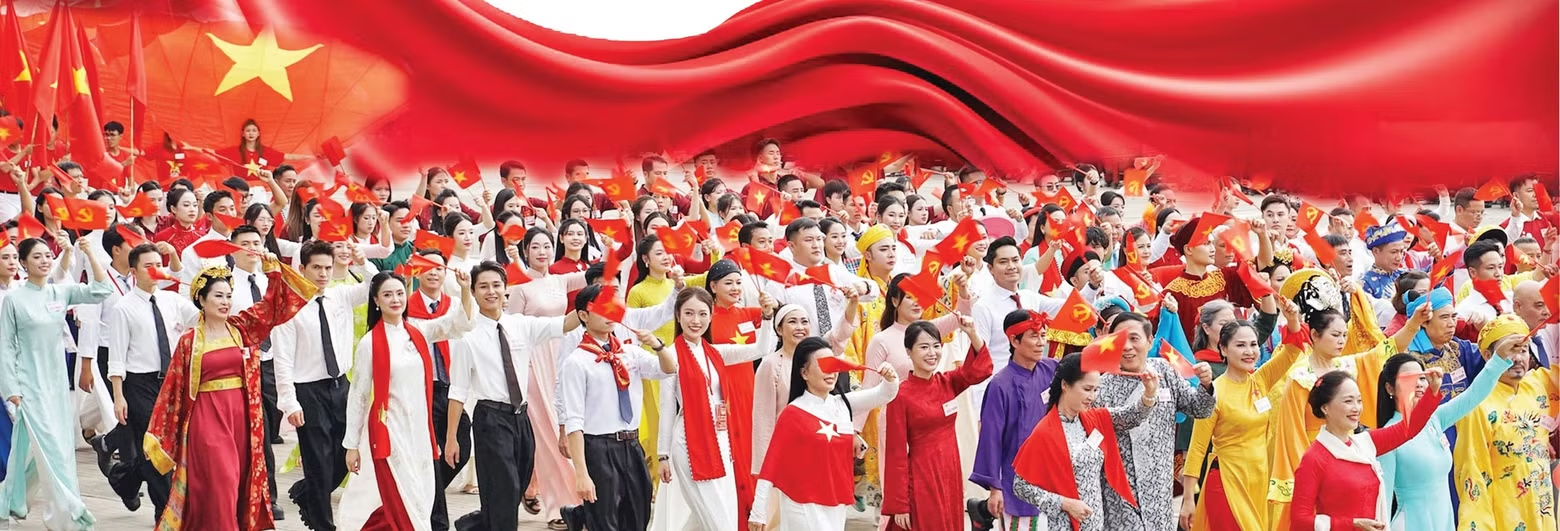
The 100-year milestone
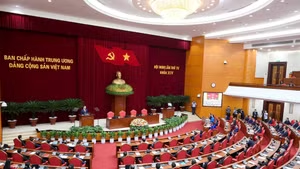
As the new year approaches — the year of the 14th National Party Congress — our entire Party, people and armed forces stand at a strategically significant juncture. This is not merely the transition of a term, but the starting point of a new development phase: an era of national rise, opening a new stage of creation founded upon the determination of the entire political system, the spirit of innovation and the strength of the people’s will. Ahead lie the two centennial milestones: by 2030, Viet Nam aims to become a developing country with modern industry and upper-middle income; by 2045, a developed, high-income nation.
As the ancients said: “Review the old to understand the new, and you may become capable of teaching others.” Looking back on 40 years of Doi Moi (Renewal), it can be affirmed as a historic and transformative decision. Most remarkable was the wisdom and courage shown in 1991 when the Soviet Union and socialist countries in Eastern Europe collapsed. That political earthquake profoundly affected Viet Nam. With the prudence and experience of a genuine revolutionary Party, we recognised that it was the collapse of a flawed model — not of a revolutionary and scientific doctrine. Amid global turbulence, we remained steadfast on our chosen path, upholding the Party’s leadership and rejecting political pluralism and opposition parties.
Great achievements do not come from luck but from favourable timing, advantageous conditions and unity among the people — all recognised and shaped by human agency that dismantles obstacles, resolves contradictions and acts with steady courage and creative thinking. The Party’s affirmation in the draft documents of the 14th Congress that “the theory of renewal” constitutes part of its ideological foundation reflects a profound synthesis of theory and practice. That theory has guided the country from a centrally planned, subsidised economy to a socialist-oriented market economy; from isolation to comprehensive integration; from prolonged crisis to stability and development; from poverty and backwardness to becoming a developing nation entering the ranks of upper-middle-income countries with strong aspirations for advancement.
Our country stands at the threshold of a new development era. The future is not inevitable but the result of decisions made today. One pivotal decision, effective July 1, 2025, involves strong reforms of the political system. The apparatus has been streamlined to meet modern governance requirements; the district level has been concluded; a two-tier local government model established; the legal system reviewed and amended to remove bottlenecks, especially institutional ones. “The road has been cleared,” yet many hardships remain ahead. Institutional reform is not merely realignment but enhancing functionality. Grassroots authorities must be entrusted with sufficient power, resources and capable cadres.
Alongside institutional reform is comprehensive digital transformation. From “digital literacy for all” to “advanced digital mastery,” the strategy aims not only to popularise skills but to build a digital culture and a lifelong learning society. Strategic Party resolutions, including Resolution No. 57-NQ/TW of the Politburo on breakthroughs in science, technology, innovation and national digital transformation, demonstrate forward-looking development thinking. Technology must be a means, not an end; a tool for support, not a dominating force. It must serve humanity, not erode thinking or alter human essence.
Renewal stems from independent and creative thinking, from the courage to face truth, correct mistakes and assume responsibility before the nation. Renewal is not abandonment of the socialist goal but the selection of a suitable path to realise that goal in new historical conditions.
A bright future springs from the human heart
Artificial intelligence is advancing rapidly. Yet every medal has two sides. Overreliance on AI for ready-made answers risks eroding independent thought and critical thinking, weakening social connections and dulling human emotion. The Party advocates breakthroughs in education and training to build high-quality human resources and talent for rapid and sustainable development in the digital economy and society. Technology may change methods, but it cannot replace the teacher’s role in nurturing intellect, shaping character, instilling values and strengthening human resilience.
In the new era, the mission of a ruling Party grows heavier yet more glorious. Building a Party that is “truly moral and civilised” is not only about virtue but about governing capacity. Morality is the foundation of trust; civilisation the measure of leadership.
The fight against corruption, waste and negativity is not only political duty but a struggle to safeguard the Party’s very life. Power must be controlled — “confined within institutional cages.” The higher the power, the tighter the supervision. The mechanism of “asking–granting” must be eliminated, loopholes sealed, and group interests prevented from manipulating policies and laws. Self-renewal and self-rectification are not slogans but laws of survival. Across three consecutive terms (11th, 12th and 13th Congresses), the issuance of Resolution 4 on self-correction reflects deep awareness of self-purification.
President Ho Chi Minh often reminded: “Cadres are the root of all work.” Building a cadre corps with virtue, strength and talent must go beyond policy to concrete action — harmonising training, planning, evaluation and supervision, especially focusing on leaders, to achieve breakthroughs in governance quality.
And there must be courage in appointing capable individuals. Shortly after September 2, 1945, President Ho Chi Minh invited Dr. Tran Duy Hung, then only 33, to serve as Chairman of Ha Noi. When Dr. Hung hesitated, saying he was unaccustomed to such work, President Ho replied: “I was not accustomed to being President either; we will grow into it.” It was one of many examples of seeking and valuing talent.
This spring continues the springs of generations past. Across the beloved Fatherland, the aspiration for a Viet Nam like a ship heading to the open sea — rich in internal strength, prudent in integration, firmly anchored in the people’s hearts — is spreading. Though storms may lie ahead, we advance with cultivated courage, the wisdom of the age and faith in a future illuminated from within.
Spring is calling us — on time, vibrant and passionate. The joy of spring is the joy of expectation — of patriotism and compassion strengthened through hardship, of a nation rising with youthful vigor. It is the renewal within continuity, the timeless essence of the nation’s spring.