Therefore, correctly identifying the system of drivers for national development and finding ways to strengthen them is a central task at every stage of the revolution.
As a great founder of the nation, President Ho Chi Minh always harboured grand aspirations and a far-reaching vision. After the success of the August Revolution, amid a context of “internal enemies and external aggressors” and an exhausted economy, he still believed that one day Viet Nam would “stand shoulder to shoulder with the powers of the five continents”.
To turn that vision into reality, he set out a rich and comprehensive system of development drivers and sought every means to maximise their strength.
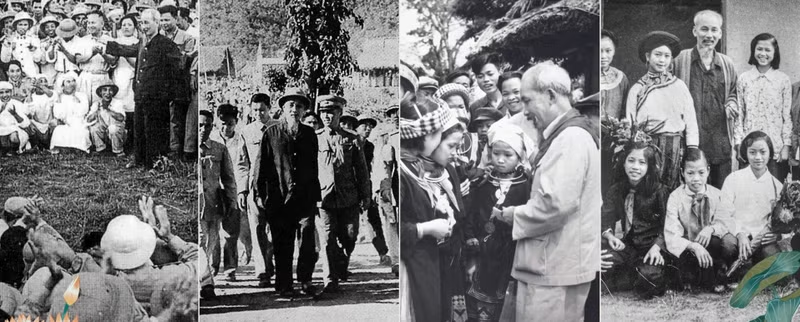
With the view that “whatever the task, it is done by people, and whether small or large, near or far, it is always so”[2], Ho Chi Minh affirmed that the most important driver of national development is the human being, understood on two levels: the individual and the community.
For the individual to become a driver of development, it is necessary to address legitimate needs and interests and to promote the people’s right to mastery and their sense of ownership. For the community, patriotism, national spirit, solidarity and creativity constitute an unparalleled driving force that has enabled the Vietnamese nation to stand firm in the face of countless severe trials with the posture of a victor.
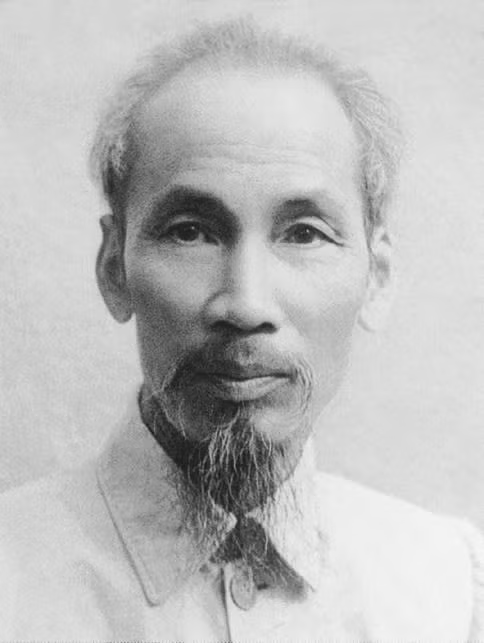
Drivers of development always exist in potential form; therefore, the leadership must know how to harness them proactively and scientifically. Ho Chi Minh thus attached great importance to political drivers, including the leadership role of the Party, state management and the unifying role of the National United Front, in which the Party’s leadership plays the “core” role.
As all social activities are grounded in the economic base, President Ho Chi Minh paid particular attention to promoting economic drivers. He held that to build economic potential and turn the economy into a driver of development, it was necessary to adopt scientific and democratic management methods, apply scientific and technological achievements to production, and vigorously practise thrift while combating embezzlement and waste.
By correctly identifying and promoting development drivers, and resolutely pushing back obstacles such as sabotage by hostile forces, outdated customs and traditions, and individualism in all its forms, President Ho Chi Minh led the Vietnamese nation to resounding heights in the cause of safeguarding the Fatherland.
As an experienced international activist, Ho Chi Minh greatly valued the role of international drivers, including cooperation among nations, the support of humanity and advanced scientific and technological achievements. However, he emphasised that internal strength plays the decisive role, and that promoting external drivers is to enhance internal power.
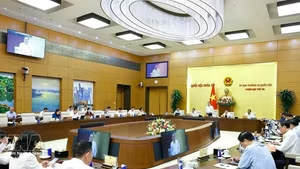
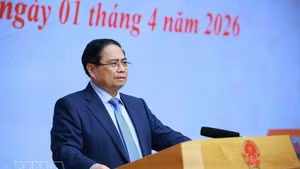
In pursuing President Ho Chi Minh’s aspiration for development, based on 40 years of Doi Moi (Renewal) achievements and the rapid changes in the global and domestic situation, the Communist Party of Viet Nam has launched the “Era of the Vietnamese nation’s rise”.
This is an era of breakthrough development along socialist lines to achieve the goals of peace, independence, democracy, prosperity, strength, civilisation and happiness under the Party’s glorious banner.
The time “window” to realise these goals is little more than two decades. Yet alongside the four risks identified in 1994, which still persist and in some respects have become more acute, Viet Nam now faces a range of new challenges such as the “middle-income trap”, “growing old before growing rich”, and “climate refugees”.
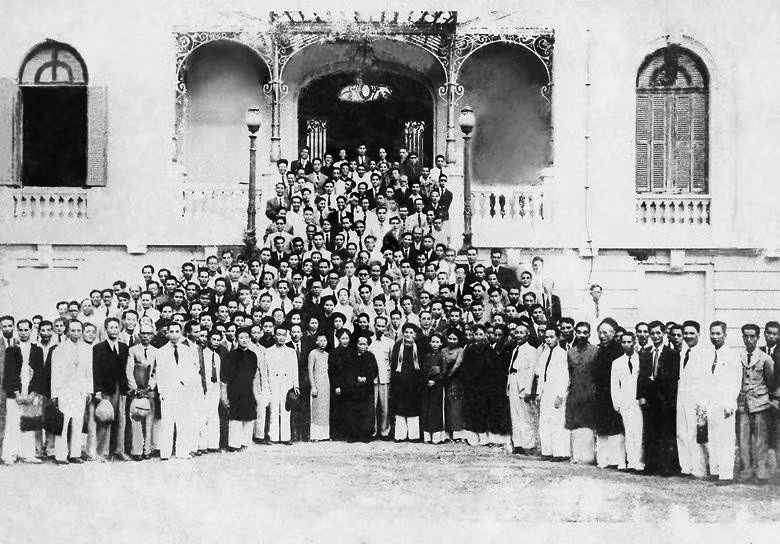
To overcome these risks and achieve rapid yet sustainable development, Viet Nam must strongly promote its current system of development drivers.
First and foremost, there must be a breakthrough in institutions to unlock all resources and potential of the country. Identifying this as the “bottleneck of bottlenecks”, the 13th Politburo issued Resolution No. 66-NQ/TW on reforming law-making and law enforcement to meet the requirements of national development in the new era.
In carrying out this task, it is essential to engrave in our hearts President Ho Chi Minh’s instruction that “the law is the law of the people, used to prevent acts harmful to the people and to protect the common interests of the overwhelming majority of the people”[3], and therefore to guard against the “insertion of group interests” in the legislative process.
It is also necessary to “refer selectively to the constitutions of friendly countries and of certain typical capitalist countries”[4] so that Viet Nam’s legal system is both compatible with the world and suited to national conditions.
Viet Nam must harness the strength of its socialist-oriented market economy model. Material prosperity will enable the country to improve living standards, strengthen national defence capabilities and enhance its international standing.
To this end, a series of measures must be implemented: establishing a new growth model based on the power of science, technology and digital transformation; accelerating the comprehensive restructuring of the economy; and fully promoting the functions and roles of all economic sectors, with the private sector as one of the most important drivers.
Vietnamese culture and people are indispensable drivers, for no nation has ever been able to “take off” and develop without relying on the strength of its culture and people.
As global integration deepens, culture is the soul and the “identity card” of each nation; only those with strong cultural internal strength can avoid assimilation and absorb the quintessence of human culture.
Sustainable development requires a harmonious combination of economic growth with social progress, social justice, national defence and security, and environmental protection, with the ultimate aim of serving people in both the present and the future.
In implementing Ho Chi Minh’s thought on international solidarity, Viet Nam must continue to promote proactive and creative international integration in order to create a favourable environment for entering the era of national rise, gradually becoming a subject that plays a role in shaping regional and global institutions.
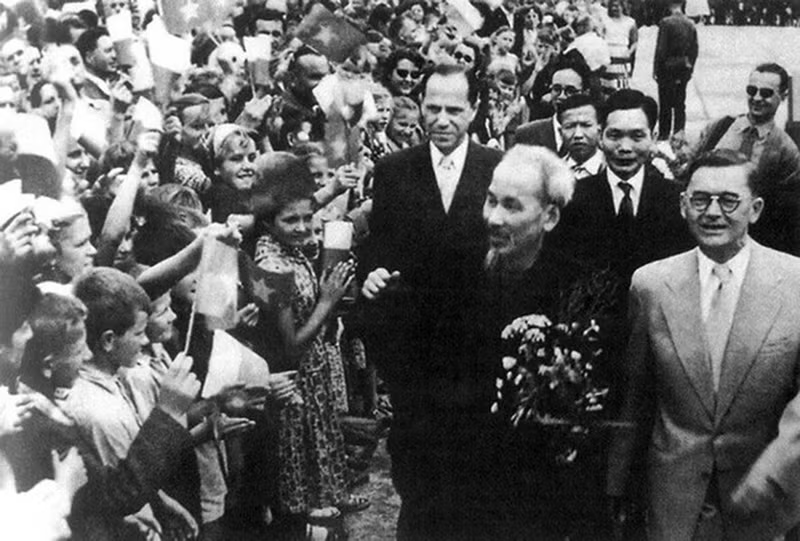
Most importantly at this time is to promote the strength of the Communist Party of Viet Nam as the sole leadership force of the Vietnamese nation. It is necessary to engrave in our hearts President Ho Chi Minh’s instruction that each Party member must wholeheartedly serve the people, because “if we do so, however great or difficult the task, we will certainly achieve victory”[5].
The Party must also renew itself to become a symbol of “civilisation”, with modern thinking, democratic leadership methods and the capacity to adapt to all fluctuations of the times, in order to fulfil its commitment to lead the Vietnamese nation to prosperity and happiness.
Prosperity and happiness are “open” indices that are constantly elevated. President Ho Chi Minh once affirmed that Viet Nam is “a nation with a long-standing culture, yet fully capable of rejuvenation”[6]. In realising his aspiration, Viet Nam must demonstrate itself not only as a nation that “dares to fight” and “knows how to win” in wars of national defence, but also one that knows how to “rise” for development. That is the Party’s pledge of honour and the self-respect of a nation with a long-standing civilisation in its journey to “reposition” itself in the development trajectory of humanity.
--------------------------
[1] Ho Chi Minh: Complete Works, National Political Publishing House, Ha Noi, 2011, Vol. 2, p. 282.
[2] Ho Chi Minh: Complete Works, ibid., Vol. 5, p. 281.
[3] Ho Chi Minh: Complete Works, ibid., Vol. 9, p. 259.
[4] Ho Chi Minh: Complete Works, ibid., Vol. 10, p. 510.
[5] Ho Chi Minh: Complete Works, ibid., Vol. 15, p. 616.
[6] Ho Chi Minh: Complete Works, ibid., Vol. 4, p. 327.