An inevitable trend
The Government’s Strategy for the Development of Science, Technology and Innovation to 2030 identifies science, technology and innovation as important contributors to national growth and development. Politburo Resolution No. 57-NQ/TW, dated December 22, 2024, on breakthroughs in the development of science, technology, innovation and national digital transformation, sets the goal that by 2030, Viet Nam’s science, technology and innovation capabilities will reach an advanced level, placing the country among Southeast Asia’s leaders in digital competitiveness and e-government.
At the 33rd Diplomatic Conference on August 5, Minister of Foreign Affairs Le Hoai Trung stressed that science and technology diplomacy, innovation and digital transformation are becoming an important pillar of development-oriented diplomacy. They play a pioneering, connecting and enabling role in creating favourable international conditions to strengthen national capabilities in science, technology and innovation, promote mastery of strategic technologies, ensure technological security and enhance the country’s position in the emerging technological order.
According to Professor and Doctor Nguyen Van Noi, former Rector of the University of Science under Viet Nam National University, Ha Noi, and Chairman of the Viet Nam Association of Laboratories, science and technology diplomacy involves using diplomatic tools to establish networks of partners and attract global intellectual resources in order to build and strengthen domestic capabilities.
The world is witnessing a shift from “one-way technology transfer” to “co-creation of knowledge”. Viet Nam must move from a passive to a proactive approach, turning urgent practical challenges such as climate change, saltwater intrusion, green materials, renewable energy and food safety into part of the international research agenda. In doing so, the country can create a global testing ground.
In recent years, research institutes, universities and many businesses have stepped up cooperation and networking efforts to attract international knowledge, technology and experts. The Viet Nam Academy of Science and Technology and the Viet Nam Academy of Social Sciences have intensified science and technology diplomacy, signing cooperation agreements with international institutes and universities to access and learn from global knowledge, train human resources, participate in joint research, master technologies and eventually develop new technologies in support of national development.
The University of Science under Viet Nam National University, Ha Noi, has successfully implemented several key projects, including the project on education and research in analytical science (OEPAC), in cooperation with the University of Tokyo and the Japan Analytical Instruments Manufacturers’ Association (JAIMA), and the project on food safety and environmental monitoring (SATREPS EDFEN), in cooperation with Waseda University, the University of Tokyo and JAIMA. These projects have provided significant momentum for improving the quality of education and research in analytical science and technology, food safety and environmental monitoring in Viet Nam.
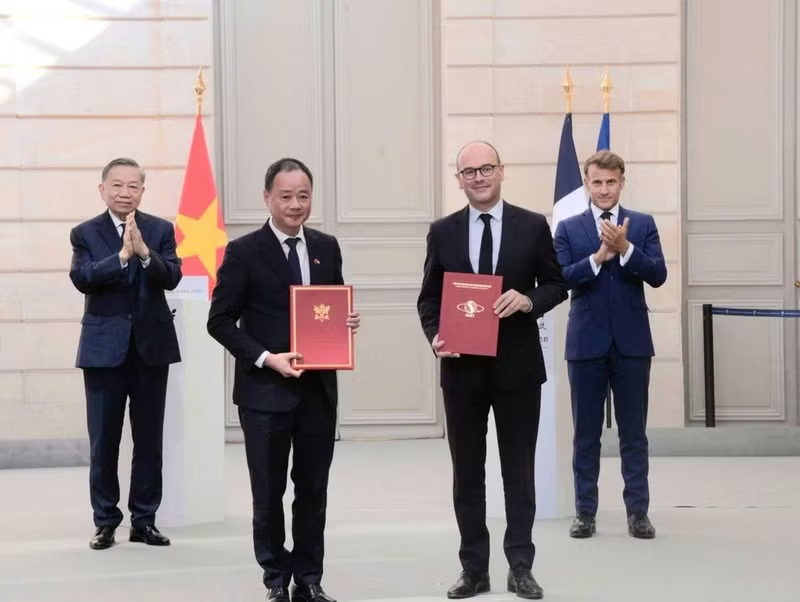
As a member of the high-level delegation accompanying General Secretary and President To Lam on his State visit to Russia, official visit to France and attendance at the Space Summit in Paris from September 7 to 12, Professor and Doctor Tran Hong Thai, President of the Viet Nam Academy of Science and Technology, said that Viet Nam would strengthen cooperation with Russia in strategic scientific fields.
These include nuclear physics, nuclear energy, new energy and advanced energy systems, foundational digital technologies, space technology, small satellites, remote sensing, unmanned aerial vehicles (UAVs), autonomous systems and advanced materials technology.
With France, Viet Nam is promoting cooperation in space technology. The VNREDSat-1 Earth observation satellite is one of the notable outcomes of scientific and technological cooperation between the two countries. Cooperation between the Viet Nam Academy of Science and Technology, the French National Centre for Space Studies (CNES) and Airbus Defence and Space is being expanded towards the next generation of Earth observation satellites. In the long term, Viet Nam aims to develop and gradually master Earth observation satellites, satellite constellations and space data infrastructure.
Mastering and co-creating technology
The ultimate goal of international scientific cooperation is to master technology. A country can only master technology when it has its own knowledge base, human resources and innovation ecosystem.
At the University of Science under Viet Nam National University, Ha Noi, international cooperation is based on clear criteria, including access to international education standards, technological autonomy for community benefit and the ability to expand innovation networks. Key laboratories are operated as open ecosystems, strongly promoting academic exchange.
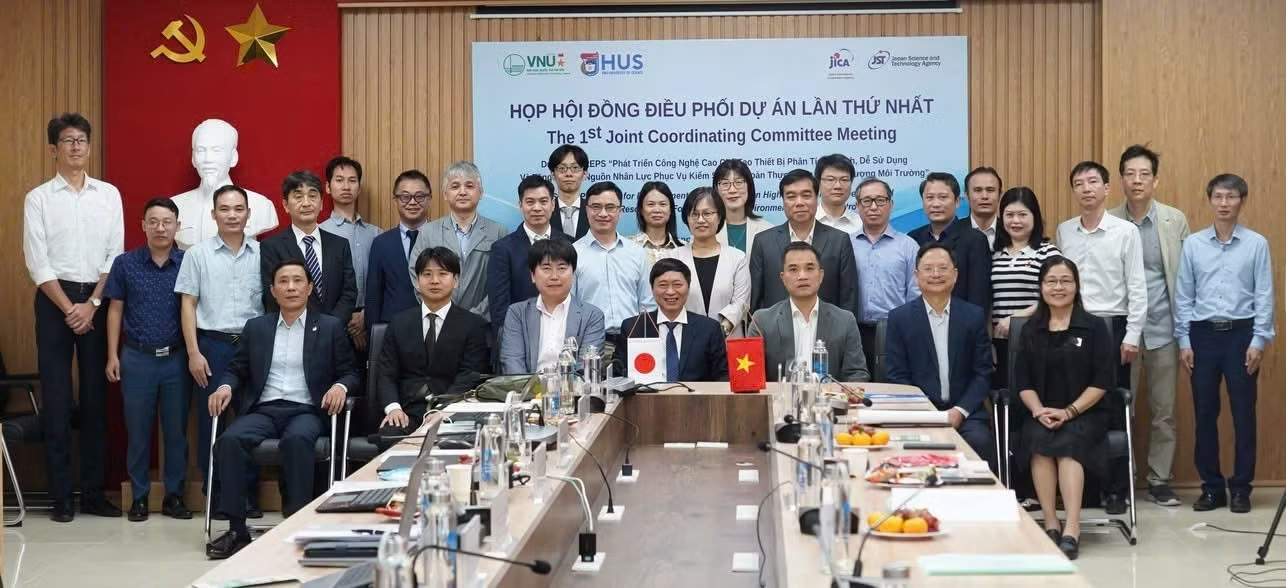
International professors and experts regularly work and cooperate closely with Vietnamese researchers, helping create internationally recognised scientific products and research.
According to Professor and Doctor Nguyen Van Noi, the core value of science and technology diplomacy lies not only in the investment and infrastructure secured, but also in the ability to attract knowledge and leading experts, forge close links with the international expert community, and provide a springboard for Vietnamese students to access and reach leading educational standards.
Science and technology diplomacy may begin with high-level commitments, but its success is determined by the absorptive capacity, proactiveness and spirit of cooperation of domestic and international researchers.
The core value of science and technology diplomacy lies not only in the investment and infrastructure secured, but also in the ability to attract knowledge and leading experts, forge close links with the international expert community, and provide a springboard for Vietnamese students to access and reach leading educational standards.
Professor and Doctor Nguyen Van Noi
The Viet Nam Academy of Science and Technology is focusing on reforming its international cooperation model, moving from “staff exchanges-scientific seminars-research projects” towards a model of “co-development of technology”. The cooperation model comprises four elements: establishing joint laboratories and research groups in Viet Nam; implementing long-term co-funded programmes centred on specific technological challenges; training experts under a “train-the-trainer” model, in which core personnel are trained to subsequently train domestic teams; and involving businesses from the R&D stage to establish a value chain from research and prototyping to testing, production and commercialisation.
Professor and Doctor Tran Hong Thai said that when designing a cooperation programme, it is essential to clearly define the areas to be mastered by the Vietnamese side, mechanisms for sharing data and research results, intellectual property rights, and milestones for assessing capacity. This helps ensure that technology transfer is closely linked to strengthening domestic capabilities, rather than merely receiving products or equipment. If, after a project, Viet Nam has only gained an additional piece of equipment without developing a team of experts capable of understanding, modifying and developing the next generation of that equipment, the cooperation cannot be considered a complete success.