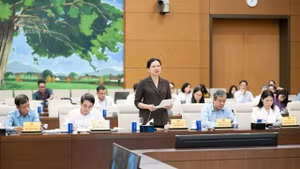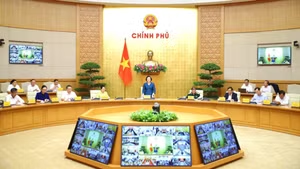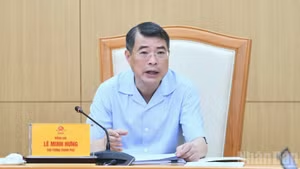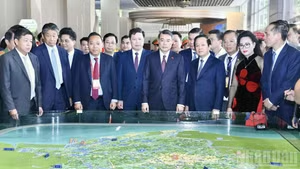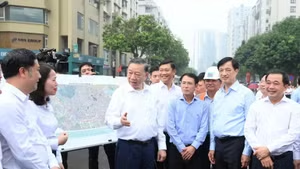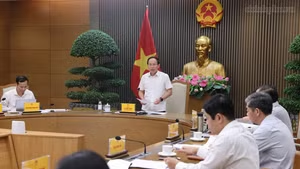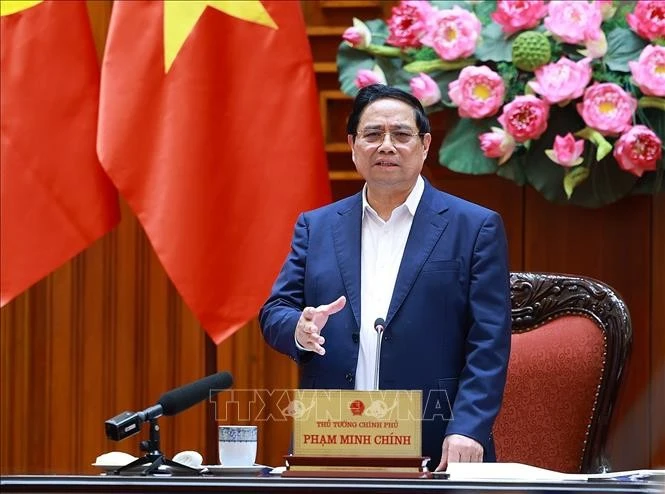
The event aimed to review and address bottlenecks in the investment and construction of the Lao Cai-Ha Noi-Hai Phong railway, the North-South high-speed railway, and urban railway projects in Ha Noi and Ho Chi Minh City.
Concluding the meeting, the PM stressed that, up to this point, the Government and ministries and sectors have focused on basically completing the institutional framework, including laws, decrees and resolutions of the National Assembly and the Government. The Lao Cai-Ha Noi-Hai Phong railway project has been actively implemented, with construction beginning on projects related to the Lang Son-Ha Noi line and the Mong Cai-Hai Phong line. At the same time, projects related to the North-South high-speed railway have also begun to be rolled out.
The Government leader requested that the Ministry of Science and Technology and the Ministry of Construction review regulations and standards on the basis of international experience, thereby selecting appropriate technologies for the construction of the North-South high-speed railway project. On that basis, they are to develop standards, procedures and approaches for selecting investment models, including public investment, public-private partnership and private investment, ensuring optimal and harmonised benefits among participating stakeholders; and avoiding group interests, negativity and corruption.
Regarding the Lao Cai-Ha Noi-Hai Phong railway project, PM Chinh noted that the Chinese side has assessed Viet Nam’s implementation as 1.5 to 2 years faster than similar projects that China has undertaken with other ASEAN countries.
For its first component project, which has already been launched with an investment of over 2 trillion VND (75.95 million USD), he instructed the Ministry of Construction to ensure the schedule is met, or even completed ahead of plan. In particular, the preparation of the pre-feasibility study for the project should be accelerated and completed no later than March 2026; thereafter, the rail connectivity agreement between Viet Nam and China must be finalised.
In terms of investment capital, the Government has currently allocated 16 trillion VND, with the capacity to allocate and disburse approximately 40-50 trillion VND each year.
On human resources, the PM directed that a roadmap be developed from now until the end of 2026 to complete the identification of the demand for railway development, specifying numbers, qualifications and fields. At the same time, a roadmap for localisation of the railway industry should be developed, initially focusing on lines connecting with China, with maximum efforts to localise locomotives, carriages, control systems, rails and systems from ground level downwards.
“The development of the railway industry should be pursued in the spirit of not only serving Viet Nam, but also contributing to meeting the needs of other countries in the region; participating in the railway ecosystem for developed countries,” the PM stressed.
For the North-South high-speed railway, he requested that the Ministry of Construction urgently complete the selection of consultancy services for surveys in accordance with regulations by January 2026.
With regard to urban rail lines in Ha Noi and HCM City, he suggested that, based on experience from lines already in operation, the two cities should select technologies with unified and interoperable standards and regulations, capable of shared use; gradually localise components, routes, stages and types of technology; ensure systems that are universal, advanced, modern and sustainable over the long term; and progressively transfer technology and build supply chains for participating enterprises.
Later in the evening, under the chair of PM Chinh, the permanent Cabinet members also met to discuss the implementation of the Ninh Thuan 1 nuclear power plant project. In recent times, the Government has directed a strong focus on completing the institutional framework related to the project, including the promulgation of various laws, decrees and circulars. Viet Nam has also held multiple working sessions with the Russian side. To date, the two sides are negotiating an intergovernmental agreement on cooperation in the construction of the plant.
The standing members provided opinions aimed at resolving outstanding issues within January 2026 in order to implement the project, while continuing to address practical obstacles related to site clearance and other issues concerning this strategic project.