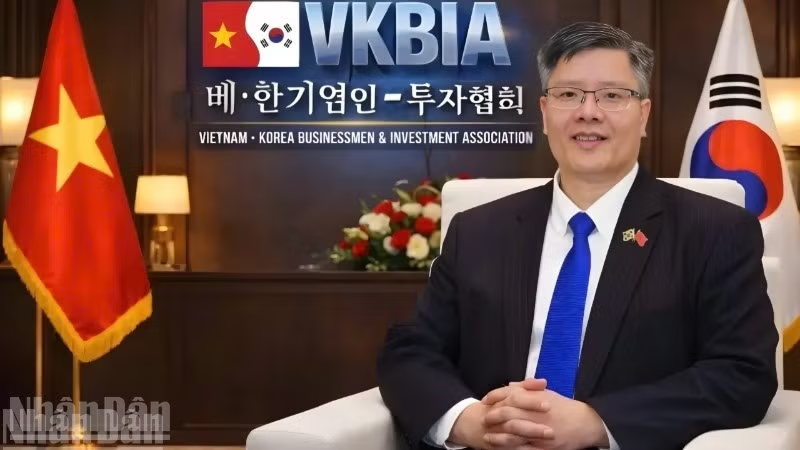
Currently living and working in the Republic of Korea (RoK), Dr Tran Hai Linh, member of the Central Committee of the Viet Nam Fatherland Front, Chairman of the Viet Nam–Korea Business and Investment Association (VKBIA), and Founding Chairman of the Viet Nam–Korea Experts and Intellectuals Association (VKEIA), continues to follow every step of the nation’s development.
On the occasion of the nation’s festival on March 15, 2026 — the day of the election of deputies to the 16th National Assembly and People’s Councils for the 2026–2031 term — Dr Tran Hai Linh shared with reporters from Nhan Dan Newspaper his views on the significance of this important political event and his expectations for the upcoming National Assembly.
The 15th National Assembly: A mark of resilience and adaptability
Looking back on the five-year journey of the 15th National Assembly, Dr Tran Hai Linh believes this was a particularly distinctive term — not only because of the achievements accomplished, but also because of the extraordinary challenges the legislature had to overcome.
The COVID-19 pandemic broke out at the very beginning of the term; wars, geopolitical conflicts, and global inflation subsequently created waves of uncertainty threatening domestic macroeconomic stability. In such a context, the National Assembly demonstrated the role of a resilient legislative body: capable of rapid response while maintaining long-term strategic direction.
According to Dr Tran Hai Linh, the most notable hallmark was the legislature’s capacity for “rapid-response lawmaking” during the pandemic. Unprecedented special resolutions enabled the Government to implement urgent packages of medical, financial, and social welfare support, helping millions of citizens and businesses withstand the storm. More importantly, however, the National Assembly did not stop at crisis management. This term also left a profound imprint in completing the socialist-oriented market economic framework, with a series of major laws amended or newly enacted to ensure greater coherence and substance in fields such as investment, land, enterprises, science and technology, and digital transformation.
Supervisory activities also saw a clear shift towards greater depth. Question-and-answer sessions were no longer merely formalities, but increasingly addressed pressing issues affecting everyday life: prices, energy, healthcare, education, and the disbursement of public investment. The spirit of power oversight has become increasingly evident in parliamentary debates, creating positive pressure on the executive apparatus to act more decisively and transparently. This reflects a maturing democracy.
However, Dr Tran Hai Linh notes that experiences from the past term also highlight lessons that the new National Assembly should seriously consider: legislative thinking must be closely linked with implementation capacity to avoid laws that are “correct in principle but difficult in practice”; supervisory activities must follow through on post-recommendation rectification; and, above all, the level of expert input and scientific criticism in parliamentary debates must be enhanced so that every decision is grounded in solid knowledge and practical realities.
The nation’s festival — Confidence in the power of the people
Assessing the significance of the nation’s festival on March 15, Dr Tran Hai Linh emphasised that March 15, 2026 is not an ordinary date on the calendar. It is the nation’s festival, when tens of millions of Vietnamese voters from north to south, from distant islands to Vietnamese communities in the RoK, Japan, Europe, and across the world all turn towards the homeland with full love and responsibility. Each ballot placed in the box carries a message of trust and reaffirms the people’s right to mastery – the sacred power granted by the Constitution to every citizen.
As a Vietnamese living and working in the RoK, Dr Tran Hai Linh feels deeply the sacredness of this moment. The community of entrepreneurs, experts, and intellectuals among overseas Vietnamese — those who shoulder the daily responsibility of connecting Viet Nam with the world — are awaiting this national festival with great confidence and expectation. According to Dr Tran Hai Linh, the quality of the National Assembly determines the quality of institutions, and the quality of institutions determines the pace and depth of national development.
“The nation’s festival on March 15 comes at a time when the Resolution of the 14th National Party Congress has just been adopted, setting out ambitious yet entirely achievable development goals, provided there is a National Assembly with sufficient vision, courage, and aspiration to create the legal foundations for the country to rise. This is precisely the close link between today’s election and the nation’s future tomorrow,” Dr Tran Hai Linh shared.
An action programme contributing to the realisation of the goals of the 14th National Party Congress
Speaking with Nhan Dan Newspaper, Dr Tran Hai Linh stated that the 14th National Party Congress set out clear strategic objectives: rapid and sustainable development; growth driven by productivity, innovation, and science and technology; the building of an independent and self-reliant economy associated with deep international integration; and the comprehensive development of people.
According to Dr Tran Hai Linh, to realise these goals, the role of the National Assembly in constructing the legal framework is indispensable and irreplaceable. First and foremost, the 16th National Assembly must prioritise the completion of the socialist-oriented market economy institution — the foundation for unlocking all social resources.
This requires a legal system that is stable, transparent, and predictable, minimising overlaps and “policy lag”. These barriers currently reduce the competitiveness of Viet Nam’s investment environment compared with other economies in the region. When enterprises and investors feel secure and confident in the law, creativity and entrepreneurial spirit will be strongly unleashed.
Secondly, pioneering sectors of the future such as the digital economy, green transition, innovation, artificial intelligence, green industry, and green energy must be promptly codified with open-minded thinking and controlled experimentation. The National Assembly should prioritise the drafting of a Law on the Digital Economy and a Law on Digital Transformation, while finalising the legal framework for the carbon market and green finance, and establishing regulatory sandbox mechanisms for innovative business models in fintech, smart logistics, and cross-border digital trade. These are tools that leading countries in the region have already successfully deployed, and Viet Nam cannot afford to fall behind.
Thirdly, to fulfil the goals of the 14th National Party Congress regarding productivity and growth quality, the National Assembly should promote institutional reforms linked with improvements to the investment and business environment: protecting property rights and legitimate business freedoms, and creating fast-track approval mechanisms for high-technology and high-value green projects.
At the same time, regulations encouraging stronger linkages between FDI enterprises and domestic firms must be strengthened, promoting technology transfer and building domestic supply chains so that Viet Nam does not remain merely a low-cost manufacturing workshop, but rises to become a strategic partner in global value chains.
Expectations for the new term: Benefits for the nation, overseas Vietnamese, businesses, and citizens
Sharing his expectations for the 16th National Assembly, Dr Tran Hai Linh hopes the new term will deliver substantive changes that create value for every citizen, every enterprise, and the overseas Vietnamese community.
For the nation, he expects this term to witness the formation of a modern, coherent, and forward-looking legal ecosystem, where laws serve not merely to manage but to open pathways to the future. When the National Assembly promulgates guiding laws for the digital economy, the green economy, and innovation, Viet Nam will attract not only a greater quantity of next-generation FDI flows, but also higher-quality investments with advanced technological content, knowledge transfer capabilities, and deeper integration into global value chains.
For the overseas Vietnamese community — with more than six million Vietnamese living, working, and contributing around the world — Dr Tran Hai Linh hopes the 16th National Assembly will establish a truly attractive legal framework that protects the interests of overseas entrepreneurs, experts, and intellectuals. From mechanisms recognising professional qualifications, preferential tax policies for returning experts, to effective connectivity frameworks linking overseas specialists with domestic research institutions and businesses, all must be clearly codified in law rather than remaining general calls for contribution.
When overseas Vietnamese feel respected, protected, and able to contribute meaningfully, the intellectual and social capital of this community of more than six million people will become a genuine strategic asset for the nation.
For the business community, what entrepreneurs — both domestic and FDI — expect most is not preferential treatment but fairness, transparency, and policy predictability. A stable legal environment that does not change abruptly; licensing procedures that are standardised and digitalised; and strong protection of intellectual property and property rights. These are the foundations businesses need to confidently make long-term investments, transfer technology, and build innovation ecosystems in Viet Nam.
“Every election offers the nation an opportunity to reflect on the journey already travelled and to look ahead with renewed expectations. The nation’s festival on March 15, 2026 is such a moment, when tens of millions of ballots converge towards a shared aspiration: a prosperous, civilised, and happy Viet Nam.”
Dr Tran Hai Linh, member of the Central Committee of the Viet Nam Fatherland Front and Chairman of the Viet Nam–Korea Business and Investment Association (VKBIA)
For the people, the policies of the National Assembly must ultimately be judged by a simple yet profound criterion: have people’s lives improved? Are there more and better employment opportunities? Are healthcare, education, and social welfare more substantively guaranteed? When the National Assembly builds an economy driven by knowledge and innovation, the fruits of that growth must be widely shared so that no one is left behind in the nation’s journey of advancement.
Dr Tran Hai Linh believes that each election is a moment for the nation to reflect on its path and move forward with renewed expectations. The nation’s festival on March 15, 2026 is such a special moment, when tens of millions of ballots converge towards a common aspiration: a prosperous, civilised, and happy Viet Nam.
“I believe in the 16th National Assembly, and in the representatives who will be chosen by the people — individuals with the integrity, capability, and courage to shape the legal foundation for a new stage of development full of challenges but also immense opportunities. Above all, I believe in the strength of the Vietnamese people — a nation that has overcome countless historical trials and has never abandoned its aspiration to rise. With that spirit, on March 15, 2026, together with millions of overseas Vietnamese and compatriots at home, I will turn towards the homeland with all my faith and love. For this is not merely an election day; it is the day we continue writing the proud history of the Vietnamese nation,” Dr Tran Hai Linh expressed.
![[Infographic] Key points from General Secretary and President To Lam’s opening remarks at the 14th PCC’S 4th plenum](https://en-cdn.nhandan.vn/images/j0QNt7m_5iy1OXpnUKiwG61aYhTv_B140GWhfriF26JwZbNNJ8LWetfvXUhz4Az6/1-8220.jpg.avif)