Viet Nam is entering a new stage of development with increasingly high demands for competitiveness and adaptability. As such, the organisation of the state apparatus must move towards greater flexibility, streamlining, and efficiency. The consolidation of the roles of General Secretary and President is the result of a carefully studied and scientifically grounded process aligned with practical realities. Previously, under objective conditions, Viet Nam had implemented this model and achieved positive outcomes, including shortening decision-making processes and enhancing consistency between policy direction and implementation.
At the core of this consolidation is the unification of authority, avoiding fragmentation and overlap. When the Party leader simultaneously serves as the head of State, policies and directives can be translated directly into state actions without passing through multiple intermediary layers. This helps reduce policy lag—a critical factor in an increasingly competitive global environment. Many analysts argue that within a single-party political system, alignment between Party leadership and State governance is essential to ensuring consistency in the exercise of power. Consolidation enables the system to operate more smoothly and cohesively, reducing situations where directives are strong at the top but weak in execution below. At the same time, individual accountability is strengthened, while collective power control mechanisms remain in place through the Politburo, the Party Central Committee, and the National Assembly.
Historically, this model has been applied during key periods of Viet Nam’s revolutionary development. In the early years of nation-building, when unity of will and action was paramount, President Ho Chi Minh simultaneously held the highest positions in both the Party and the State. He served as President of the Democratic Republic of Viet Nam from January 1946 to September 1969, and as Chairman of the Party from February 1951 to September 1969 (the highest position in the Party at that time). More recently, in September 2018, late General Secretary Nguyen Phu Trong was elected President by the 14th National Assembly, holding both positions from October 2018 to April 2021. To Lam himself also held both roles from August to October 2024.
In the current context, the need for consolidation arises from both internal system requirements and external realities. The world is entering an era of comprehensive strategic competition, where the speed of decision-making and policy implementation is crucial. A cumbersome and fragmented apparatus would struggle to meet such demands, whereas a unified and clearly structured system can generate synergistic strength, enabling the country to better seize development opportunities.
Globally, several countries adopt models in which the head of the ruling party also serves as head of state. In practice, such arrangements have often facilitated the mobilisation of national resources for long-term strategic initiatives. Concentrated leadership can support the implementation of large-scale projects — from infrastructure and technology to defence — without disruption caused by fragmented authority. While each country has its own specific conditions, a common trend is the strengthening of leadership unity to enhance governance effectiveness. Viet Nam, in its deepening international integration, is no exception.
From both theoretical and practical perspectives, the consolidation of the positions of Party General Secretary and President is a suitable step in the new development era. It is also an inevitable requirement in building a socialist rule-of-law state, contributing to improved leadership effectiveness and governance efficiency. At the same time, this policy aligns with global trends in organisational reform and responds to practical demands arising from National Assembly activities and the new term’s urgent requirements.
Internationally, media outlets such as The Straits Times and Channel NewsAsia cited expert opinions suggesting that with General Secretary To Lam concurrently serving as President, Viet Nam will enhance its capacity to implement economic development policies, improve living standards, maintain political stability, pursue a balanced foreign policy, sustain cooperation with major powers, and promote international economic integration.
However, it is unsurprising that organisational changes in Viet Nam have been distorted by hostile forces. Exploiting public attention, some extremist individuals and groups have attempted to misrepresent this development as “authoritarianism”, “absolute concentration of power”, or even a “setback for democracy”. It must be emphasised that within Viet Nam’s governance framework, no individual can stand above the collective. Even when holding dual roles, the leader must adhere to the principle of “collective leadership with individual responsibility”.
All major policy decisions are subject to democratic discussion within the Politburo and Party Central Committee, made in accordance with democratic centralism, and overseen and approved by the National Assembly. Rather than weakening power control mechanisms, consolidation clarifies responsibilities and strengthens accountability. It does not alter the nature of power, but instead enables it to operate more efficiently, reducing conflict and improving responsiveness to rapid domestic and international developments.
Amid ongoing reforms—from administrative restructuring to civil service streamlining—the consolidation reflects a consistent reform mindset: prioritising efficiency and serving the people. A streamlined and well-functioning apparatus allows policies to reach citizens more quickly and effectively. However, organisational reforms can only succeed with broad social consensus, public trust in Party and State leadership, and coordinated efforts across the political system. When people fully understand the nature and objectives of consolidation, they will recognise it not as a formal change, but as a step towards enhancing national governance quality.
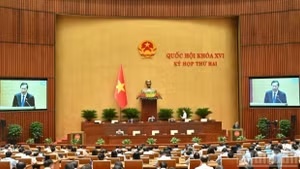
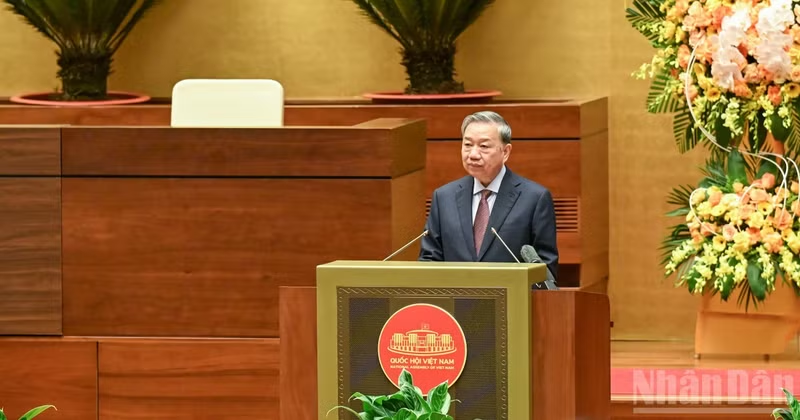
The National Assembly’s unanimous vote electing General Secretary To Lam as President reflects strong confidence, unity, and consensus in both will and action, as well as the deep trust and expectations of the Party and the people.
The National Assembly’s unanimous vote electing General Secretary To Lam as President reflects strong confidence, unity, and consensus in both will and action, as well as the deep trust and expectations of the Party and the people. This event is not only a milestone in high-level personnel work but also a strategic move to streamline the system, optimise internal strengths, enhance leadership effectiveness and ensure coherence between Party leadership and state governance — thereby enabling policies to be implemented more swiftly, consistently, and in line with reality.
With the Party leader also serving as head of State, Viet Nam’s international standing is expected to be further elevated, fully reflecting the nation’s will. In this role, the country’s leader will possess both the authority and the capability to make timely and accurate decisions, remove bottlenecks, and drive national development.
Recent achievements in anti-corruption efforts, administrative reform, economic growth, and social welfare have strengthened public confidence in the Party and the State. These tangible results provide a solid foundation for society to embrace new reforms with greater proactiveness.
The current stage of development presents unprecedented demands: digital transformation, green economy, deep integration, and strategic competition — all requiring a leadership apparatus that is strong, flexible, and decisive. Enhancing leadership and governance effectiveness is therefore a prerequisite for breakthrough development. In this context, the election of General Secretary To Lam as President stands as a significant milestone, sending a clear message: Viet Nam is proactively adapting its organisational model to the demands of the times, better harnessing resources, and realising its development aspirations.