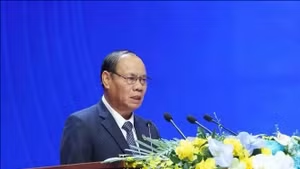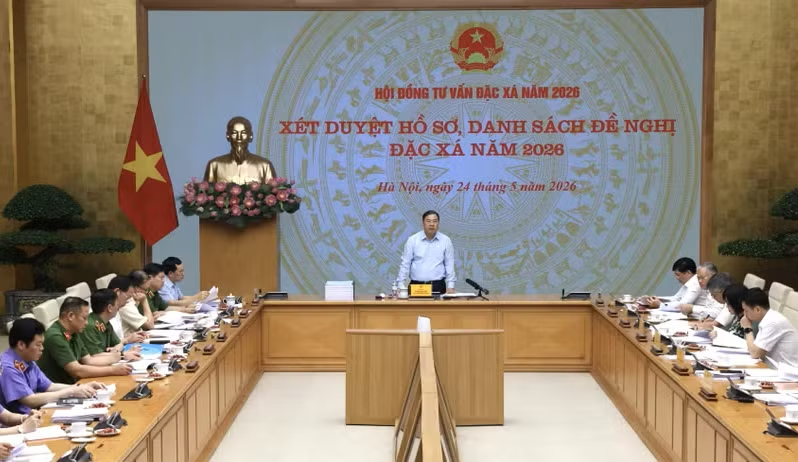
Politburo member and Standing Deputy Prime Minister Pham Gia Tuc on May 24 called for the public, transparent and prudent assessment of every case proposed for amnesty in 2026, stressing the need for strict compliance with legal regulations and humanitarian principles.
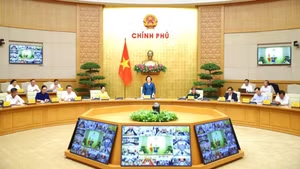
Chairing a meeting of the 2026 Amnesty Advisory Council to review dossiers and proposed lists of eligible prisoners, Tuc, who is also head of the council, underscored that clemency and humanitarian treatment to offenders reflect Viet Nam’s tradition of compassion.
He stated that while Vietnamese law maintains strict punishment for masterminds, repeat offenders and those resisting rehabilitation, it also demonstrates leniency toward prisoners who sincerely repent, make efforts to atone for their crimes and seek reintegration into society.
Since the adoption of the Amnesty Law, Viet Nam has granted amnesty in 12 rounds from 2009 to the present, benefiting more than 118,000 inmates who demonstrated good conduct and rehabilitation. The majority of those granted amnesty have successfully reintegrated into society, secured stable livelihoods and avoided reoffending, with the recidivism rate remaining relatively low.
Tuc noted that on the occasion of the 51st anniversary of the Liberation of the South and National Reunification (April 30, 1975–2026), the success of the 14th National Party Congress, and elections for the 16th National Assembly and People’s Councils for the 2026–2031 term, and in implementation of the Amnesty Law, the State President issued Decision No. 457/QD-CTN dated April 7, 2026 on the granting of amnesty and Decision No. 481/QD-CTN dated April 9, 2026 establishing the 2026 Amnesty Advisory Council.
Despite the short timeframe and the large volume of documents (exceeding 10,000 dossiers), ministries, agencies and council members, particularly the Ministry of Public Security and the Supreme People’s Court, have worked intensively to ensure that the process is conducted rigorously and in accordance with the law, he said.
At this meeting, the council reviewed dossiers of prisoners eligible and ineligible for amnesty, as well as cases involving individuals temporarily suspended from serving prison sentences who may qualify under the President’s decision.
Standing Deputy PM Tuc urged council members to carefully examine and evaluate each individual case in a transparent and objective manner, and strictly adhere to the standards and conditions stipulated in the Amnesty Law and the President’s decisions.
The Ministry of Public Security highlighted the importance of post-release reintegration support, calling on local authorities, political and social organisations, businesses and communities to help former prisoners overcome stigma, access vocational training and secure employment in order to reduce the risk of reoffending.
For those facing particularly difficult circumstances, ministries and social organisations were encouraged to support access to loans and livelihood opportunities to help stabilise their lives and facilitate reintegration into the community.
Following the meeting, the Amnesty Advisory Council will compile and submit to the State President the list of eligible inmates proposed for amnesty for consideration and decision.