Yet few people know of another historic milestone: the mission to take control of the island and raise the national flag there in 1959, formally asserting Viet Nam's sovereignty.
A little-known historic mission
Quite by chance, the author learned from Colonel Ha Hoai Nam, son of the late Major General Ha Vi Tung, about his father's role in leading the mission to take control of Con Co Island on July 27, 1959.
Drawing on research by Dr Hoang Chi Hieu, Colonel Ha Hoai Nam recounted the memories of General Doan Khue, former Minister of National Defence, who at the time served as Political Commissar and Party Secretary of Brigade 341 stationed in Vinh Linh, Quang Tri Province, alongside Brigade Commander Ha Vi Tung, concerning this historically significant operation.
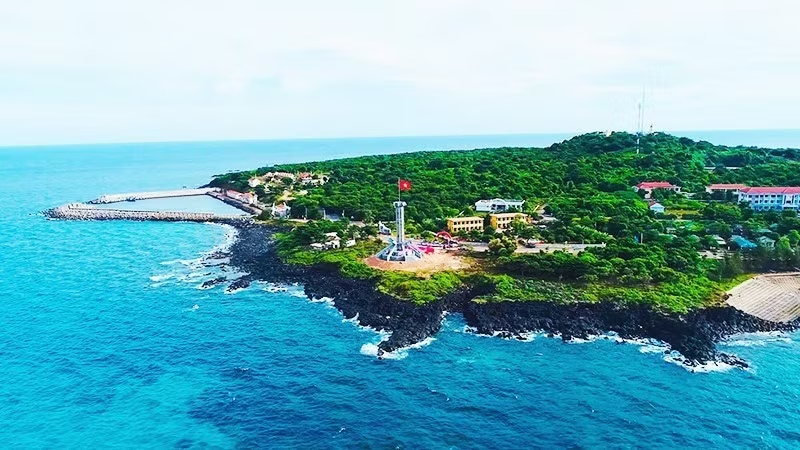
Following the 1954 Geneva Accords, although most of Vinh Linh had been liberated, Con Co Island (located between 17°08'15'' and 17°10'05'' north latitude, and 107°19'50'' and 107°20'40'' east longitude) remained completely unoccupied. Situated nearly 13 nautical miles offshore, the island commands a wide field of observation. From there, it was possible to monitor military activities of the US and the Republic of Viet Nam south of the demilitarised zone, as well as detect enemy warships from a considerable distance.
For many years, the island served merely as a temporary refuge for fishermen from Vinh Linh during bad weather. However, from 1959 onwards, establishing control over the island became increasingly urgent in order to reinforce the legal basis for, and affirm the sovereignty of, the Democratic Republic of Viet Nam over Con Co Island. This urgency arose amid a series of developments in the East Sea/South China Sea following China's declaration of September 4, 1958, as well as moves by the Saigon administration concerning the island.
Securing Con Co would provide an immense strategic advantage, enabling early detection of hostile forces, strengthening the defence of northern Viet Nam in general and Vinh Linh in particular, while also supporting the opening of maritime supply routes to the revolutionary forces in the South.
The mission was assigned to Brigade 341. Doan Khue and the brigade command promptly organised a reconnaissance mission led by Regiment Commander Ha Vi Tung to assess conditions on the island. Based on the findings, Brigade 341 decided on July 27, 1959, to deploy Company 6 of Infantry Battalion 2 to occupy Con Co, thereby formally establishing the Democratic Republic of Viet Nam's control over the island.
News that "North Vietnamese" troops had occupied Con Co sent shockwaves through military circles in Saigon, although the authorities could do little more than report the development through military bulletins and newspapers.
Laying the foundations for sovereignty
Brigade 341's deployment to Con Co effectively thwarted the Saigon administration's plans to seize the island as a forward base for threatening Vinh Linh. Just two days later, the opposing side dispatched two commando vessels carrying troops in an attempt to retake the island. Detecting the move, Company 6 opened fire, forcing the vessels to withdraw.
Immediately after securing the island, the brigade not only built a comprehensive defensive system, including fortifications, anti-aircraft positions, trenches and communication trenches around the island, but also, with support from the Vinh Linh Regional Party Committee and Administrative Committee, accelerated preparations for civilians to settle there permanently.
Permanent and temporary housing, together with essential facilities, were constructed to enable residents to live alongside the troops defending the island. Establishing effective control and creating conditions for long-term civilian settlement constituted the strongest practical evidence of the Democratic Republic of Viet Nam's sovereignty over Con Co Island.
By securing the island, Brigade 341 under Commander Ha Vi Tung gained control of a strategically vital position, expanded the country's defensive space and transformed Con Co into a frontline observation post safeguarding socialist North Viet Nam and protecting the Vinh Linh area. Through continuous construction and reinforcement, the island later became an "unsinkable battleship" in the East Sea/South China Sea throughout the US war against North Viet Nam.
For this achievement, Brigade 341 and the generations of soldiers who followed were honoured with President Ho Chi Minh's famous tribute: "Con Co blossoms with the flowers of victory/Striking the US aggressors into ruin."
The events of July 27, 1959, therefore marked a historic milestone, reflecting Viet Nam's far-sighted maritime strategy at a pivotal moment during the resistance war against the US. Among those who played decisive roles were Political Commissar Doan Khue, Lieutenant Colonel Ha Vi Tung and the officers and soldiers of Brigade 341. The raising of the national flag on Con Co Island opened a heroic new chapter in the island's history that continues to resonate today.
Covering an area of 4.4 square kilometres and located nearly 30 kilometres from Cua Viet Port, Con Co—also known as Hon Co, Con Hoi or Hon Me—became one of the fiercest battlegrounds during the war. The island fought 841 engagements, shot down 48 aircraft, sank or damaged 17 enemy warships, and endured more than 5,200 tonnes of bombs and shells. It was twice awarded the title of Hero of the People's Armed Forces.