Building national capacity
According to Dr. Nguyen Si Dung, former Deputy Head of the National Assembly Office, Resolution 19 features many "puzzle pieces" to form a new development model. These include innovation, science, and technology development; digital transformation; green economy; national governance innovation; and human resource development.
To properly implement the resolution, it is necessary to clearly understand the architecture of the new development model to determine the correct position, role, and focus of action of ministries, sectors, localities, and businesses.
The new development model that Resolution 19 set out is not a set of policies but a development architecture consisting of five organically linked layers: development resources, resource transformation system, national capacity, prosperity, and national strength.
The model's breakthrough does not lie in adding new growth drivers but in placing national capacity at the centre of the entire development process. This model operates according to five basic principles: creating capacity instead of exploiting resources; productivity is created from innovation; value is created from connection; pursuing development while creating national prosperity and strength; and finally, all subjects participate in building national capacity.
Notably, in the new model, the state is no longer the only subject creating development. Instead, businesses, people, social organisations, and universities are all subjects participating in creating national capacity. Each subject needs to determine the correct position, role, and focus of action to connect into a unified operating mechanism, converting resources into capacity, productivity, prosperity and national strength.
According to Dr Nguyen Si Dung, the biggest requirement for ministries, sectors, and localities in the new development model is not to do more things but to do the right things better. The success of localities is not only measured by the number of investment projects or the growth rate of Gross Regional Domestic Product (GRDP), but also by the innovation ecosystem, quality of human resources, quality of governance, and regional connectivity.
For ministries and sectors, each policy issued must contribute to building national capacity. Specifically, science and technology policies must aim to improve innovation capacity; financial policy must help mobilise and allocate resources more effectively; and education policy must aim to improve human capacity. For the business community, the goal is not only to expand scale or increase profits but also to master technology, improve productivity, build brands, and participate more deeply in the global value chain.
Foundation for rapid, sustainable growth
To put Resolution 19 into practice, the government has issued an action programme comprising 40 specific targets. These include striving to achieve breakthrough growth of 10% or more during the 2026-2030 period, with GDP per capita reaching around 8,500 USD by 2030; growth of 8-8.5% during the 2031-2035 period, with average income per capita reaching around 13,500 USD; and growth of around 7.5% during the 2036-2045 period, with average income per capita reaching around 28,000 USD.
Thoroughly grasping the spirit and new development thinking of Resolution 19, the Viet Nam Business Council for Sustainable Development chose the theme "Accompanying to create sustainable growth: Businesses-Locality-Nation" for the annual event of the Connecting and Sharing Programme on Sustainable Development 2026. Thereby sustainable development is not just a goal but a method of development for businesses, localities, and the government to create new growth drivers while following a self-reliant, creative, humane, sustainable, and integrated development model.
Prof. Dr. Nguyen Khac Quoc Bao, Deputy Director of Ho Chi Minh City University of Economics, said that Ho Chi Minh City in its development orientation for the 2026-2030 period will shift to a growth model based on science, technology, innovation, digital transformation, and high labour productivity; developing green economy, digital economy, circular economy, low carbon economy; and building a modern, transparent governance system, taking the satisfaction of people and businesses as a measure of effectiveness. According to this orientation, the city is focusing on three breakthroughs: completing and fully operating the international financial centre in Thu Thiem; building infrastructure connecting regions — seaports, logistics, urban railways; and bringing innovation, digital transformation, artificial intelligence, and green transformation into real productivity in every business.
Dr Nguyen Thi Huong, Head of the General Statistics Office, said that after 40 years of Renewal, the economy has begun to show signs of transitioning from a growth model with heavy reliance on the expansion of capital and labour to one driven by innovation, science, technology, and digital transformation, with a focus on enhancing labour productivity.
The clearest indication is that, on average during the 2021-2025 period, labour productivity increased by 5.2% per year, while the contribution of total factor productivity (TFP) to growth reached 47.04%. The share of value added by the digital economy in GDP also increased continuously from 12.87% in 2021 to 14.02% in 2025.
Concurrently, science, technology, and innovation are gradually shifting from supporting factors to drivers of competitiveness and value creation. These developments show that the economy is strengthening its growth drivers and laying the foundation for development during the 2026-2030 period.
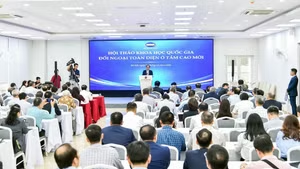
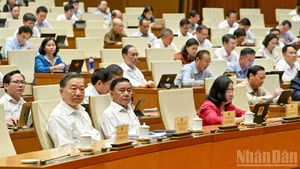
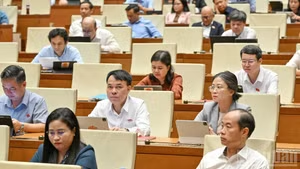
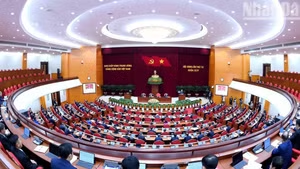
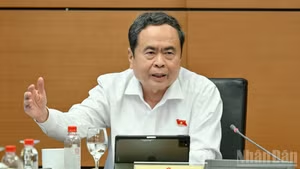
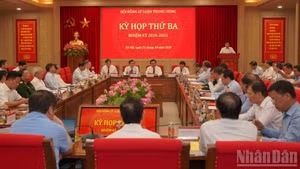
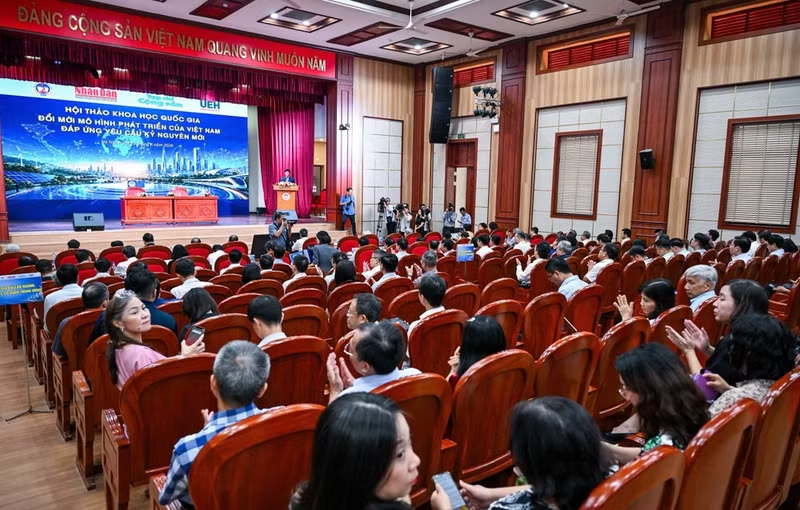
Nhan Dan Newspaper, in collaboration with the Communist Review, the National Economics University, and the University of Economics Ho Chi Minh City, held a scientific seminar titled "Innovating Viet Nam's development model to meet the requirements of the new era" in Ha Noi on August 20. The event was attended by leaders from the Party, National Assembly, and government agencies, as well as ministries and sectors, alongside experts, scientists, and theoretical researchers and representatives from universities, research institutes, the business community, and press agencies.
The joint organisation of the seminar by four major bodies is a practical step towards implementing and clarifying the scientific and practical foundations to put Resolution No. 19-NQ/TW (dated July 28, 2026) of the third Plenum of the 14th Party Central Committee on renewing Viet Nam's development model into practice.