However, as the country enters a new phase of development, Vietnamese literature and the arts are confronted with long-standing “bottlenecks” that require bold innovation in thinking, operating mechanisms, and organisational methods to unlock creative resources.
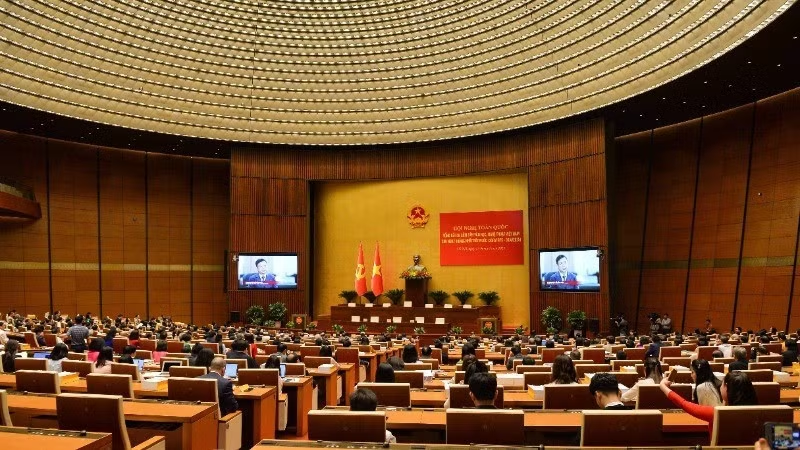
Lively discussions at recent major forums — notably the national conference reviewing 50 years of Vietnamese literature and the arts since national reunification, and the scientific seminar organised by the Ho Chi Minh City Union of Literature and Arts Associations — have frankly pointed out limitations and sought fundamental solutions to effectively implement the spirit of Conclusion 84-KL/TW, Resolution 23-NQ/TW, Resolution 33-NQ/TW, and the Party’s policy on cultural revitalisation.
Identifying the “bottlenecks” hindering creativity
The report presented at the national conference reviewing 50 years of Vietnamese literature and the arts since reunification highlighted that over the past 50 years, under the leadership of the Party, Vietnamese literature and the arts have achieved significant accomplishments and have grown robustly in theoretical thinking, creative practice, and reception trends.
However, alongside these achievements, the development of Vietnamese literature and the arts has yet to match its potential and is facing acute challenges. Notably, current theoretical and critical work has not kept pace with contemporary creative practices or the fast-changing digital content market. Many good works are not adequately recognised, while deviant phenomena can stir public noise and distort value systems. A shortage of specialised critics, a lack of high-quality academic forums, and insufficient long-term research policies have left criticism “outpaced” by a creative flow that is diverse, fast, and expansive.
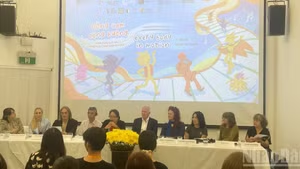
At the scientific seminar of the Ho Chi Minh City Union of Literature and Arts Associations, Nguyen Truong Luu, the chairman of the union, also stressed that many works still “revolve around personal stories rooted in specific regions” and are failing to reflect vibrant urban life or address new issues such as digital transformation, social change, or the pressures faced by citizens in a globalised era. Gaps in thematic exploration and limitations in problem formulation have prevented a segment of works from keeping pace with modern life, which evolves daily with complex issues of environment, migration, digital challenges, and consumer culture. This is not merely a technical constraint but also a call for renewed thinking, fresh perspectives and the courage to tackle difficult themes rather than remaining in safe general territory.
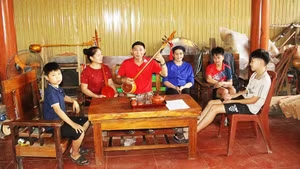
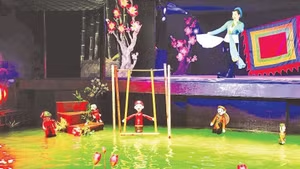
From another perspective, director and journalist Tang Hoang Thuan expressed concern that a “superficial achievement mindset” persists, particularly in the theatre sector. Many productions are created “just to win medals”, lacking a true theatrical life, with artistic value left untested. This is also one of the reasons why traditional art forms such as tuong, cheo, cai luong, and traditional musical instruments have long faced a shortage of successors.
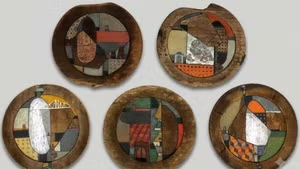
In the new era, the digital sphere provides opportunities but also major challenges, as “fast, cheap, easy-to-watch” entertainment products flood online platforms, overshadowing genuine spiritual and artistic values. Meanwhile, public art — especially urban fine arts and sculpture — has yet to fulfil its role of “beautifying the soul” and creating cultural identity. Despite being a major city with a dynamic arts scene, Ho Chi Minh City’s literary and artistic landscape, particularly regarding fine arts, still lacks “signature works” and demonstrates limited integration with urban space, as noted by Professor Dr Nguyen Xuan Tien, Chairman of the Ho Chi Minh City Fine Arts Association.
Assessing the root causes of these shortcomings, discussions among artists at various forums largely converge on the view that existing policies “have not penetrated real life”; mechanisms for organising contests, festivals, and commissioning works remain cumbersome and overly administrative. The implementation of Conclusion 84-KL/TW, which transfers responsibility for organising festivals and performances to professional associations, has been slow, resulting in artistic activities lacking professional standards and expert appraisal.
Unleashing creativity and renewing operational structures
To remove bottlenecks and create conditions for stronger development of literature and the arts, perhaps the most crucial issue — as affirmed by Professor Dr Nguyen Xuan Tien at the scientific seminar of the Ho Chi Minh City Union of Literature and Arts Associations — is the need to reform institutions and transfer real authority in line with Conclusion 84-KL/TW. This includes clarifying roles whereby state agencies focus on management, while creative and professional activities belong to specialised associations, artists, and creative entities; transferring full authority to professional associations in organising festivals and performances; and recognising professional associations as bodies of critique and appraisal. In parallel, a flexible and transparent legal framework must be established to reduce administrative procedures for artistic projects.
To prevent “achievement chasing” and improve artistic quality, many artists agree on the necessity of building a mechanism of “autonomy – accountability – transparency” for literature and arts associations, particularly in major cities such as Ho Chi Minh City and Ha Noi.
Alongside mechanism reform, it is essential to increase focused investment and foster a professional creative environment. The state should concentrate resources on priority fields, such as major works addressing contemporary themes, traditional arts, public art projects, digital creativity and multimedia arts, as well as young talent development. It is especially important to establish public–private cooperation models in culture and the arts, encouraging enterprises to invest in public art, film, theatre, and cultural industries.
Investing in creative human resources is a “precious capital”, requiring a strong shift toward training aligned with market demand and emerging creative trends, expanding international cooperation, and sending young artists abroad for study and artistic practice. Training programmes must be accompanied by creative practice environments, support for debut works, and digital platforms for promoting young artists’ creations.
Finally, across forums, artists and cultural managers consistently affirmed the vital importance of developing theory and criticism. Strengthening theory and criticism is essential to restore aesthetic orientation. Only when criticism is strong can the artistic flow become healthy, true values be honoured, and deviations corrected.
Once these measures are synchronously implemented, supported by strong political will and broad social consensus, we can fully believe that Vietnamese literature and the arts will enter a new phase of development, truly becoming a spiritual foundation and a driving force contributing to a prosperous and happy nation.