Resolution No. 80-NQ/TW dated January 7, 2026 of the Politburo on the development of Vietnamese culture (Resolution 80) marks an important turning point, reflecting a fundamental change in thinking on cultural development and investment, placing culture on a level equal to politics, economy and society, making it a pillar, an internal resource and a regulating force for rapid and sustainable national development.
Resolution 80 affirms that investing in culture is investing in the sustainable development of the country and in the future of the nation. The Resolution requires a strong renewal of thinking, unity in awareness and action to develop culture in the new era. The consistent viewpoint is that the development of culture and people is the foundation, a great driving force, a pillar and a regulating system for national development.
The orientation of Resolution 80 is consistent with the trend of globalisation and the knowledge economy, in which culture is not only a spiritual value but also soft power and a creative economic resource contributing to enhancing national standing. In the context of the Fourth Industrial Revolution and digital transformation, this new thinking helps culture adapt, becoming a bridge between tradition and modernity, between the nation and the international community, thereby creating new vitality for comprehensive development.
For a long time, awareness of investment in culture has still contained incomplete understandings. Many people, when referring to investment in culture, only think of increasing the state budget for cultural and artistic activities or building cultural institutions. This has sometimes caused investment to stop at physical works without paying sufficient attention to operational efficiency, the creative environment and the cultural market. The consequence is waste of resources, cultural products lacking attractiveness and failing to meet the increasingly high and diverse demands of the public, especially the younger generation in the context of digitalisation and integration.
Investment in culture, if only focused on infrastructure or performance activities, is not sufficient. More important is to create an environment for cultural values to spread, closely linked with social life, the economy, tourism and creative industries. When culture is regarded as a development resource, investment is no longer a cost but becomes a deep, long-term investment for the development of society.
Professor, Doctor Tu Thi Loan, President of the Viet Nam Association for Community Cultural Development
Professor, Doctor Tu Thi Loan, President of the Viet Nam Association for Community Cultural Development, said that investment in culture, if only focused on infrastructure or performance activities, is not enough. More important is to create an environment for cultural values to spread, closely linked with social life, the economy, tourism and creative industries. When culture is regarded as a development resource, investment is no longer a cost but becomes a deep investment for long-term social development. International experience such as that of the Republic of Korea demonstrates this: the shift in thinking from preservation to developing cultural industries has turned K-pop into a billion-dollar economic sector, not only generating revenue but also enhancing national image and creating jobs for many workers. Similarly, Viet Nam can learn to turn heritage such as the ao dai, cuisine or festivals into globally competitive cultural products, thereby multiplying the value of investment.
Another limitation of old thinking is the lack of connection with practical needs and the market. Many programmes and projects have been implemented in an administrative manner, without deep connection with the creative community, businesses and audiences. As a result, cultural products find it difficult to compete and fail to create wide influence. According to Associate Professor, Doctor Nguyen Thi Thu Phuong, Director of the Viet Nam National Institute of Culture, Arts, Sports and Tourism: for culture truly to become a driving force, it is necessary to shape thinking on the development of the cultural market. The State plays a guiding role, protecting core values, but must create mechanisms encouraging businesses, artists and communities to participate strongly in the production and distribution of cultural products. When the cultural market is formed and operates effectively, creative values will have the conditions to spread and play their role in social life.
To make culture truly a driving force, it is necessary to shape thinking on the development of the cultural market. The State maintains a guiding role and protects core values, but must create mechanisms encouraging enterprises, artists and the community to participate strongly in the production and distribution of cultural products.
Associate Professor, Doctor Nguyen Thi Thu Phuong, Director of the Viet Nam National Institute of Culture, Arts, Sports and Tourism
In the context of the knowledge economy and digital transformation, investment in culture needs to be understood more broadly: not only infrastructure but also investment in people, institutions and the creative environment. Professor, Doctor Ta Ngoc Tan, former Standing Vice-Chairman of the Party Central Committee Theoretical Council, emphasised that people are both the goal and the driving force of cultural development; therefore, cultural investment cannot be separated from investment in people and the improvement of social institutions shaping personality and lifestyle. This requires a shift from short-term thinking to long-term thinking, investing in arts education from the grassroots level, training creative talents so that they become pillars of cultural industries. From the perspective of state management, Minister of Culture, Sports and Tourism Nguyen Van Hung assessed that perfecting cultural institutions is a key factor, creating the foundation to mobilise social resources and turn culture into a strong driving force.
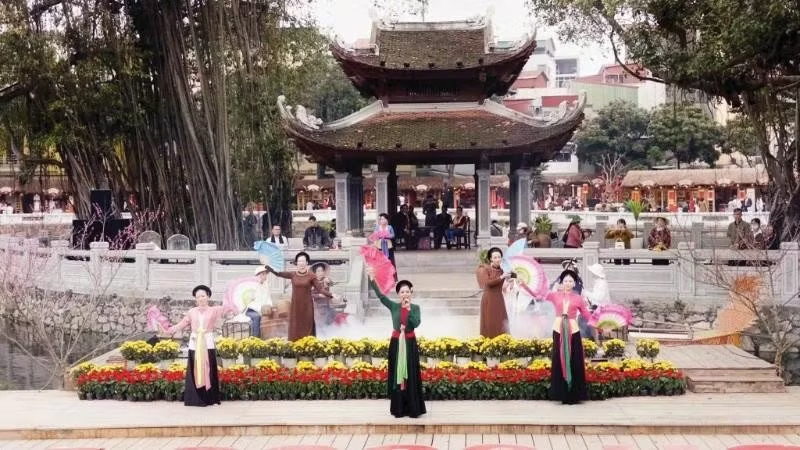
Resolution 80 emphasises building a synchronous creative ecosystem, from creation and production to distribution and consumption. If only one stage is focused on without linkage, effectiveness will be limited. Practical experience in several localities has shown that a change in thinking brings clear results. In Ha Noi, introducing contemporary art activities into heritage spaces such as the Old Quarter, the Thang Long Imperial Citadel or Van Mieu–Quoc Tu Giam has enriched urban cultural life and attracted young audiences and tourists. Street performances, interactive exhibitions and music events in heritage sites not only preserve but also “renew” heritage values, turning them into living resources.
To make culture a sustainable resource, priority must be given to changing policies, human resources and especially thinking. When society and businesses regard culture as a potential economic sector, they will be ready to invest long term, accept risks and gain socio-economic value.
Doctor Pham Viet Long, former Chief of Office of the Ministry of Culture and Information (now the Ministry of Culture, Sports and Tourism)
Doctor Pham Viet Long, former Chief of Office of the Ministry of Culture and Information (now the Ministry of Culture, Sports and Tourism), expressed the view that to make culture a sustainable resource, priority must be given to changing policies, human resources and especially thinking. When society and enterprises regard culture as a potential economic sector, they will be ready to invest long term, accept risks in exchange for socio-economic value. This thinking needs to be nurtured from education and communication to policies encouraging creativity and cultural start-ups.
Professor, Doctor Tu Thi Loan noted that soft power is increasingly important in enhancing international standing; for Viet Nam, culture is a resource creating attraction and influence. Products such as films, music, fashion and digital content have been effectively promoting the image of the country. The breakthroughs in thinking in Resolution 80 are the key leverage: when awareness changes, culture will truly become a long-term development resource, contributing to building a prosperous and happy country. Changing thinking for cultural development is an urgent requirement and a breakthrough point of Resolution 80, consistent with the trend of the times and social needs, contributing to the realisation of the vision of building a strong Viet Nam.