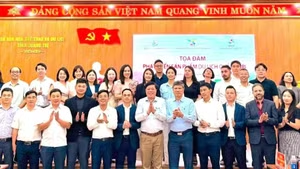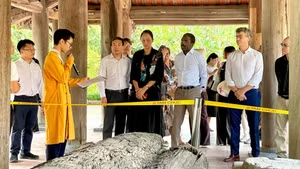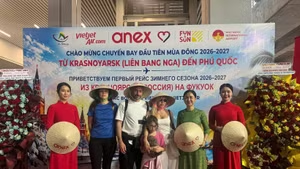
From this reality, many localities have carried out surveys and consulted experts and businesses in order to reposition resources and strengths for developing tourism products in their areas.
This is a necessary step to adapt to the new tourism space. For example, many communes and wards of Ha Noi have conducted surveys to clearly identify resources and develop tourism products. The city also hopes that each commune and ward will have its own distinctive tourism product.
However, when looking more deeply into the issue, certain shortcomings emerge. At the provincial and city levels, administrative mergers create new development space for localities. But at the commune and ward levels, the space becomes narrower than the former district-level administrative units, yet larger than the previous commune and ward units. This leads to situations where some communes and wards have more “dense” tourism resources. Conversely, in some communes and wards, tourism potential has declined due to the absence of scenic sites, heritage or limitations in infrastructure and accommodation facilities.
In tourism product development, two approaches have long existed in parallel: area-based thinking and product-based thinking. Local authorities often focus on area-based thinking, meaning they concentrate on what their locality possesses and aim to build tourism products within that scope. This is also one of the reasons why many localities remain less dynamic in linking tourism development. Meanwhile, travel companies attach greater importance to product-based thinking. To meet the needs of tourists, travel companies always choose the best destinations, accommodation facilities and services to create tourism tours and routes, without paying too much attention to which locality they belong to.
Administrative changes have altered tourism resources, and in many communes and wards, tourism resources have become limited. This is the moment when tourism development thinking needs to change more strongly, shifting toward product-based thinking and strengthening links with neighboring localities instead of each locality developing products independently.
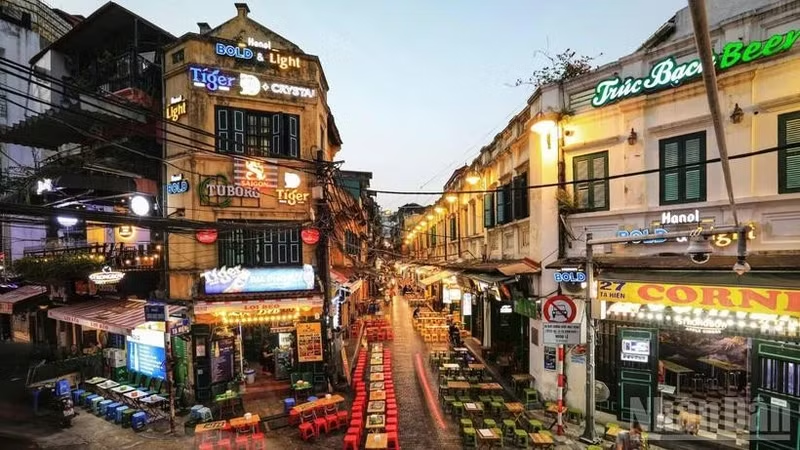
Returning to the case of Ha Noi, the former Hoan Kiem district once built a strong digital platform to support tourism development, especially apps related to cuisine and tourism in Hoan Kiem. The former Hoan Kiem district is now Hoan Kiem ward, characterized by the Old Quarter; and Cua Nam ward, with prominent tourism potential from the old French Quarter. Although there are differences, the Old Quarter and the old French Quarter remain a continuous flow of urban development and possess strong cultural, architectural and culinary appeal for both domestic and international visitors. It is regrettable that some very strong tourism apps of the former Hoan Kiem district are now being neglected. This is a typical example showing that although administrative boundaries have changed, tourism development achievements of former district-level administrations still need to be inherited and promoted. It also demonstrates the necessity of linkage in the new context.
A similar situation is occurring in several other localities where newly established communes and wards are seeking solutions to build “internal” tourism products. Changes in administrative boundaries should be seen as an opportunity to fundamentally change tourism development thinking toward product-based thinking in order to create the best tourism products. To achieve this, closer coordination is needed between tourism authorities of provinces and cities and communes and wards to clearly identify resources and strengths. At the same time, it is necessary to remove the “level-playing-field” mindset in tourism development that fails to properly assess each locality’s strengths and weaknesses.


![[Video] Viet Nam among Top three Asian destinations for return visitors](https://en-cdn.nhandan.vn/images/nyM650OGFWrOVWc-xajqN-rTZ68Rlmc1fiGJOhBRYHErj-E25MBpvJqrpphXazfrpe9t-fYCGuQU4CN0yXo3Rg/du-lich-vietnam.jpg.avif)