However, most of these values remain “dormant” within the professional community, not yet truly becoming a rich tourism resource to be widely promoted to visitors.
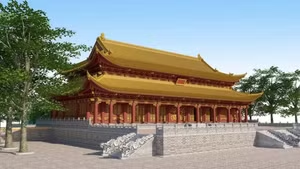
The Thang Long Imperial Citadel, after more than 20 years of continuous excavation, is becoming a bright spot in archaeological tourism. Not only displaying archaeological artifacts in the traditional way, the unit has continuously innovated in its promotion to attract tourists.
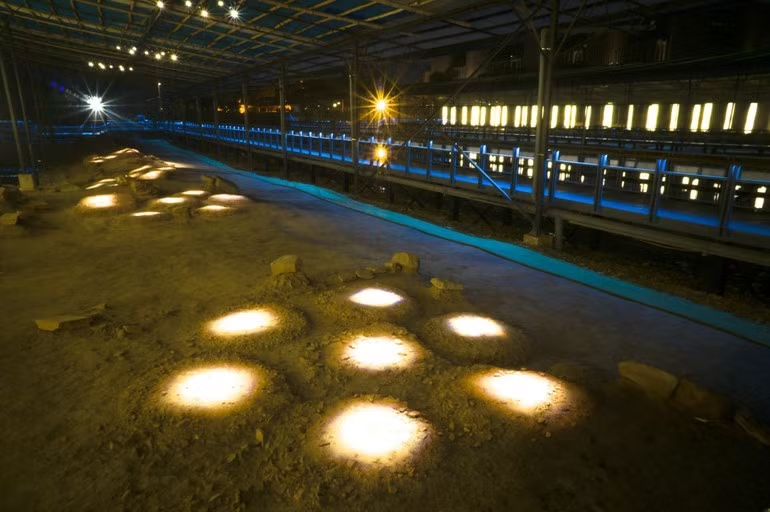
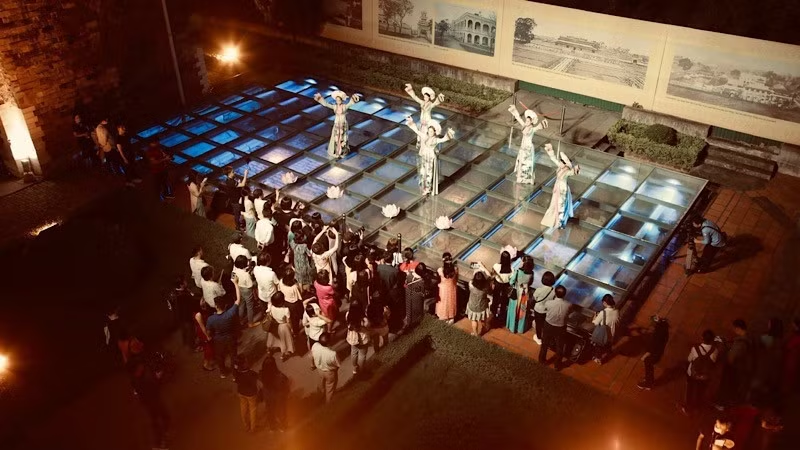
One of the highlight activities is the “Decoding Thang Long Imperial Citadel” night tour. Launched in 2022, the night tour has become a unique product, bringing archaeology closer to the public.
By combining archaeological sites, exhibiting artifacts, telling historical stories, and recreating the imperial palace space under modern lighting and sound, the “Decoding Thang Long Imperial Citadel” has “awakened” layers of archaeological sediments buried deep underground for thousands of years.
Held only on Friday and Saturday evenings each week, the “Decoding Thang Long Imperial Citadel” always receives great interest from visitors. Mac Thi Thu Ha, from the Guidance and Interpretation Department of the Thang Long Ha Noi Heritage Conservation Centre, stated: The “Decoding Thang Long Imperial Citadel” night tour has welcomed approximately 4,000 visitors and is gradually becoming an attractive tourist tour for visitors to Ha Noi.
The Thang Long Imperial Citadel aims to apply science and technology and digital transformation not only to conservation activities but also to the development and introduction of new tours for the archaeological site to enhance its value and provide the best experiences for visitors; simultaneously, it aims to perfect and regularly operate the night tour for foreign tourists.
Through the aforementioned tourism model, the Thang Long Imperial Citadel has demonstrated a feasible approach: preserving the original cultural layers, combining artistic performances and technology to increase attractiveness, and simultaneously generating revenue for reinvestment in the site. Archaeology can absolutely become the foundation for high-quality tourism products, not just limited to displaying artifacts or introducing academic knowledge.
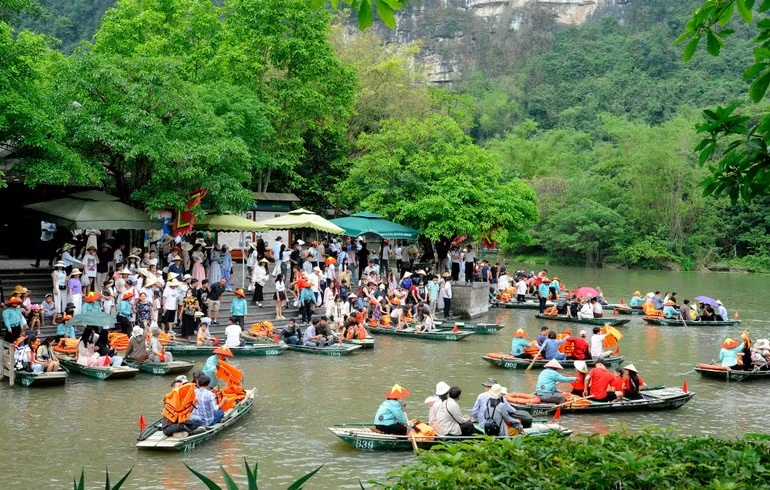
According to statistics from the Ninh Binh Provincial Department of Tourism, it is estimated that in the first 11 months of 2025, nearly 18.5 million tourists visited Ninh Binh. Of these, the Trang An Scenic Landscape Complex welcomed approximately 7 million visitors, with most experiences related to the cave system that was once inhabited by people tens of thousands of years ago.
Excavations at Trong Cave, Boi Cave, and Mang Cave over the years have contributed valuable information about the appearance and habitation of prehistoric humans in Vietnam and Southeast Asia, thus contributing to shaping the Trang An tourism centre as it is today, allowing tourists to access the story of prehistoric Vietnamese people within the context of an eco-cultural tourism route.
In particular, the research results and discovery of human remains dating back over 12,000 years, along with valuable data on stratigraphy, ancient ecosystems, and burial practices of prehistoric inhabitants at Thung Binh 1 cave, recently announced, are clear evidence of the enormous archaeological potential of Trang An.
The international conference “Scientific research associated with the management, conservation, and promotion of the value of the Trang An Scenic Landscape Complex World Cultural and Natural Heritage Site,” held at the end of September, assessed the significance of the new archaeological discoveries at Trang An.
At this conference, many delegates argued that the unique scientific values are a solid foundation for building culturally rich tourism products, increasing attractiveness and creating differentiation, while also raising community awareness of the responsibility to preserve and promote the value of the Trang An World Heritage Site.
At this conference, Dr. Nguyen Viet, Director of the Southeast Asian Prehistory Centre, proposed an archaeological-cultural experiential tourism model called “Living with the Prehistoric People of Trang An.” This is not only an attractive tourism product but also a vibrant method of heritage education, helping the community and younger generations to become more attached to, proud of, and responsible for their homeland's heritage.
Recently, at the 60th National Conference on New Archaeological Discoveries, 2025, the field of archaeology published 385 papers covering important topics ranging from prehistoric, early historical, and early state archaeology to history, Champa-Oc Eo, and underwater archaeology. These scientific reports demonstrate that archaeological activities are vibrant and widespread throughout the country, providing a foundation for promoting cultural heritage values and serving the goals of conservation and sustainable development.
With the available archaeological resources, integrating archaeological sites into tourism development is likely an inevitable trend and promises to be a potential “gold mine” if exploited correctly.
However, with thousands of archaeological sites already excavated, only a few have become tourist destinations. According to Dr. Ha Van Can, Director of the Institute of Archaeology, Vietnam Academy of Social Sciences, developing archaeological sites into tourist destinations is very difficult.
It's not just a technical issue; it also involves institutional matters and many other factors, requiring significant costs from preservation and display to promotion. Effectively operating and exploiting these sites for tourism, conveying the story through artifacts, is also a considerable challenge. If archaeological discoveries are skilfully combined with preservation and tourism product development, the potential is enormous.
The layers of sediment beneath the ground are waiting to be told, and when they are told through the language of tourism, it will be a journey of discovery into the past and a way to nurture pride and attachment in today’s generation to their ancestral heritage.