From resource exploitation to value creation
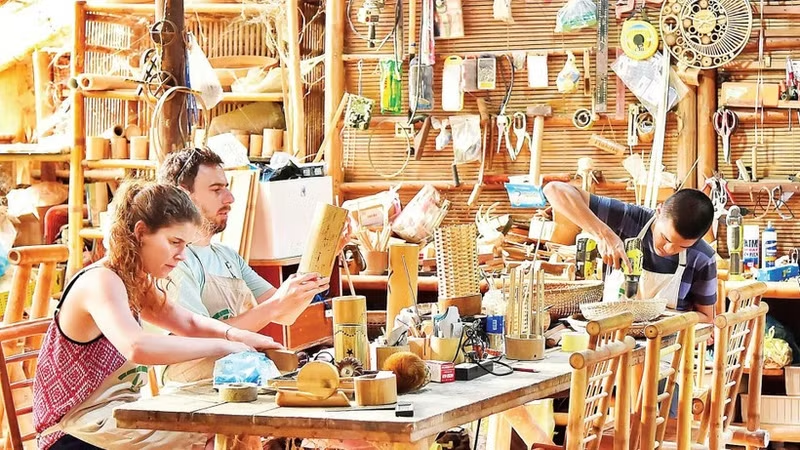
Identified as a component of cultural tourism, creative tourism goes beyond conventional sightseeing and cultural exploration to encourage visitors’ active participation in creative activities at destinations through interaction with local communities. This approach aligns with the modern travellers’ desire for personalised experiences and has therefore attracted growing interest from many countries, which seek to turn trips into engaging creative journeys with deep cultural connections.
With its rich natural and human resources, including a wide range of tangible and intangible cultural heritage across the country, Viet Nam possesses outstanding strengths for the development of creative tourism. From the sophistication of design and handicrafts to the uniqueness of performing arts, music, painting, and cuisine, all can serve as materials to be “productised” into distinctive creative experiences.
With its rich natural and human resources, including diverse tangible and intangible cultural heritage across the country, Viet Nam possesses outstanding strengths for the development of creative tourism.
In recent years, efforts to develop creative tourism have helped some destinations significantly improve their competitiveness in attracting visitors. A typical example is Duong Lam, a more-than-thousand-year-old ancient village in Ha Noi. Previously, visitors could only tour architectural sites such as communal houses, village gates, and old houses, but now Duong Lam attracts tourists with various hands-on activities such as lacquerware making, creating figures from straw, and experiencing farm work.
Similarly, visitors to Bat Trang Pottery Village or Quang Phu Cau Incense Village (Ha Noi) are “kept longer” through experiences of personally carrying out pottery-making and incense-making processes.
Over the years, Hoi An (Da Nang) has become known as a prominent creative tourism destination, successfully tapping into experiential models linked to craft villages and folk arts.
In addition, there are many other creative tourism products with strong potential, such as tours exploring the Cu Chi Tunnels that allow visitors to “step into the role” of wartime soldiers; or more recently, “Sac hoa Tuong Phieu”, which invites visitors to stroll through vibrant flower fields, learn about craft village stories, and become gardeners themselves. In these activities, creative experience plays a core role, creating strong appeal for the tourism journey.

Building a creative tourism ecosystem
The Viet Nam Tourism Development Strategy to 2030 identifies a key orientation: prioritising cultural tourism development while linking tourism growth with the preservation and promotion of heritage values and national cultural identity.
The Cultural Development Strategy to 2030 emphasises the need to integrate heritage preservation and promotion with tourism development. Notably, the Strategy for the Development of Viet Nam’s Cultural Industries to 2030, with a vision to 2045, approved by the Prime Minister on November 14, 2025, affirms the task of building and developing distinctive, specialised, and regionally characteristic cultural tourism products that enhance visitor experience value. These orientations contribute to fostering the development of creative tourism.
According to experts, Viet Nam still lacks a dedicated comprehensive strategy for creative tourism development, resulting in difficulties in establishing models, investment projects, and specific support policies.
According to experts, Viet Nam still lacks a dedicated comprehensive strategy for creative tourism development, resulting in difficulties in establishing models, investment projects, and specific support policies. Experts also point out that intellectual property protection has not received sufficient attention, leading to the copying of many creative tourism products, which undermines the appeal of original offerings and reduces the ability to exploit unique cultural values at destinations.
Dr Do Cam Tho, from the Viet Nam National Authority of Tourism, commented that the greatest challenge in developing creative tourism destinations lies in the lack of mechanisms, resources, and methods to transform resources into sustainable tourism experiences with high economic value. Therefore, it is necessary to build a national legal framework for creative tourism development, including criteria and procedures for recognising and honouring creative tourism destinations; to introduce preferential mechanisms and financial and tax support for creative tourism start-ups; and to integrate sustainable creativity into tourism system planning to ensure coherence between culture, creative industries, and tourism.
In practice, creative tourism has long been discussed globally but remains relatively new in Viet Nam, making it difficult to avoid surface-level exploitation that focuses more on performance and re-enactment rather than deeper interaction and creative participation.
![[Video] Viet Nam among Top three Asian destinations for return visitors](https://en-cdn.nhandan.vn/images/nyM650OGFWrOVWc-xajqN-rTZ68Rlmc1fiGJOhBRYHErj-E25MBpvJqrpphXazfrpe9t-fYCGuQU4CN0yXo3Rg/du-lich-vietnam.jpg.avif)








![[In Pictures] Nui Chua Rock Park: A million-year-old outdoor museum of landforms on the Khanh Hoa coast](https://en-cdn.nhandan.vn/images/nyM650OGFWrOVWc-xajqNz57td8idIAL_VG9puyG2UZEKOnmq1DVlT1--ZclbO3z2WBaWZhbt6O3e8kjPZqJMWkfEz7RO9qhcwg8o8LQFK8/ndo-br-cao-nguyen-da-moi.jpg.avif)