At the same time, there was a strong shift in mindset and methods of implementation, leaving notable marks. The results contributed to fulfilling the targets and tasks of the term, while generating wide-ranging spillover effects and further consolidating public trust.
Early and proactive prevention linked with streamlining the organisational apparatus
The year 2025 marked a new operational context for anti-corruption, anti-wastefulness, and anti-negativity efforts, closely linked with the restructuring and streamlining of the political system’s organisational apparatus and the operation of the three-tier local government model. This reality underscored a fundamental requirement: the more streamlined the apparatus and the greater the decentralisation and delegation of authority, the stricter the control of power must be, and the clearer and more specific accountability must become, in order to prevent corruption, wastefulness, and negative practices at an early stage and from afar.
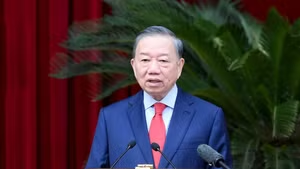
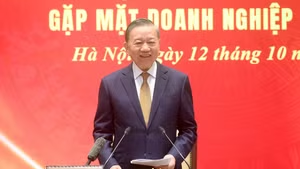
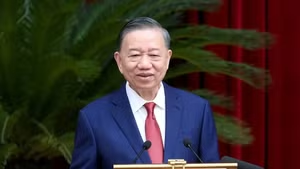
Party General Secretary To Lam, Head Central Steering Committee for Prevention and Control of Corruption, Wastefulness, and Negative Phenomena, repeatedly emphasised that this work must be carried out resolutely from the very outset of implementing the two-tier local government model, with the aim of building an apparatus that is truly clean, close to the people, serving the people, and operating with efficiency, effectiveness, and efficacy.
The Politburo issued Directive No. 42-CT/TW dated January 16, 2025, on strengthening the Party’s leadership in education on thrift, integrity, honesty, impartiality, and selflessness; and Directive No. 53-CT/TW dated October 26, 2025, on strengthening the Party’s leadership in enforcing accountability of agencies, organisations, and individuals in public service activities. These directives have brought about positive changes in awareness and action among officials, Party members, and the public, contributing to preventing corruption, wastefulness, and negative practices at their roots.
The Government issued 28 decrees on decentralisation, delegation of authority, and clarification of powers between the Government and two-tier local governments, establishing an important legal framework and affirming the principle that “local authorities act, local authorities are accountable.”
Accordingly, the commune level now assumes more than 80% of administrative tasks previously handled by the district level, expanding initiative and flexibility while also posing new challenges in power control and the prevention of corruption, wastefulness, and negative practices at the grassroots level. Anti-corruption efforts therefore focus not only on handling violations but, more importantly, on clearly defining authority boundaries and quantifying individual responsibilities, especially those of heads of agencies and units.
Provincial-level steering committees have proactively consolidated their organisational structures following mergers and reorganisations, directing the comprehensive implementation of tasks, particularly strengthening inspection, supervision, and examination at the grassroots and Party cell levels, and strictly handling violations.
Alongside decentralisation and delegation of authority, 2025 also witnessed major efforts to review and improve institutions and laws in order to remove bottlenecks, unlock resources, and at the same time close legal loopholes that had been exploited for corruption and negative practices or posed risks thereof.
Alongside decentralisation and delegation of authority, 2025 also witnessed major efforts to review and improve institutions and laws in order to remove bottlenecks, unlock resources, and at the same time close legal loopholes that had been exploited for corruption and negative practices or posed risks thereof.
During the year, the Politburo and the Secretariat issued more than 130 documents related to Party building, the political system, and anti-corruption, anti-wastefulness, and anti-negativity work. The National Assembly and the Government revised and promulgated 89 laws and more than 900 decrees, directives, and resolutions, with a focus on addressing shortcomings, inconsistencies, and overlaps in legal documents, improving institutions governing the operation of the State apparatus under the three-tier government model, and promoting socio-economic development.
Ministries, sectors, and localities revised, supplemented, and issued nearly 12,000 guiding documents to implement legal regulations on socio-economic management, contributing to improving the effectiveness of anti-corruption, anti-wastefulness, and anti-negativity efforts.
In the context of streamlining the apparatus, alongside institutional and legal improvements, the application of information technology to enhance transparency in administrative procedures and work processing at all levels of government has been identified by many localities as a breakthrough solution. The application of information technology, the development of digital government, and the provision of online public services have significantly reduced direct contact between officials and citizens or businesses, thereby helping to prevent harassment and negative practices.
Decisive fight against wastefulness, unlocking resources for development
One of the most prominent hallmarks of 2025 was that the fight against wastefulness was elevated to its proper standing and given due emphasis, becoming a central task alongside the prevention and control of corruption and negative practices within the overall mission of Party building and rectification as well as national socio-economic development.
The consolidation of the Central Steering Committee and the addition of waste prevention and control, particularly in the management and use of public finance and public assets, marked an important shift in thinking. Wastefulness is no longer viewed as a secondary consequence but as a systemic issue that directly affects the country’s development capacity.
Wastefulness represents a loss of development resources and a direct barrier to socio-economic growth. Therefore, combating waste is an urgent requirement to unblock, reallocate, and use resources more effectively. This spirit was clearly reflected in the directions of General Secretary To Lam, who called for the immediate implementation of key, breakthrough tasks in waste prevention and control, with the consistent principle: “Do not allow waste to persist, but do not legalise violations.”
On April 22, 2025, the Prime Minister issued the National Strategy on Waste Prevention and Control through 2035, which clearly stated that this is an important, urgent, and pressing task of the entire political system and society as a whole. The strategy places this work under the leadership of the Party and the management of the State, assigns it a status equivalent to the prevention and control of corruption and negative practices, and calls for strong, resolute, persistent, and synchronised implementation, with clear priorities and focal points, closely combining prevention, detection, handling, and the comprehensive application of measures.
Ministries, sectors, and localities promptly reviewed, classified, and developed plans to handle nearly 3,000 delayed and long-stalled projects and works at risk of causing losses and waste; more than 1,150 projects have already been resolved. Many large-scale projects that had faced prolonged delays for years, such as the second campuses of Bach Mai Hospital and Viet Duc Friendship Hospital, have been put into operation. A total of 10,971 surplus houses and land facilities following administrative unit reorganisation have been inventoried and assigned appropriate usage plans.
Inspection, supervision, and the handling of violations have been intensified in the spirit of leaving no “forbidden zones.” The Government Inspectorate completed inspections of more than 70 projects and directed the completion of inspections of 421 delayed and long-stalled projects as requested by the Steering Committee. Judicial authorities initiated and investigated 62 cases involving 373 defendants related to wasteful practices, thereby demonstrating strong deterrent, warning, and preventive effects.
These results affirm a clear message: wastefulness is no longer a “grey area” in state management. Strengthening the fight against wastefulness has added a solid pillar to the prevention and control of corruption and negative practices, contributing to the release of capital, land funds, and public assets that had been “frozen” in stalled projects and unfinished works, thereby supplementing resources for development.
One of the most prominent hallmarks of 2025 was that the fight against wastefulness was elevated to its proper standing and given due emphasis, becoming a central task alongside the prevention and control of corruption and negative practices within the overall mission of Party building and rectification as well as national socio-economic development.
At the local level, Ha Noi stands out as a model for decisive and methodical implementation. The city conducted a comprehensive review of state-owned houses and land, particularly surplus offices following organisational restructuring and properties used inefficiently, many of which are located in prime areas. These assets were reclaimed, reallocated, or reassigned to units in need, or auctioned and leased in accordance with regulations. At the same time, the city resolutely addressed projects with delayed implementation or inefficient land use. Of the 712 projects reviewed, inspected, and examined, Ha Noi resolved 439 projects, achieving a rate of 61.66%.
The achievements of 2025 continue to lay an important foundation for ensuring that the prevention and control of corruption, wastefulness, and negative practices are carried out not only resolutely and persistently, but also in an increasingly systematic, in-depth manner, with clear priorities and focal points. This approach aligns with practical requirements as well as the mission of building a clean, strong Party and political system, making a positive contribution to the realisation of national development goals.