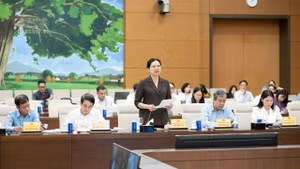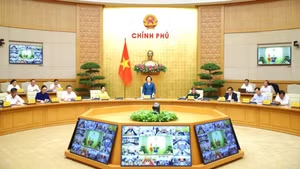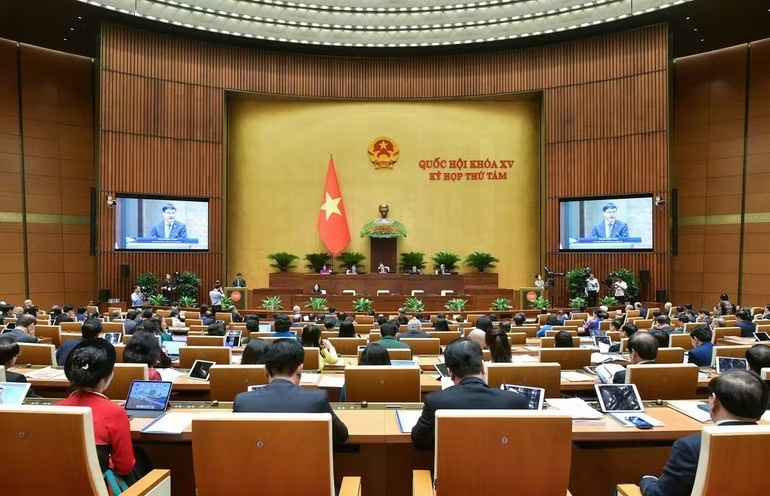
Therefore, the requirement to renew thinking in building and improving the legal institutional framework, removing bottlenecks, unlocking resources and promoting development, so as to firmly lead the country into a new era, has become more urgent than ever.
On this occasion, Politburo member, Standing Deputy Secretary of the Party Committee of the National Assembly and Standing Vice Chairman of the National Assembly Do Van Chien granted an interview to the press on renewing thinking in legislative work in the coming period.
The Standing Vice Chairman of the National Assembly stated clearly that after 40 years of renewal, the country has achieved many great and historically significant accomplishments, in which the building of institutions and the improvement of the legal system have played an important role.
However, in the context of rapid, complex and unpredictable global and domestic developments, together with increasing requirements for digital transformation, green transition, innovation and deeper international integration, a number of limitations and shortcomings of the legal institutional framework have become more evident, emerging as “bottlenecks” hindering development. If institutions are slow to be renewed, lack coherence, lack feasibility and fail to keep pace with reality, they risk becoming barriers to state management, production and business activities, as well as social life.
Renewing thinking in building and improving the legal institutional framework is an objective requirement of long-term strategic significance. It requires a strong shift from the mindset of “making laws for management” to that of “legislation that creates development”, closely following the guiding thinking of General Secretary To Lam: the work of building and enforcing the law is a “revolution in thinking”, which must decisively abandon the approach of “if it cannot be managed, then prohibit it”, replacing it with the creation of a transparent and stable legal framework for effective governance, encouraging innovation, unleashing productive forces and unlocking all resources in society. The law must truly go one step ahead, becoming a stable and long-term foundation for development, while being sufficiently flexible to adapt to new practical requirements.
According to the Standing Vice Chairman of the National Assembly, this renewed thinking is clearly reflected in Politburo Resolution No. 66-NQ/TW dated April 30, 2025, on renewing the work of building and enforcing the law to meet national development requirements in the new era. The resolution affirms that building and improving the legal institutional framework is one of the strategic breakthroughs and an important “lever” to unlock all resources and create new drivers for development; at the same time, it requires the legal system to be built in a coherent, modern, feasible and transparent manner, taking development effectiveness and the interests of the people as the yardstick, while ensuring harmony among the interests of the State, society and the market.
The Standing Vice Chairman noted that, implementing the General Secretary’s guidance, the National Assembly has continuously renewed legislative thinking, removed many bottlenecks and promoted socio-economic development, contributing to the fulfilment of the 2025 targets and the goals set by the 13th National Congress of the Party.
In the coming period, thoroughly grasping the guidelines and resolutions of the 14th National Congress, the National Assembly will continue to renew legislative thinking, focusing on improving the quality of policy impact assessments, collecting broad and substantive opinions from affected groups, especially the business community, experts and scientists.
Law-making must not only be correct in principle and rigorous in technique, but more importantly feasible, accessible and easy to implement, without overlaps or contradictions, and consistent across sectors, fields, central and local levels; at the same time, it is necessary to promptly review, amend, supplement or abolish regulations that are no longer appropriate and that cause obstacles in mobilising, allocating and effectively using social resources.
The law should be built in a concise and clear manner, regulating only major and principled issues; decentralisation and delegation of authority should be strengthened, creating flexibility for the Government, ministries, sectors and localities in implementation, coupled with inspection and supervision mechanisms to ensure effectiveness and efficiency.
“Focus on removing bottlenecks that are hindering development, especially in key areas such as investment, land, finance, the budget, science, technology and innovation. It is necessary to boldly pilot new mechanisms and policies of a breakthrough and exceptional nature, on the basis of strict risk control, summarising practical experience in order to promptly refine and replicate them. This approach allows the law to ensure stability while remaining flexible enough to adapt to the rapid dynamics of reality,” the Standing Vice Chairman emphasised.
At the same time, it is necessary to improve the quality of personnel engaged in building and enforcing the law, ensuring political integrity, professional competence, innovative thinking and a high sense of responsibility. In particular, a contingent of National Assembly deputies and advisory and support bodies with sufficient qualities, capacity and credibility, commensurate with their tasks, must be built; discipline and order in law enforcement must be strengthened, linking authority with responsibility; and information technology application and digital transformation in law-making, dissemination and enforcement must be promoted to enhance transparency and the effectiveness of state management.
Focus on removing bottlenecks that are hindering development, especially in key areas such as investment, land, finance, the budget, science, technology and innovation. It is necessary to boldly pilot new mechanisms and policies of a breakthrough and exceptional nature, on the basis of strict risk control, summarising practical experience in order to promptly refine and replicate them. This approach allows the law to ensure stability while remaining flexible enough to adapt to the rapid dynamics of reality.
Standing Vice Chairman of the National Assembly Do Van Chien
The Standing Vice Chairman of the National Assembly stressed that, as the country stands before new opportunities and prospects, renewing thinking in building and improving the legal institutional framework is of special importance and decisive significance in removing constraints, unleashing productive forces and inspiring development aspirations and creativity across society. Proper implementation of this task will create a solid legal foundation, ensuring national autonomy, self-reliance and resilience, firmly guiding the country into a prosperous era of development and bringing a warm and happy life to the people.