The book launch in Algeria was held on November 19 in a solemn atmosphere, with the attendance of Prime Minister Pham Minh Chinh during his working visit to Arab countries. The event marks a new development for the Vietnamese publishing industry in its journey to bring the nation’s historical values to the world.
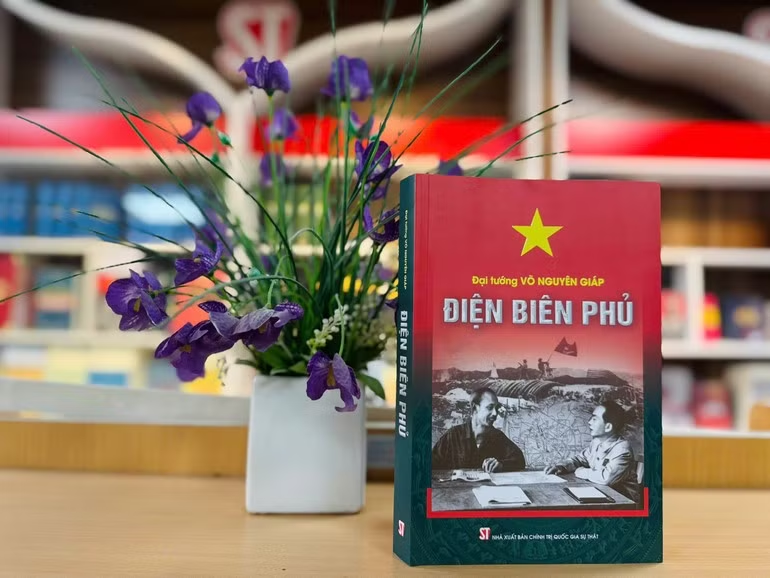
The book “Dien Bien Phu”, reissued in Vietnamese by the Truth National Political Publishing House and released alongside its Arabic version by Light Books, is one of the most important primary historical works in the corpus of literature on Viet Nam’s military history. The work compiles General Vo Nguyen Giap’s articles, analyses, and memoirs on the full strategic command process, force organisation, and developments of the three offensive phases of the 1954 Dien Bien Phu Campaign.
Through several editions, especially those launched in 2024 and 2025, the book has been edited and supplemented with important materials to ensure the integrity of the historical records left by General Vo Nguyen Giap. The work consists of four major parts: President Ho Chi Minh’s letters to the Dien Bien Phu frontline; Dien Bien Phu; writings on Dien Bien Phu; and an appendix system comprising operational orders, attack directives, battle statistics, information on both sides, and related documents. Many original archival elements have been preserved by the publisher, reflecting the absolute respect for the content compiled by General Vo Nguyen Giap.
With original quotations from six historic letters written by President Ho Chi Minh to officers and soldiers at the Dien Bien Phu frontline, to supply units and public labourers participating in the campaign, and later to praise the soldiers, labourers, youth volunteers, and ethnic groups of the Northwest upon the resounding victory, the first part of the book lays the foundation for its second part: Dien Bien Phu. This second part, written by General Vo Nguyen Giap, offers profound, primary-source analysis of the events of the campaign.
Notably, this section includes the general’s strategic analyses of the Nava Plan, the situation of both sides, and his pivotal decision to shift the operational guideline from “strike swiftly to win swiftly” to “strike firmly, advance steadily” — a decision considered one of the most valuable aspects of the work. General Vo Nguyen Giap called it “the most difficult decision of my command career.” His sharp strategic thinking, prudence combined with resolve, and scientific command approach contributed to the ultimate triumph of the campaign, creating a world-shaping turning point in the struggle for national liberation.
The third part of the book compiles selected writings and interviews by General Vo Nguyen Giap on the Dien Bien Phu Victory across various commemorations, offering increasingly comprehensive and objective historical perspectives while maintaining the spirit of Dien Bien Phu in today’s nation-building efforts.
The Arabic translation of “Dien Bien Phu” was carried out by a team of translators who are lecturers from the Department of Arabic Language and Culture, University of Languages and International Studies – Viet Nam National University, Ha Noi, in collaboration with the Truth National Political Publishing House. This is an important step in introducing Vietnamese history to international audiences, particularly in Arab nations that share longstanding ties of friendship and multifaceted cooperation with Viet Nam.
The book not only enables readers in the region to access information on one of the most iconic military victories of the 20th century but also opens opportunities for extensive research and academic exchange on national liberation warfare, military art and Viet Nam’s spirit of peace loving.